

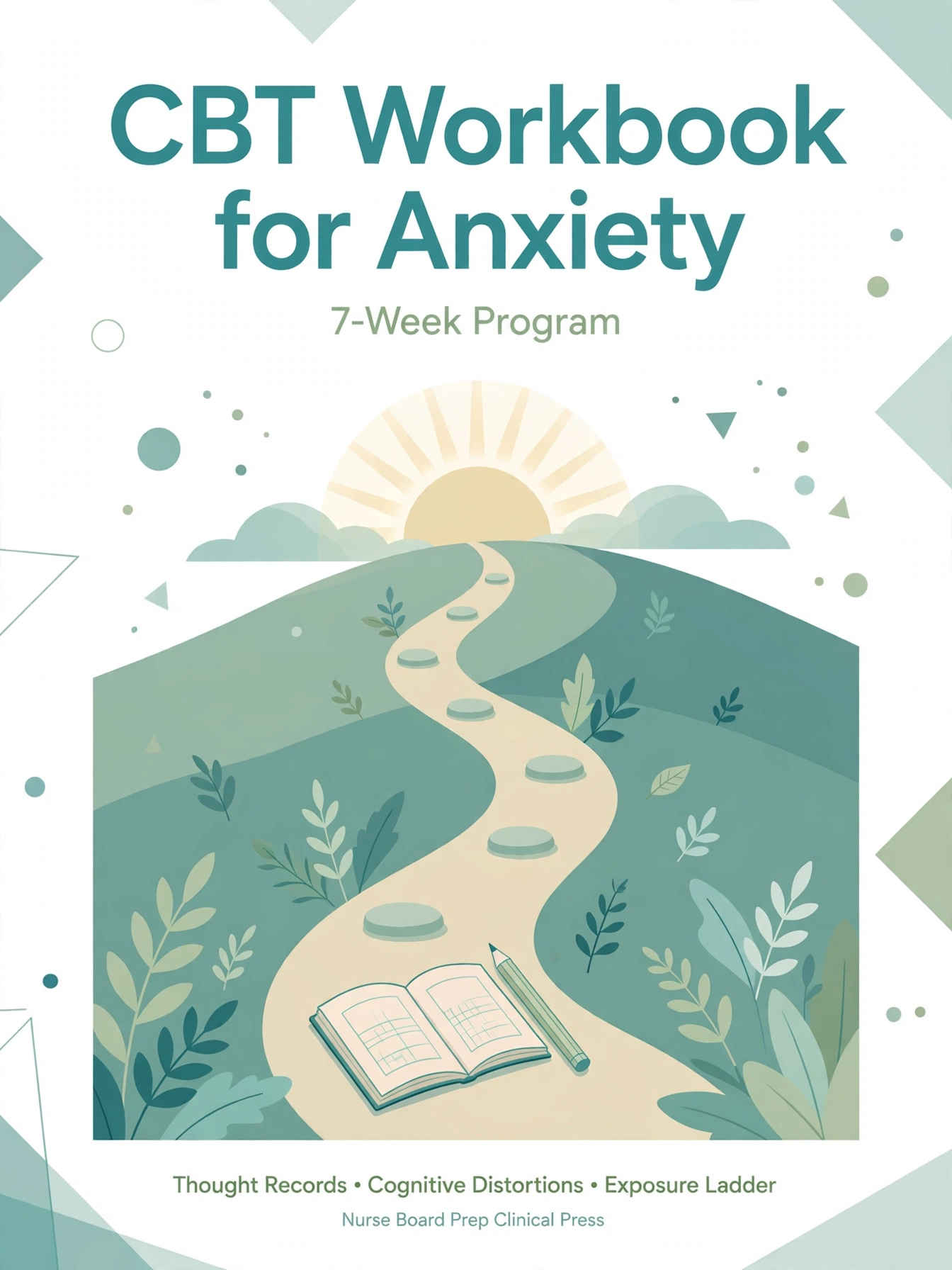
CBT workbook for anxiety, cognitive behavioral therapy workbook, anxiety workbook printable — if you are looking for a CBT workbook for anxiety on Etsy, you have probably seen the KOREHealing CBT Workbook: Anxiety Relief, Self-Care. It is a 304-page workbook in 8 chapters with 300+ prompts, rated 4.8 stars from 367 reviews, at $8.94 on sale (list $17.88, 50% off). Our CBT Workbook for Anxiety — 7-Week Program is $22 list — $8.80 with the ChristmasDeal 60% off sale (to 31 Dec 2026). The difference is not just price: KOREHealing is a large workbook and daily journal to work through at your own pace, while ours is a time-boxed 7-week program — one skill a week, about 20–30 minutes a day — built around thought records, cognitive distortions and an exposure ladder.
Get the CBT Workbook for Anxiety — 7-Week Program — $8.80 on Sale
Try these free CBT exercises for anxiety
These are real exercises from our workbook. Try them now — free.
Try-it 1 — Catch the thought (Week 1, p. 8). A fictional example from the workbook: on Tuesday at 3 p.m., an email arrives from a manager asking for a meeting, with no subject given. The automatic thoughts are: "I am going to be fired." "I must have done something wrong." "Everyone will find out I am not good enough." The hot thought — the one that stings most — is "I am going to be fired." Anxiety is rated 75 out of 100. How it works in the workbook: write the evidence for and against the hot thought, then write a balanced thought based on all the evidence. In the example the balanced thought is: "I do not know what the meeting is about yet. One mistake last month does not mean I am being fired — my recent work was praised, and I was just asked to present. I can prepare two questions and find out." Anxiety is then re-rated at 40 out of 100.
Try-it 2 — Spot the distortion (Week 2, p. 14). Read this fictional thought from the workbook's Spot the Distortion worksheet: "My friend left me on read. She hates me now." Answer: Mind reading (jumping to conclusions). The workbook's answer key gives this as mind reading — assuming you know what someone else thinks, with no facts to support it. A steadier version starts by dropping the guess: "I do not know what she thinks — I could ask."
Try-it 3 — Build an exposure ladder (Week 4, p. 23). The workbook's fictional example ladder is for the fear of speaking in meetings. Rung 1 is: "Ask one question in a small team meeting" — anxiety 3 out of 10. Rung 2 is: "Give a 1-minute update in a small meeting" — anxiety 4 out of 10. The ladder climbs in small steps to rung 5: "Present for 10 minutes to the whole department" — anxiety 8 out of 10. How it works in the workbook: pick one fear, list 8–10 situations from easiest to hardest, rate each 0–10, and start at a step rated about 3–4. Repeat a step until its rating drops by at least half, then move up one rung.
Try-it 4 — Worry time (Week 5, p. 27). Pick a slot of 15–30 minutes, at the same time and place every day — not right before bed. When a worry pops up outside the slot, write it down in one line, then tell yourself: "I will think about that at 5:30 p.m." — and go back to what you were doing. How it works in the workbook: during worry time, sort each worry into solvable or not solvable right now. Solvable worries go to the 6-step problem-solving sheet; not-solvable worries get a "what I would do if it happened" line, then you let them go for today and return to them tomorrow if they are still there. When the time is up, stop — the slot is closed until tomorrow.
Try-it 5 — Grounding 5-4-3-2-1 (p. 42). When anxiety spikes, name 5 things you can see right now — the workbook's examples are the clock, the window, a blue pen — then 4 things you can feel, 3 things you can hear, 2 things you can smell and 1 thing you can taste. How it works in the workbook: practise it once a day when you are calm, so the steps are familiar when you need them, and rate your anxiety 0–100 before and after. Grounding does not argue with the thought — it gives your attention something else to do for two minutes.
The honest comparison
| | KOREHealing CBT Workbook: Anxiety Relief, Self-Care (Etsy) | Our CBT Workbook for Anxiety — 7-Week Program |
|---|---|---|
| Price | $8.94 sale (list $17.88, 50% off) | $22 list — $8.80 with the ChristmasDeal 60% off sale (to 31 Dec 2026) |
| Reviews | 4.8 stars / 367 reviews | New listing |
| Pages | 304 pages | 50 pages |
| Content | 304-page CBT workbook, 8 chapters, 300+ prompts, plus a bonus CBT daily journal | 29 worksheets in a 7-week program: 7 weeks, 7 skills |
| Structure | Open-ended workbook and journal, work at your own pace | Time-boxed: one skill a week, 20–30 minutes a day |
| Key tools | CBT exercises and quizzes, prompts, daily journal, hyperlinked pages | Thought records, all 10 cognitive distortions, exposure ladder, worry time, sleep and relaxation |
| Format | PDF download (3 PDFs), print or use digitally | PDF download, print-ready, US Letter |
Be honest about the difference: KOREHealing is the bigger book and the cheaper one per page — 304 pages at $8.94 is about 34 pages per dollar, against our 50 pages at $8.80 on sale, about 5.7 pages per dollar — and its 367 reviews are a real strength, a long-established listing against our new one. Where ours is different is structure, not size: it is a 7-week program with one skill a week — catch the thought, spot the distortion, behavioral activation, exposure ladder, worry time, sleep and relaxation, then relapse prevention — with a check-in at the end of every week and reusable blank thought records. If you want a large workbook and journal to dip into at your own pace, the KOREHealing format may suit you better. If you want a program that tells you what to do this week and next, ours is built for that.
Get the CBT Workbook for Anxiety — 7-Week Program — $8.80 on Sale
What the full guide covers
Week 1 — Catch the thought: automatic thoughts, the 3-column catch, a fully worked 7-column thought record and your first thought record. Week 2 — Spot the distortion: all 10 cognitive distortions with anxiety examples, a spot-the-distortion exercise and a distortion diary. Week 3 — Act first, feel later: behavioral activation, activity brainstorm, weekly activity schedule and a pleasure and mastery log. Week 4 — Face it gradually: how avoidance keeps anxiety going, building an exposure ladder with a worked example, your own ladder and an exposure practice log. Week 5 — Tame the worry: worry time, the 6-step problem-solving method, worry time log, problem-solving sheet and worry sorting. Week 6 — Rest the body: sleep habits, slow diaphragmatic breathing, progressive muscle relaxation, sleep log, wind-down planner and relaxation log. Week 7 — Keep the gains: relapse prevention, early-warning plan, maintenance plan and completion reflection. Extra tools include grounding 5-4-3-2-1, a safety behaviours audit and questions to test a thought — plus 2 reusable blank thought records, a distortion quick-reference card and a 7-week tracker.
Get the CBT Workbook for Anxiety — 7-Week Program — $8.80 on Sale
Not affiliated with KOREHealing or Etsy. Educational material, not a substitute for professional care. This workbook does not diagnose, does not give treatment advice for any individual, and does not promise anxiety will disappear. If you are in crisis, contact your local emergency services or a crisis helpline right away — in the US call or text 988, in the UK and Ireland call Samaritans on 116 123.