

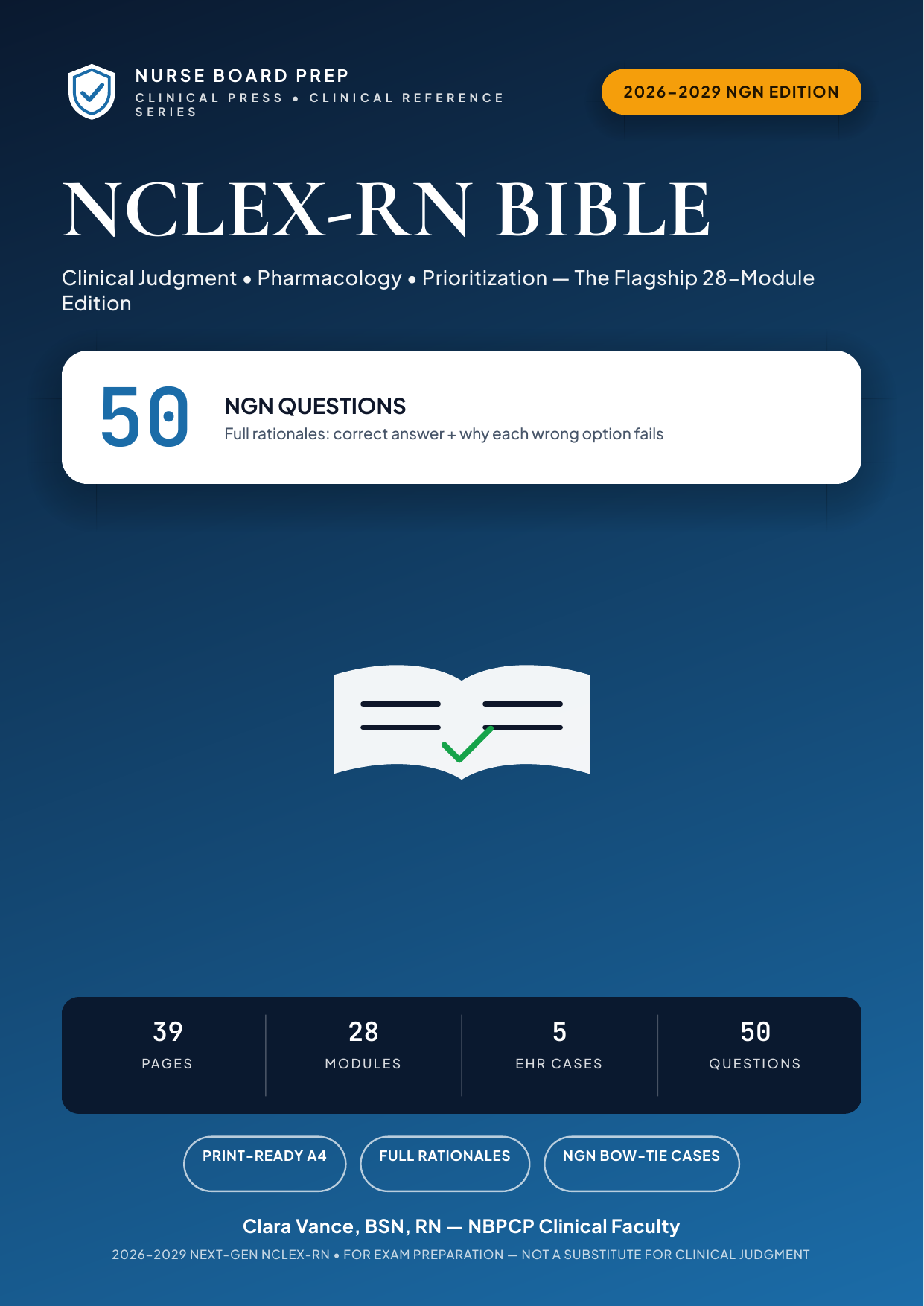
Lippincott NCLEX-RN review, NCLEX-RN clinical judgment questions, NCLEX pharmacology study guide — if you are preparing for the NCLEX-RN, you have seen the prices. The Lippincott Q&A Review for NCLEX-RN, 14th Edition, sells for **$83.99** list price on the publisher's own store (on sale at $58.79). Our NCLEX-RN Clinical Judgment, Pharmacology and Prioritization Guide, with 50 original Next-Gen practice questions, 28 modules and 5 EHR case studies, is **$8.82 on sale** ($49 list, 82% off Black Friday sale, to 31 Dec 2026). Same exam. A $75.17 difference.
Get the NCLEX-RN Clinical Judgment, Pharmacology and Prioritization Guide — 50 Questions — $8.82 on Sale
Browse the full NCLEX, TEAS 7 and HESI A2 study library
## Try these free NCLEX-RN practice questions
These are original practice questions written for exam practice. Try them now — free.
**Question 1 — Prioritization.** Which client should the RN see FIRST?
A) Post-op day 2, reporting incisional pain 6/10
B) DKA on insulin drip, K⁺ 3.1 mEq/L
C) Heart failure, weight up 1 lb since yesterday
D) New admission awaiting initial assessment
**Answer: B — DKA on insulin drip, K⁺ 3.1 mEq/L.** Potassium of 3.1 on an insulin drip is a lethal dysrhythmia risk — insulin drives potassium into the cells. Hold insulin if K⁺ is below 3.3. ABCs and electrolytes outrank pain and routine tasks.
**Question 2 — EKG.** Which rhythms are SHOCKABLE? (Select all that apply)
A) Ventricular fibrillation
B) Pulseless ventricular tachycardia
C) Asystole
D) PEA
E) Unstable SVT with a pulse
**Answer: A and B — Ventricular fibrillation and pulseless ventricular tachycardia.** Only V-fib and pulseless V-tach get unsynchronized defibrillation. Asystole and PEA are never shocked — CPR plus epinephrine. Unstable SVT with a pulse gets synchronized cardioversion, not defibrillation.
**Question 3 — Case study (bow-tie).** A chest tube water-seal chamber shows continuous bubbling. What is the condition, and what do you do?
A) Air leak — check connections for looseness, notify the provider; monitor the bubbling pattern and respiratory status
B) Normal tidaling — document and continue routine care
C) Pneumothorax resolved — prepare for tube removal
**Answer: A — Air leak.** Continuous water-seal bubbling means an air leak: check the connections, notify the provider. Tidaling alone is normal — do not confuse the two.
**Question 4 — Pharmacology.** Digoxin 0.25 mg is ordered. Heart rate is 52, K⁺ is 3.2. What is the nurse's action?
A) Give the dose; the heart rate is acceptable
B) Hold the dose and notify the provider
C) Give half the dose
D) Recheck the heart rate in 1 hour, then give
**Answer: B — Hold the dose and notify the provider.** Heart rate below 60 plus hypokalemia is a digoxin toxicity setup. Hold and notify; recheck potassium. Never "give and watch."
**Question 5 — Delegation.** Which tasks can the RN delegate to unlicensed assistive personnel (UAP)? (Select all that apply)
A) Vital signs on a stable client
B) Initial post-op assessment
C) Assisting with ambulation
D) IV push medication
E) Intake and output measurement
**Answer: A, C and E — Vital signs on a stable client, assisting with ambulation, and intake and output measurement.** UAP handle stable vital signs, ambulation, intake and output, and daily living activities. Assessments, teaching, IV push medications and care planning stay with the RN. Never delegate what you have not assessed.
## The honest comparison
| | Lippincott Q&A Review for NCLEX-RN, 14th Edition | Our NCLEX-RN Clinical Judgment, Pharmacology and Prioritization Guide |
|---|---|---|
| Price | $83.99 list ($58.79 sale on publisher site) | **$8.82 on sale** ($49 list) |
| Questions | Thousands of NCLEX-style questions, 6 comprehensive exams | 50 original Next-Gen questions |
| Pages | 1,152 pages, paperback | 39 pages, PDF download, print-ready |
| Rationales | Detailed rationales for correct and incorrect answers | Full rationales on every question |
| Case studies | Next Generation NCLEX scenarios | 5 EHR case studies |
| Format | Printed book (4 lbs) | PDF download, print-ready |
Be honest about the difference: the Lippincott review is a 1,152-page comprehensive textbook with thousands of questions and six full exams — it is far bigger than our guide, and per page it is cheaper ($83.99 ÷ 1,152 pages is about $0.07 a page, against about $0.23 a page for ours). What ours does is different: it is a focused 39-page clinical-judgment guide — 28 high-yield modules, 5 EHR case studies, and 50 original Next-Gen questions built around the traps the exam actually sets (prioritization, pharmacology, EKG, delegation, bow-tie and trend cases), with a rationale on every question that explains why the right answer is right and why the others are not. If you want one huge reference book, Lippincott is the established choice. If you want a short, dense guide you can finish in a weekend and carry into your final review, ours is $8.82 on sale.
Get the NCLEX-RN Clinical Judgment, Pharmacology and Prioritization Guide — 50 Questions — $8.82 on Sale
## What the full guide covers
28 modules covering the April 2026 NCSBN test plan, the Clinical Judgment Measurement Model and every Next-Gen item type, ICP and EVD care, high-alert antidotes, toxidromes, lab and critical-value cutoffs, ABGs, must-know formulas, cardiac emergencies and ECG dysrhythmias, respiratory and ventilator care, endocrine, renal, GI and hepatic, maternal-newborn andpediatrics, infection control, burns — plus 5 EHR case studies (post-craniotomy EVD bow-tie, DKA trend, sepsis, eclampsia, pancreatitis) and 50 original Next-Gen practice questions with a full answer key. Built for the 2026–2029 Next Generation NCLEX-RN.
Browse the full NCLEX, TEAS 7 and HESI A2 study library
*Not affiliated with Lippincott, Wolters Kluwer, or the NCSBN. Original practice questions written for exam practice. Educational use only; does not guarantee a pass.*