

Keywords: NCLEX-PN, LPN, LVN, coordinated care, data collection, stable clients, delegation, prioritization, SNF, scope of practice, five rights of delegation, pharmacology
Table of Contents
1. Know your scope, check stability first
2. Data collection is not assessment
3. Reinforce teaching — never initiate it
4. Stable versus unstable decides everything
5. Delegation: the LPN delegates only to assistive personnel
6. Pharmacology the PN way: classes, checks, then the drug
7. A worked mini-case
8. Key Numbers to Memorize
9. What the review book covers
10. Exam snapshot
11. Honest notes
12. More from Nurse Board Prep Clinical Press
1. Know your scope, check stability first
For practical and vocational nursing students, one idea answers more NCLEX-PN questions than any other: know your scope, and check the client's stability before you act. The PN exam calls this section Coordinated Care — the PN name for the section the RN exam calls Management of Care. It tests how the LPN contributes to safe team care, not only bedside tasks.
👉 Get the full review book here: https://payhip.com/b/R0caT
2. Data collection is not assessment
The RN uses the full nursing process. The LPN works a modified version of it, under the direction of an RN or provider:
- Assessment: the RN performs the initial, comprehensive assessment. The LPN performs focused, ongoing data collection on stable clients.
- Diagnosis: the RN formulates diagnoses. The LPN contributes observations.
- Planning: the RN creates the care plan. The LPN follows it and contributes to it.
- Implementation: the LPN carries out direct care within scope.
- Evaluation: the RN evaluates the plan. The LPN evaluates assigned tasks and reports outcomes to the RN.
Exam tip: when an answer option says the LPN should "assess to determine the cause," that verb is the giveaway. Interpreting findings and deciding the cause is RN judgment. The LPN collects the data and reports it.
3. Reinforce teaching — never initiate it
Teaching follows the same boundary. The RN (or provider) initiates teaching. The LPN reinforces teaching the RN already started, on a stable client. Teaching, Assessment, Planning, and Evaluation stay with the RN — the LPN repeats and clarifies them after the RN did them first, never the first time, and never on an unstable client.
4. Stable versus unstable decides everything
The LPN cares for stable clients with predictable outcomes. When the client or the situation turns unstable or unpredictable, the RN takes over. Three traps to watch:
- "Stable yesterday" does not mean "stable today." Re-check stability on every question.
- A new admission, a fresh post-operative day-one client, or any sudden change is not an LPN assignment.
- When you find a change, the LPN action is to collect the data, report it to the RN, and keep monitoring — not to manage the unstable client on their own.
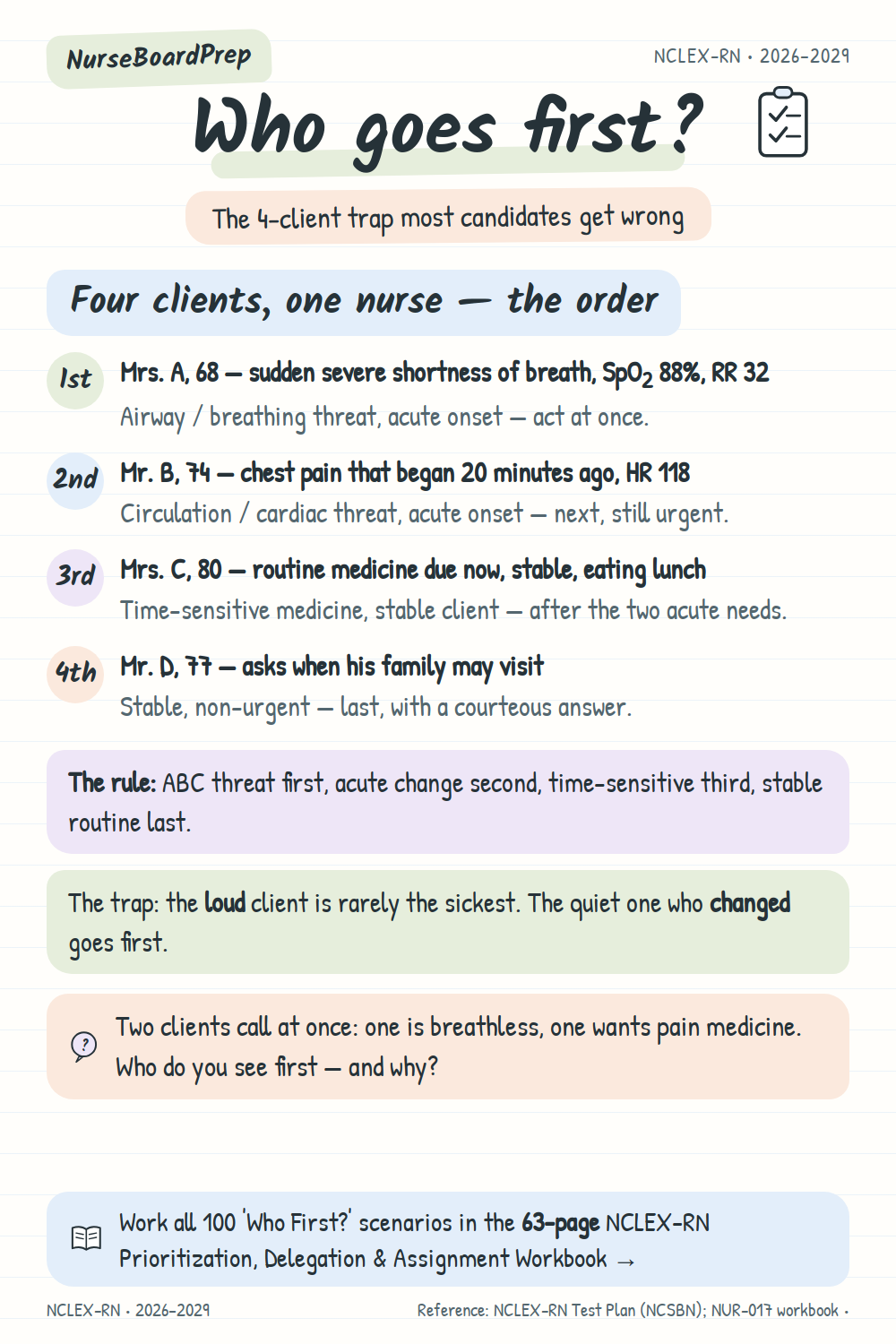
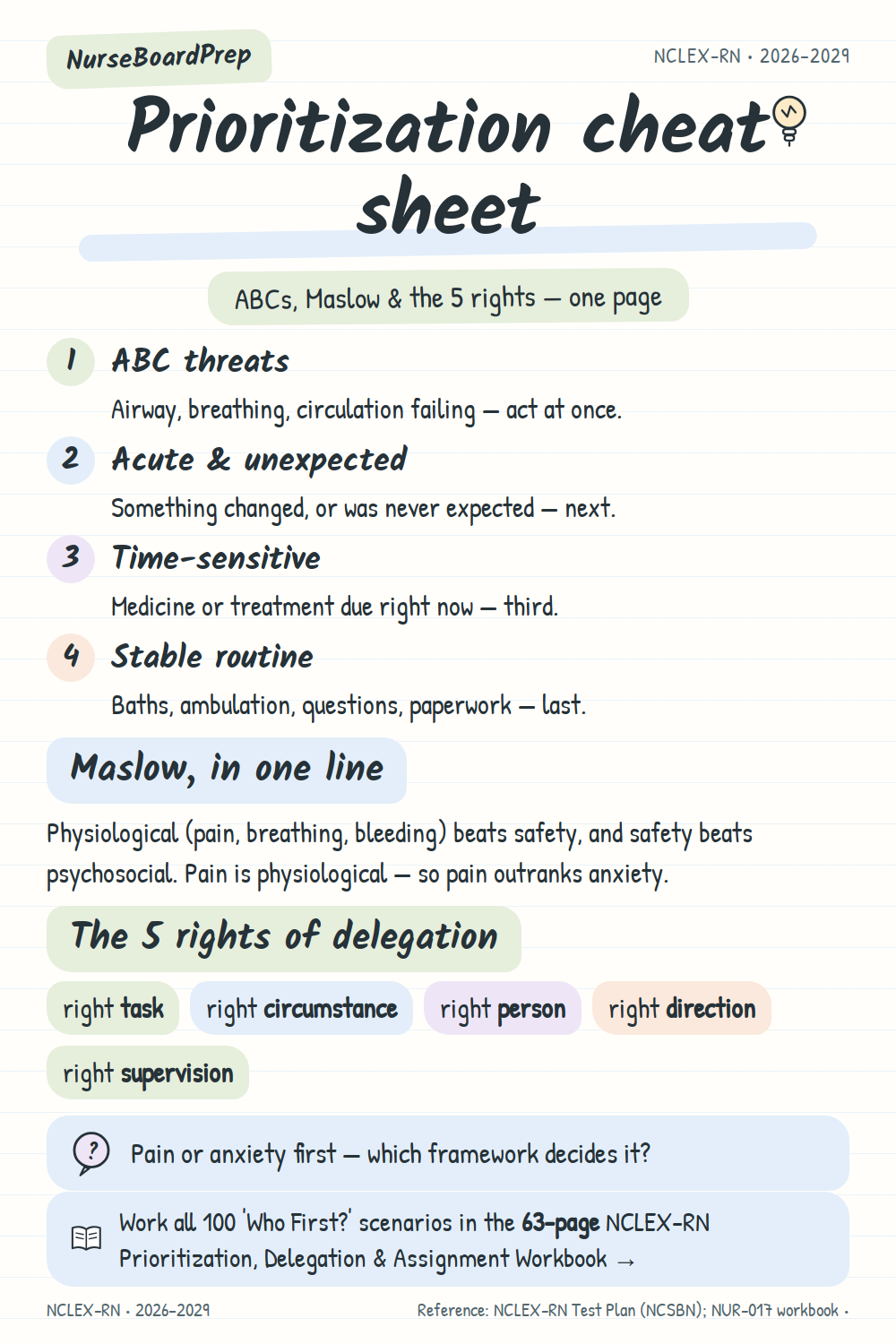
For prioritization in a skilled nursing facility (SNF) and anywhere else, use the same order: airway, breathing, and circulation first; acute beats chronic; actual problems beat potential ones; safety risks happening now come before teaching and feelings. Compare each cue with that client's own baseline — a new, unexpected finding outranks an expected one.
👉 Get the full review book here: https://payhip.com/b/R0caT
5. Delegation: the LPN delegates only to assistive personnel
The LPN may delegate to unlicensed assistive personnel (UAP) only, and only routine tasks for stable clients with predictable outcomes: hygiene, ambulation, routine vital signs on a stable client. The LPN never delegates assessment, teaching, evaluation, or medication administration to a UAP. Every delegation decision runs through the five rights of delegation: right task, right circumstance, right person, right direction and communication, and right supervision.
6. Pharmacology the PN way: classes, checks, then the drug
PN pharmacology rewards class knowledge over memorizing single drugs. Learn what each class does, its major adverse effects, the lab values to monitor, and when to hold a dose. Before giving a drug, check its hold parameter — pulse, blood pressure, or a lab value — and confirm the client is stable enough for it. If anything is unsafe or unclear, stop and verify before administering. This review teaches drug classes and safety checks; it asserts no milligram doses.
7. A worked mini-case
A skilled nursing facility client who was stable yesterday is now newly confused, with blood pressure dropping. The LPN collects the data: rechecks the vital signs, notes the mental-status change, and reports the change to the RN right away, then keeps monitoring blood pressure, mental status, and urine output. Rationale: a new, unexpected change means the client is no longer stable, so the situation leaves LPN scope and goes to the RN. Routine care waits; reporting does not.
8. Key Numbers to Memorize
Exam length: Minimum 85, maximum 150 items.
Exam time: Up to 5 hours including breaks.
Cases by format: Best action 15, SATA 7, Trend 2, Bow-Tie 2, Matrix 1, Cloze 2, prioritization (rank order) 1.
9. What the review book covers
NCLEX-PN Complete Board Review: Practical and Vocational Nursing builds this whole system into 30 NGN-PN cases with full rationales — the correct answer, why each wrong option fails, and a short memory strip restating each case's teaching point. The five teaching sections are LPN Coordinated Care, Stable Clients with Predictable Outcomes, LPN Medication Scope, Skilled Nursing Facility (SNF) Prioritization, and Pharmacology High-Yield, supported by 9 tables, including data-versus-assessment, teaching, delegation, stable-versus-unstable, medication routes, and a pharmacology-classes table.
Cases by scope: LPN Coordinated Care 6, Stable Clients 5, LPN Medication Scope 3, Pharmacology 7, SNF Prioritization 5, Basic Care and Safety 1, Health Promotion 1, Psychosocial Integrity 1, Physiological Adaptation 1. Cases by format: best action 15, SATA (select all that apply) 7, Trend 2, Bow-Tie 2, Matrix 1, Cloze 2, prioritization (rank order) 1.
10. Exam snapshot
From the verified 2026 NCLEX-PN Test Plan (effective April 2026): the exam runs a minimum of 85 and a maximum of 150 items, with up to 5 hours including breaks.
👉 Get the full review book here: https://payhip.com/b/R0caT
11. Honest notes
All 30 cases are original teaching cases written for this review. No question bank was copied. Scope and delegation points that vary by state are worded as "usually / varies by state" in the book, and the book defers to each state's Nurse Practice Act where scope is state-dependent. Drug teaching covers classes and safety checks, and no milligram doses are asserted in the book. No book, including this one, can guarantee a pass.
12. More from Nurse Board Prep Clinical Press
Follow us on Pinterest for more NCLEX-PN pins: https://www.pinterest.com/NurseBoardPrep/ — Board: "NGN Case Studies & Bow-Tie".
— Nurse Board Prep Clinical Press (NBPCP)