

Keywords: NCLEX microbiology rapid review, infection control precautions NCLEX, contact droplet airborne precautions, C. difficile soap and water, MRSA TB precautions, NCLEX infectious disease questions
The hook: the exam does not test what the germ is — it tests what you do first
A client has diarrhea after antibiotics. A client coughs for a month and loses weight. A child has chickenpox on the ward. Three different infections, three different answers — and the NCLEX asks the same question every time: what do you do first? This article gives you the rule and one worked case. The 11 pathogen profiles, the full precautions system, the antimicrobial tables and all 12 worked cases live inside the guide.
The core rule (the only rule you need to start)
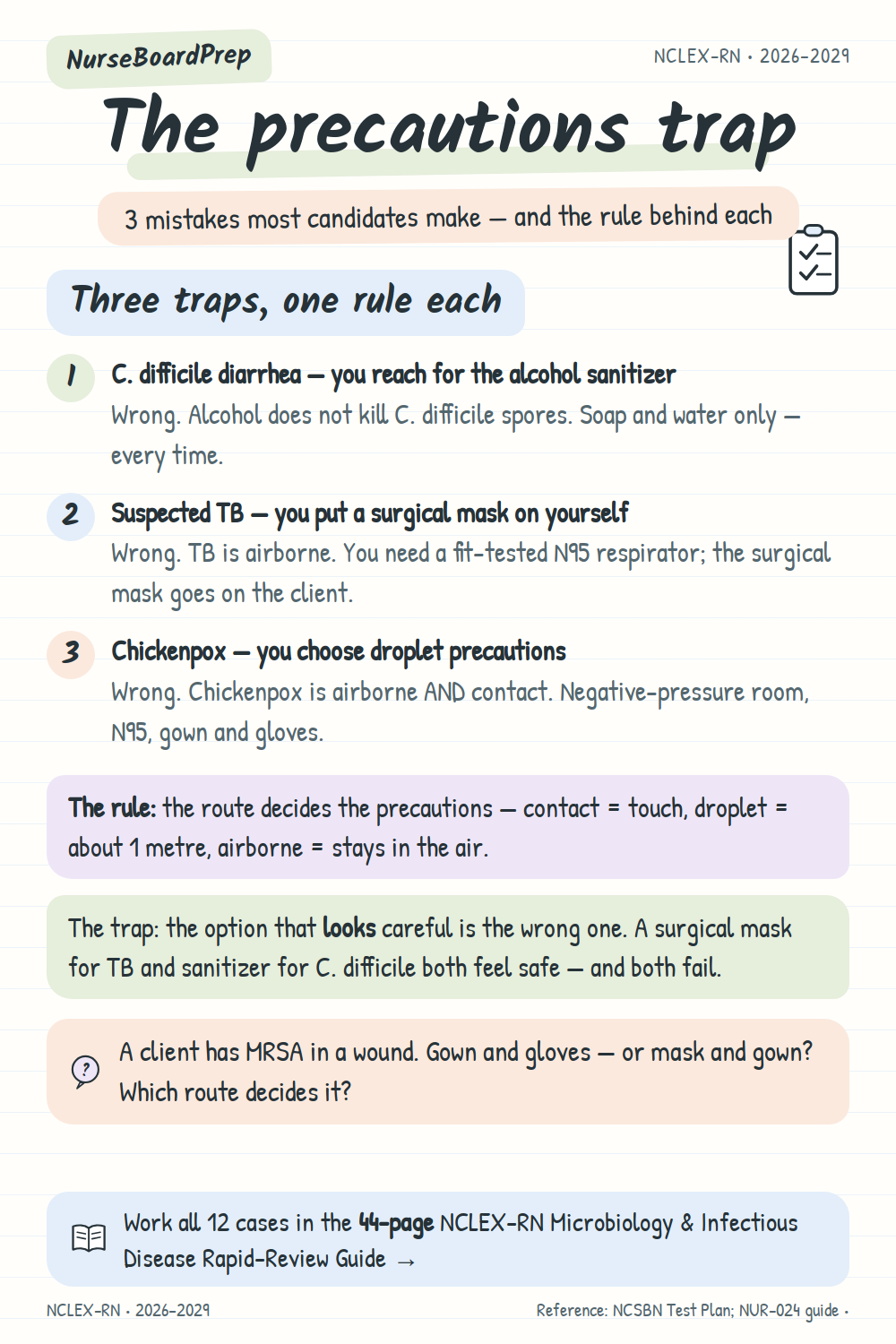
The route decides the precautions — and the route is in the stem.
- Contact — the organism spreads by touch: gown and gloves. MRSA, VRE, C. difficile, scabies.
- Droplet — large droplets that travel about 1 metre and fall: surgical mask within 1 metre. Influenza, pertussis, meningococcal disease.
- Airborne — tiny particles that stay suspended in the air: fit-tested N95 respirator, negative-pressure room, door closed. Tuberculosis, measles, chickenpox.
- Standard precautions — every client, every time, on top of all of the above.
That is the whole fork. Read the route, pick the precautions, and never let a surgical mask answer a TB question.
One example — try it before you read on
A nurse has just finished caring for Mr. F, 76, who has C. difficile diarrhea and is in contact precautions. Her hands are not visibly soiled. She is about to care for her next client. What should she do before touching the next client?
- A. Use alcohol-based hand sanitizer — it is faster and her hands look clean.
- B. Put on a second pair of gloves over the first and continue.
- C. Wipe her hands on a paper towel and continue.
- D. Wash her hands with soap and water, and change gloves before the next client.
The answer is D. Alcohol-based sanitizer does not kill C. difficile spores — soap and water is the only hand hygiene that works here, every time, even when the hands look clean. That is the exam's favourite trap: the option that feels careful is the one that fails.
What the full guide holds (the rest lives here, not in this article)
- The 11 pathogen profiles — MRSA, streptococci, E. coli, Pseudomonas, C. difficile, tuberculosis, HIV, hepatitis viruses, respiratory viruses, herpesviruses, Candida — each with spread, disease, red flag, nursing priorities, and the NCLEX trap.
- The infection-control system — standard and transmission-based precautions, hand hygiene, the PPE donning and doffing order, sterilisation and disinfection, isolation and protective isolation.
- The antimicrobial tables — antibiotic classes and mechanisms, antivirals, antifungals, resistance, and the adverse effects the exam actually tests (kidneys and hearing, tendon rupture, photosensitivity).
- The vaccines and immunity section — vaccine types, schedules, herd immunity, immunocompromised patients, and post-exposure prophylaxis (HIV PEP within 72 hours).
- The 12 worked cases with full rationales, the answer key, and the 3 master quick-reference tables.
All of it lives only inside the 44-page Microbiology & Infectious Disease Rapid-Review Guide.
Where the Full Method Lives
The pin gives you the rule in seconds. The full method — the foundations, the 11 pathogen profiles, the precautions system, the antimicrobial tables, the vaccine section, the special-populations section, and all 12 worked cases — is inside the 44-page guide only.
It is the same book the pin's facts come from: microbiology foundations, pathogen profiles, infection control, infectious disease by system, antimicrobials, vaccines and immunity, special populations, and exam application, in one print-ready PDF.