

Keywords: NCLEX disaster triage START, START triage RPM respiratory rate 30, SALT triage vs START, mass casualty triage NCLEX, community health NCLEX, bioterrorism NCLEX
The hook: a disaster question is a sorting question
A bus crash. Twenty patients, one nurse, no time. The NCLEX does not ask you to treat them all — it asks you to sort them. Who goes first, who can wait, and who cannot be saved? That is triage, and it follows one rule you can learn in a minute: RPM. This article gives you the rule and one worked case — the full START and SALT systems, the bioterrorism agents, and all 20 practice questions live inside the guide.
The core rule (the only rule you need to start)
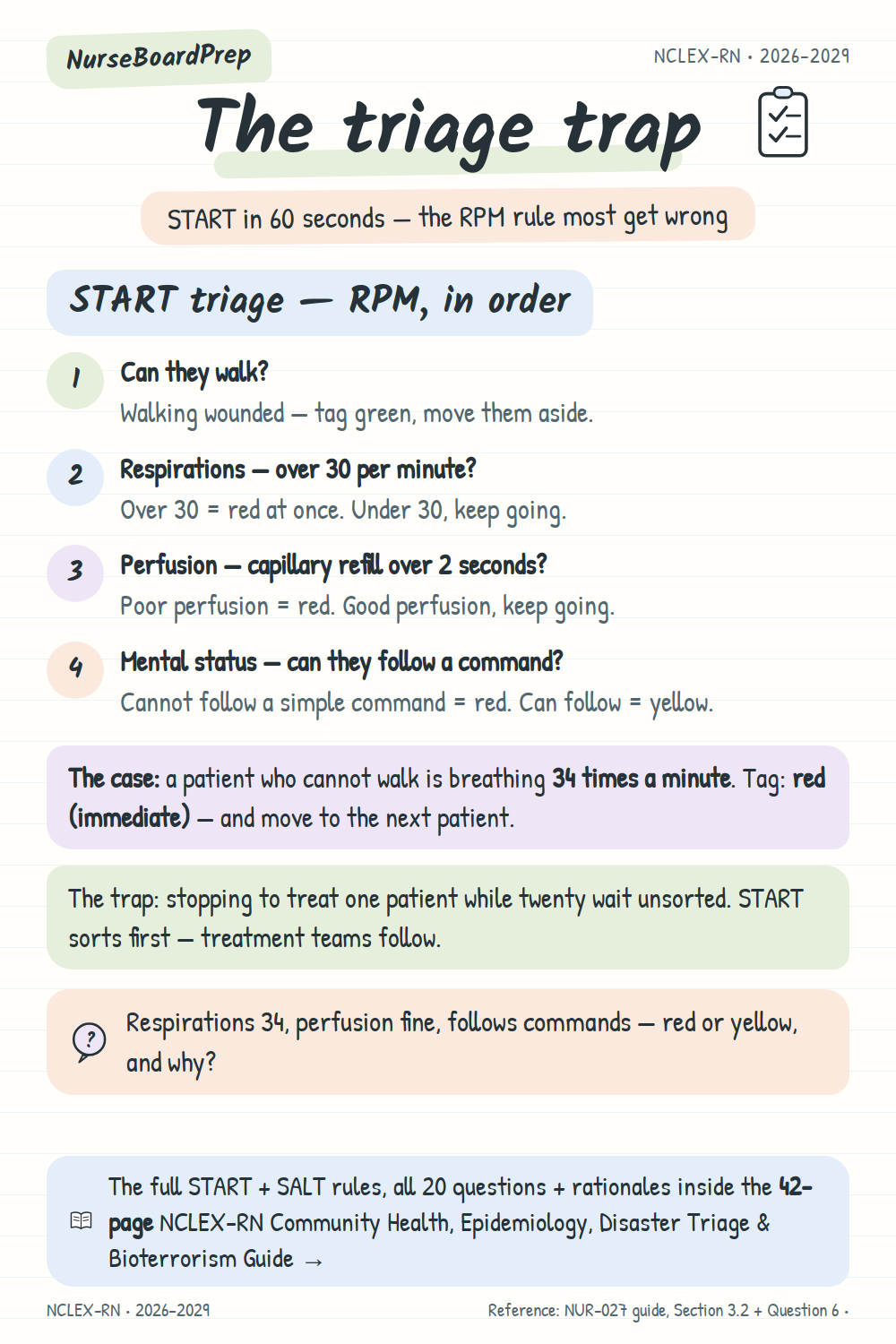
START triage sorts by RPM — Respirations, Perfusion, Mental status — in that order.
- Walking? If the patient can walk, tag green (minor) and move them aside.
- Respirations: not breathing — open the airway; breathing starts, tag red; breathing does not start, tag black. Breathing faster than 30 per minute — tag red at once.
- Perfusion: capillary refill longer than 2 seconds, or no radial pulse — tag red.
- Mental status: cannot follow a simple command — tag red. Can follow it — tag yellow.
That is the whole fork. Walk, breathe, perfuse, respond — and never stop to treat while you are still sorting.
One example — try it before you read on
A patient at a mass casualty incident cannot walk. Breathing: 34 times a minute. What is the tag?
Red — immediate. A respiratory rate above 30 tags red at once under START, before perfusion or mental status are even checked. And the nurse moves to the next patient: START sorts first, treatment teams follow. Stopping to treat one patient while twenty wait unsorted is the trap this question is built around.
👉 The full START + SALT triage rules, the bioterrorism recognition tables, and all 20 practice questions with full rationales are inside the 42-page Community Health, Epidemiology, Disaster Triage & Bioterrorism Guide: https://payhip.com/b/8Znq9
What the full guide holds (the rest lives here, not in this article)
- SALT triage — how it differs from START: global sort first, lifesaving interventions during triage, and a separate grey expectant category.
- Bioterrorism — anthrax, plague, smallpox and botulism at a glance: the signature sign of each, which ones spread person-to-person, and what to report first.
- Epidemiology — incidence vs. prevalence, outbreak investigation in nine steps, reading an epidemic curve, case-control vs. cohort.
- Public health emergencies — isolation vs. quarantine, pandemic response, communication, and the ethics of scarce resources.
- 20 practice questions — every one with a full rationale and the principle it tests, plus a 10-case rapid review and a glossary.
All of it lives only inside the 42-page Community Health, Epidemiology, Disaster Triage & Bioterrorism Guide
Where the Full Method Lives
The pin gives you the rule in seconds. The full method — the frameworks with worked examples, the agent tables, the decontamination steps, and all 20 exam-practice questions — is inside the 42-page guide only.
It is the same guide the pin's facts come from: community health foundations, epidemiology, disaster triage, bioterrorism, public health emergencies and environmental health, in one print-ready PDF.