

Keywords: NCLEX ER triage who goes first, ESI 1 2 3 4 5 NCLEX, ABCDE primary survey, shock types NCLEX, toxidromes antidotes NCLEX, ED triage prioritization, rapid stabilization NCLEX
The hook: five patients arrive at once — who goes first?
Five patients walk into the ED within minutes. One cannot breathe. One has crushing chest pain. One is confused after a fall. One has a broken arm. One has a sore throat. The NCLEX does not test whether you know the diseases — it tests whether you can rank them. The rule is always the same: the most unstable, most time-critical patient first. This article gives you the ranking rule and one worked case — the 50 cases, the toxidrome table and the stabilization checklists live inside the guide.
The core rule (the only rule you need to start)
Rank by ABCDE first, then ESI level, then the trend, then the clock.
- Airway, Breathing, Circulation, Disability, Exposure — fix A before B, B before C. A threatened airway beats everything.
- ESI 1–5 — 1 is dying now, 2 is high-risk or time-critical, 3 is urgent, 4 is less urgent, 5 is non-urgent. Arrival order never decides.
- The trend — a heart rate rising while the blood pressure falls is shock until proven otherwise, even if the blood pressure still looks normal.
- The clock — stroke signs and chest pain are time-critical; note exactly when they began.
That is the whole fork. ABCDE, then ESI, then the trend, then the clock.
One example — try it before you read on
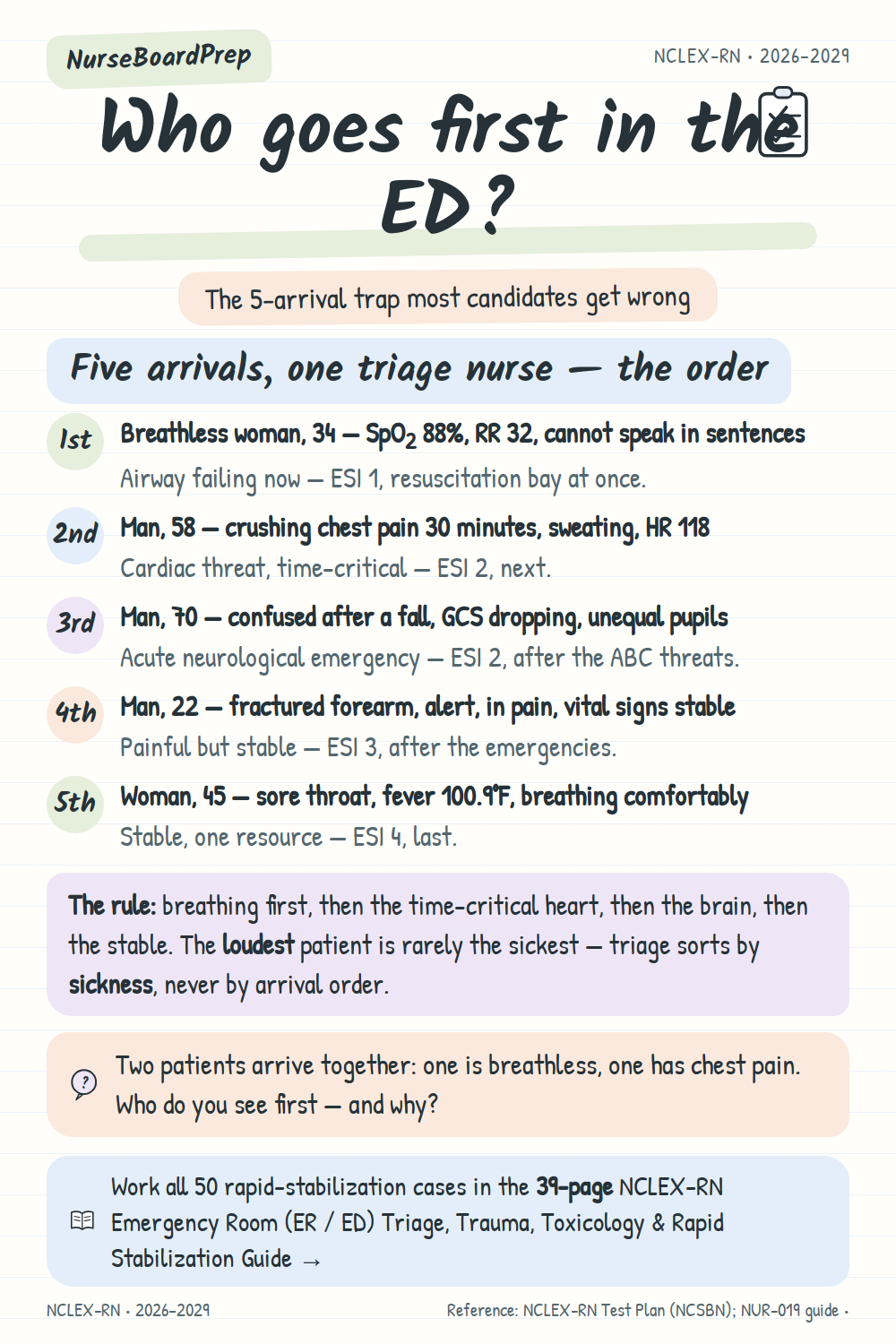
Five arrivals, one triage nurse: a breathless woman (SpO2 88%, respiratory rate 32, cannot speak in full sentences), a man with crushing chest pain, a confused man with a falling GCS and unequal pupils, a young man with a fractured forearm, and a woman with a sore throat and a fever. Who first?
The breathless woman — breathing is an ABC, it is failing now, and it is ESI 1. The chest-pain man is second (ESI 2, time-critical cardiac threat). The confused head-injury patient is third (ESI 2, but the two ABC threats go first). The fractured arm is fourth (ESI 3, painful but stable). The sore throat is last (ESI 4). The exam rewards the nurse who sees the airway first and everything else second.
What the full guide holds (the rest lives here, not in this article)
- The ESI 1–5 triage table and the ABCDE primary survey — with red flags at every step.
- The four shock types — hypovolemic, cardiogenic, distributive, obstructive — and the signs that tell them apart.
- The five toxidromes and the antidotes to recognize — opioid/naloxone, acetaminophen/N-acetylcysteine, organophosphate/atropine + pralidoxime, and more.
- The rapid-stabilization checklists — stroke (BE-FAST), heart attack, sepsis, anaphylaxis, the first ten minutes.
- The SBAR handover and the discharge safety net — including teach-back.
- The 50-case answer key and the triage, shock, toxidrome & stabilization quick-reference tables.
All of it lives only inside the 39-page ER Triage, Trauma, Toxicology & Rapid Stabilization Guide.
Where the Full Method Lives
The pin gives you the rule in seconds. The full method — the triage tables with worked examples, the shock and toxidrome tables, the stabilization checklists, and all 50 ED cases — is inside the 39-page guide only.
It is the same book the pin's facts come from: ESI triage, ABCDE, shock, trauma, toxicology and rapid stabilization, in one print-ready PDF.