

Keywords: NCLEX lab values cheat sheet, BUN creatinine ratio dehydration, potassium critical value NCLEX, order of draw tube colors, troponin vs BNP, neutropenia ANC NCLEX, pre post procedure care NCLEX
The hook: the exam never asks you to recite a range
The NCLEX does not ask "what is the normal potassium?" It shows you a potassium of 2.8, a weak client with cramps and an irregular pulse, and asks what you do first. Or it shows a BUN of 42 and asks whether the kidneys have failed. The range is only the first step — the number only matters because of what it does to the client. This article gives you the reading rule and one worked case — the full tables, the critical-values list, the tube-colour order and the 15 worked cases live inside the pocket reference.
The core rule (the only rule you need to start)
Read every lab value with compare, pair, trend, act.
- Compare with the range — and with the reporting laboratory's own range, which governs.
- Read the pair — BUN with creatinine, troponin with the chest-pain story, potassium with the heart rhythm. One number is a clue; a pair is a pattern.
- Compare with the baseline — a creatinine of 1.4 is a warning in a client whose baseline is 0.8, and routine in a client whose baseline is 1.3. A trend is worth more than one number.
- Act on what the value does — low potassium changes the rhythm, low platelets change bleeding risk, low hemoglobin changes oxygen delivery. Assess the client, report the abnormal value with its trend, monitor, and anticipate orders.
That is the whole fork. Compare, pair, trend, act.
One example — try it before you read on
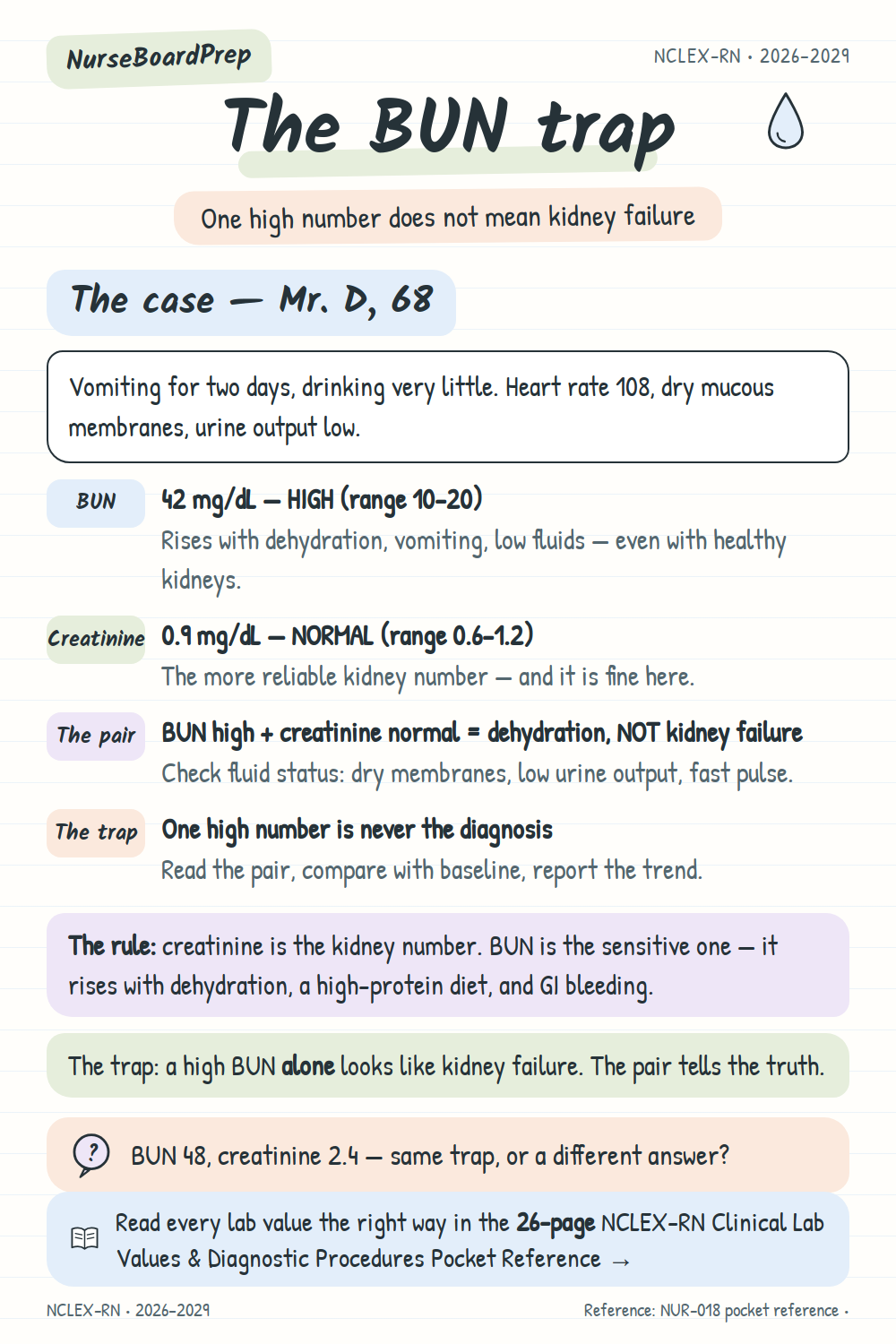
Mr. D, 68, has been vomiting for two days and drinking very little. BUN 42 mg/dL (range 10–20). Creatinine 0.9 mg/dL (range 0.6–1.2). Heart rate 108, dry mucous membranes, urine output low.
Kidney failure? No — dehydration. BUN rises with dehydration, vomiting and low fluid intake even when the kidneys are healthy; creatinine is the more reliable kidney number, and it is normal here. The pair says dehydration, not kidney failure. Assess fluid status and report the trend — fluids follow provider orders.
What the full pocket reference holds (the rest lives here, not in this article)
- The CBC section — WBC, ANC, hemoglobin, platelets, neutropenia precautions, and the HIT trap (platelets falling by half on heparin).
- The electrolyte tables — sodium, potassium, calcium, magnesium, phosphorus, plus the critical-values list that must be reported at once.
- The kidney, coagulation, cardiac and liver sections — BUN and creatinine together, PT/INR for warfarin and aPTT for heparin, troponin vs BNP, AST vs ALT, ammonia and lipase.
- The order-of-draw table — all 7 tube colours in order, with what each tube is for.
- The 4 diagnostic procedures — bronchoscopy, paracentesis, thoracentesis, lumbar puncture, pre- and post-procedure care.
- The 15 worked cases with full rationales — every case explains the correct answer and why each other option fails.
- The master quick-reference table — every value on one spread, for the bedside.
All of it lives only inside the 26-page Clinical Lab Values & Diagnostic Procedures Pocket Reference.
Where the Full Method Lives
The pin gives you the rule in seconds. The full method — every reference range with its red flag and first action, the critical-values list, the tube-colour order, the 4 procedures, and all 15 worked cases — is inside the 26-page pocket reference only.
It is the same book the pin's facts come from: CBC, electrolytes, kidney, coagulation, cardiac, liver and pancreas values, order of draw, and diagnostic procedures, in one print-ready PDF.