

Keywords: NCLEX pathophysiology, disease mechanisms NCLEX, clinical manifestations NCLEX, pathophysiology compendium, heart failure weight gain NCLEX, stroke FAST NCLEX, sepsis NCLEX, NGN pathophysiology questions
The hook: the exam never asks you to name the disease
It gives you a client with signs and symptoms and asks what is happening inside the body, what will happen next, and what to do first. The candidates who pass are not the ones who memorized the most lists — they are the ones who can run one chain: mechanism → manifestation → priority. This article gives you the chain and one worked case — the 51 mechanisms, the red-flag table, and the case reasoning live inside the compendium.
The core rule (the only rule you need to start)
For every disease, ask three questions in this order:
- Mechanism — what is failing? Which organ, which process?
- Manifestation — what does that failure produce? Which signs follow from it?
- Priority — which sign is dangerous right now? ABCs, acute change, unexpected finding?
That is the whole fork. If you can explain why a sign appears, you can answer the question even when the stem is unfamiliar. If an option does not follow from the mechanism, it is a distractor, however plausible it sounds.
One example — try it before you read on
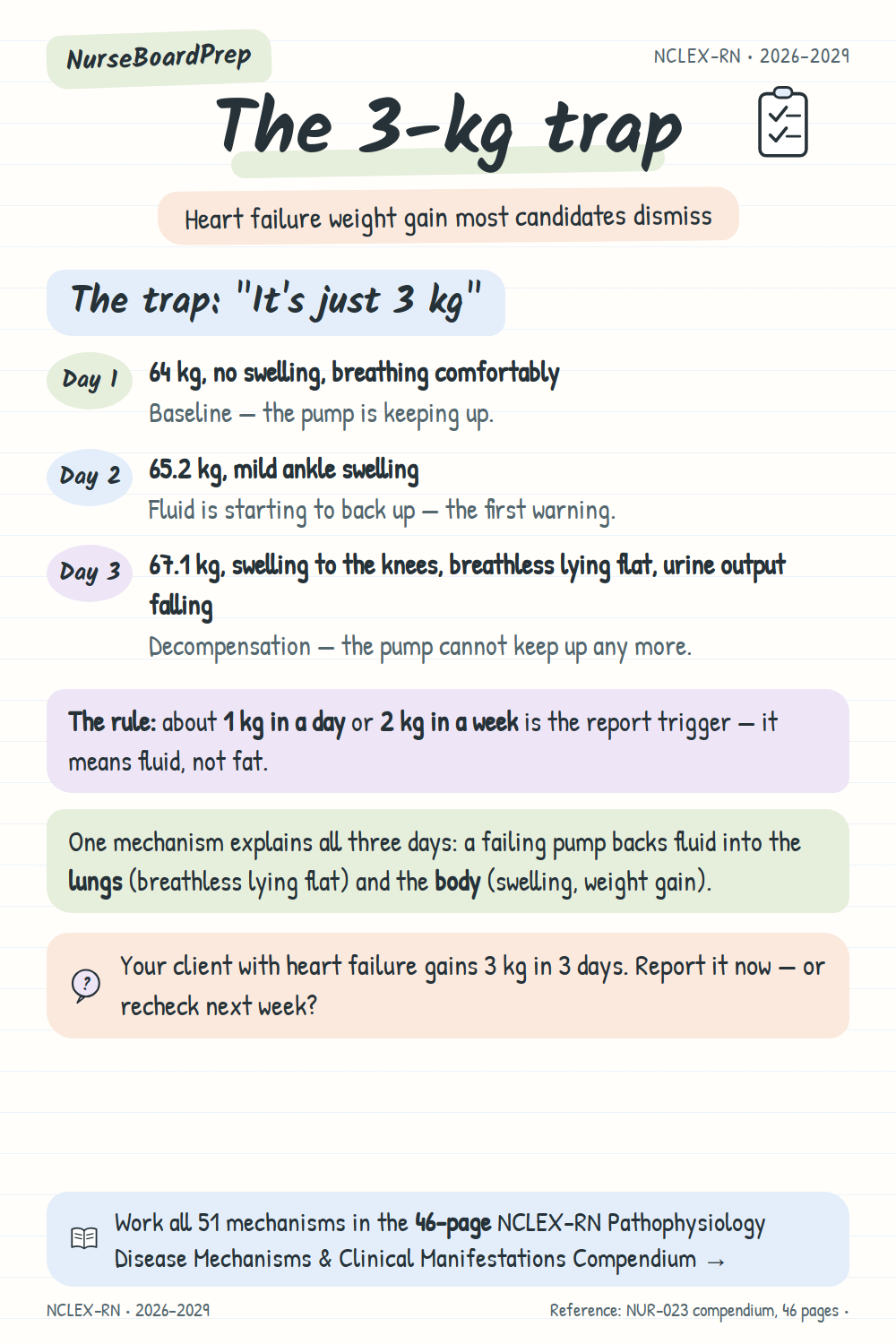
A client with heart failure weighs herself daily. Day 1: 64 kg, no swelling, breathing comfortably. Day 2: 65.2 kg, mild ankle swelling. Day 3: 67.1 kg, swelling to the knees, breathless lying flat, urine output falling.
One mechanism explains all three days: a failing pump backs fluid into the lungs (breathlessness lying flat) and into the body (swelling, weight gain). About 1 kg in a day or 2 kg in a week is the report trigger — it means fluid, not fat. The trap is dismissing the weight gain as harmless. The priority is reporting the full trend promptly — not rechecking next week.
What the full compendium holds (the rest lives here, not in this article)
- 51 topics across 11 systems — foundations, cardiovascular, respiratory, neurological, endocrine, renal, gastrointestinal, hematologic/immune, musculoskeletal/integumentary, reproductive, and infectious disease and sepsis.
- The master red-flag table — 20 findings that change the priority at once, from anaphylaxis to preeclampsia.
- Clinical manifestations, done properly — general principles, system-specific patterns, red-flag findings, and disease progression and complications.
- Exam application — pathophysiology in NCLEX-RN questions, clinical judgment and prioritization, and case-based reasoning for NGN case studies.
All of it lives only inside the 46-page Pathophysiology Disease Mechanisms & Clinical Manifestations Compendium.
Where the Full Method Lives
The pin gives you the chain in seconds. The full method — all 51 mechanisms with their manifestations, priorities, and knowledge checks, plus the red-flag table and the exam-application section — is inside the 46-page compendium only.
It is the same book the pin's facts come from: disease mechanisms and their clinical manifestations across the full NCLEX-RN exam scope, in one print-ready PDF.