

Keywords: NCLEX perioperative nursing, PACU care NCLEX, post-op complications NCLEX, five W's post-op fever, wound dehiscence evisceration NCLEX, pre-op assessment consent NCLEX, NGN perioperative questions
The hook: after surgery, the day tells you the diagnosis
A patient spikes a fever after surgery. Is it the lungs, the urine, or the wound? The NCLEX does not expect you to guess — it expects you to know the day. Post-op fever follows a pattern so reliable it has a name: the five W's. This article gives you the pattern and one worked case — the 50 cases, the PACU readiness checklist and the red-flag table live inside the guide.
The core rule (the only rule you need to start)
Match the fever to the day after surgery.
- Wind (day 1–2) — atelectasis, then pneumonia: low-grade fever, shallow breathing, diminished breath sounds.
- Water (day 3–5) — urinary tract infection: fever, cloudy urine, a catheter in place.
- Wound (day 5–7) — wound infection: redness, warmth, swelling, purulent drainage, increasing pain.
- Walking (day 2 onward) — deep vein thrombosis and pulmonary embolism: calf pain and swelling; sudden dyspnea and chest pain for embolism.
- Wonder drugs (any time) — drug fever: fever with no other cause, after a new medicine.
That is the whole fork. The day names the cause — and the cause names the action.
One example — try it before you read on
Mrs. K, 70, post-op day 2 after knee surgery. Her left calf is swollen, warm, and painful; the right leg looks normal. No chest pain, breathing comfortable. What first?
Keep her in bed, do not massage the leg, assess her fully, and notify the provider at once. A swollen, warm, painful calf after surgery is a deep vein thrombosis until proven otherwise — and massaging it or walking it off can dislodge the clot. The exam rewards the nurse who sees the pattern and protects the leg first.
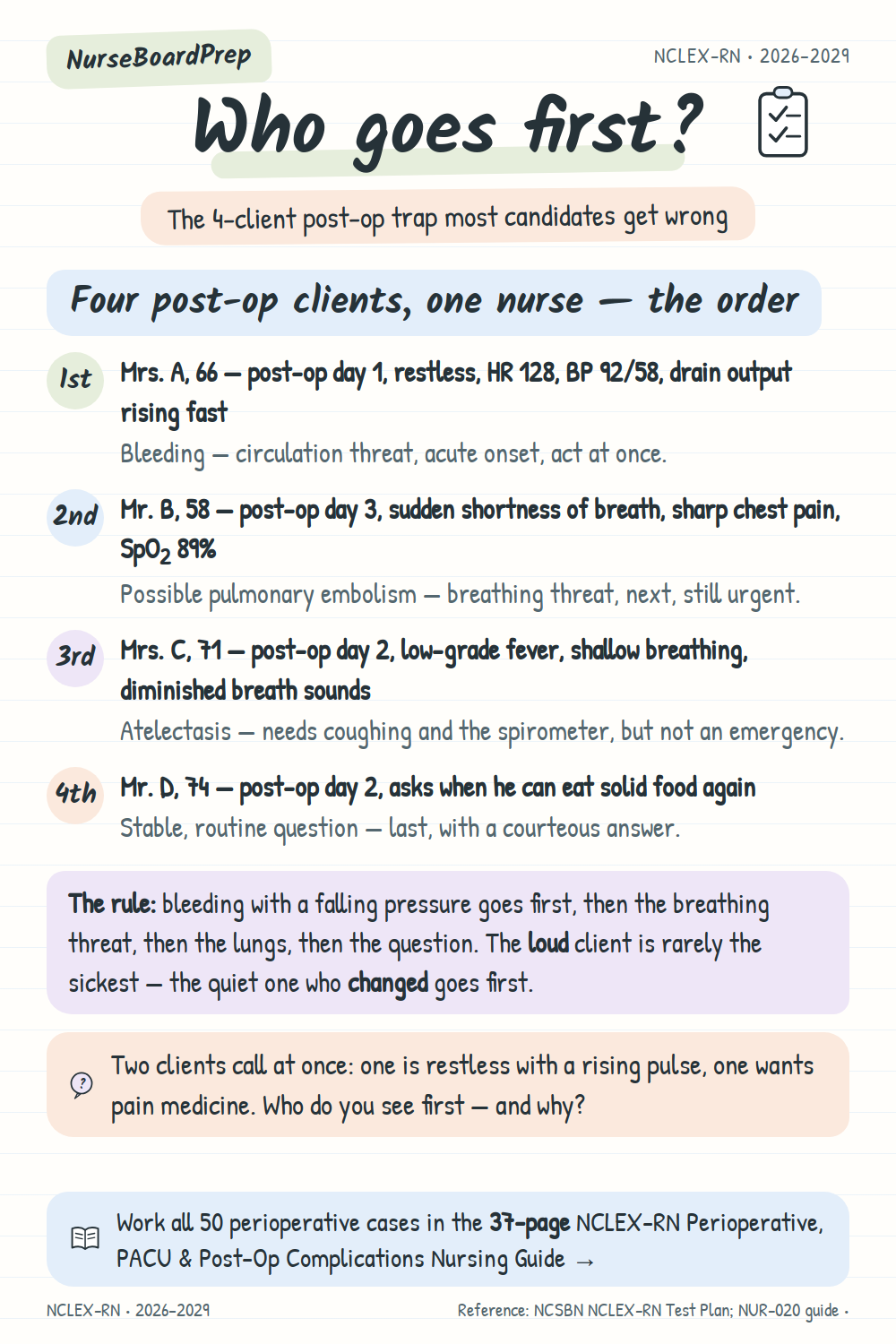
What the full guide holds (the rest lives here, not in this article)
- The pre-op assessment checklist — allergies, medicines, NPO, consent, site and side, and what to report before surgery.
- The informed consent rules — who obtains consent, who witnesses it, and when to stop.
- The PACU order of work — ABCs first, then the five discharge-readiness checks.
- The red-flag quick table — hemorrhage, embolism, dehiscence, evisceration, retention, ileus: the sign, the thought, the first action.
- The 50-case answer key — pre-op, consent, anesthesia, PACU, respiratory, VTE, wound, pain and discharge cases.
All of it lives only inside the 37-page Perioperative, PACU & Post-Op Complications Nursing Guide.
Where the Full Method Lives
The pin gives you the pattern in seconds. The full method — the pre-op checklist, the consent rules, the anesthesia section, the PACU readiness checks, the red-flag table, and all 50 exam cases — is inside the 37-page guide only.
It is the same book the pin's facts come from: perioperative assessment, PACU care, and post-op complications, in one print-ready PDF.