

Keywords: suicide risk assessment NCLEX; ask directly about suicide does not increase risk; ideation plan means intent; prior suicide attempt strongest predictor; 1:1 observation remove means; protective factors suicide
Table of Contents
- The Hook: The Hardest Question in Nursing Is Also the Most Tested
- The Core Rule
- One Example — Try It Before You Read On
- Exam Table: Risk Tiers — What Raises Risk, What Protects
- What the Full PDF Holds
- Find This Pin on Pinterest
The Hook: The Hardest Question in Nursing Is Also the Most Tested
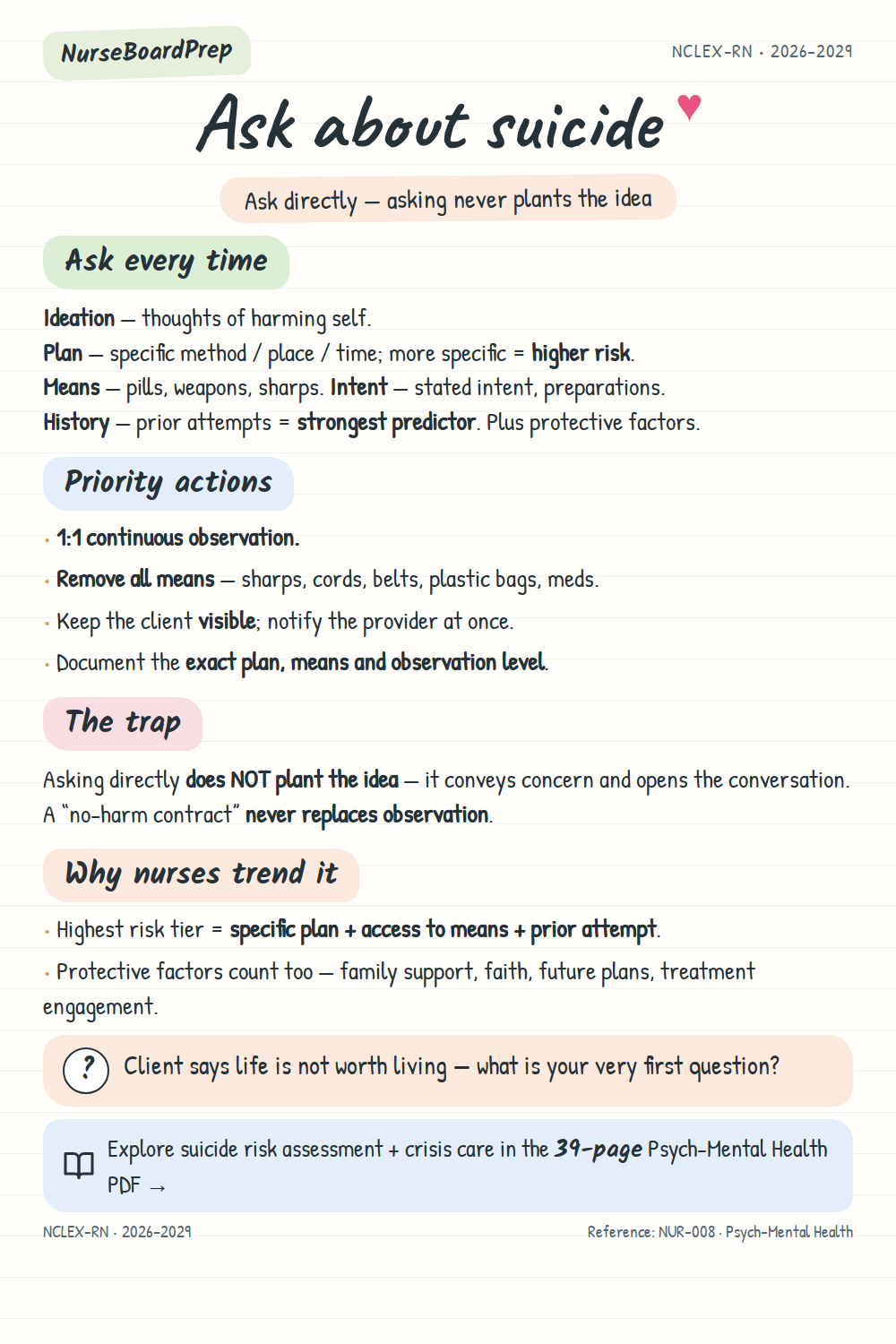
"Are you thinking of harming yourself?" Students freeze on it. They worry the question plants the idea. It does not — asking directly never plants the idea. It conveys concern, opens the conversation, and is the first step of every suicide risk assessment the exam will ever ask about.
👉 Get the full crisis chapter in the 39-page Psych-Mental Health PDF: https://payhip.com/b/V3ePt
The Core Rule
Ask every time, in this order: ideation → plan → means → intent → history.
- Plan — specific method, place, time. More specific = higher risk.
- Means — pills, weapons, sharps. Access is risk.
- Intent — stated intent, preparations.
- History — prior attempts are the strongest predictor.
And the priority actions once risk is found: 1:1 continuous observation, remove all means, keep the client visible, notify the provider at once, and document the exact plan, means and observation level. A "no-harm contract" never replaces observation.
One Example — Try It Before You Read On
A client says life is not worth living. What is your very first question?
Ask directly about thoughts of harming self — then the plan, then the means. The highest risk tier is a specific plan plus access to means plus a prior attempt, and that tier gets 1:1 observation and a room with nothing harmful in it.
👉 The full suicide risk assessment, the risk tiers, protective factors, documentation rules and crisis actions are inside the 39-page Psych-Mental Health PDF: https://payhip.com/b/V3ePt
Exam Table: Risk Tiers — What Raises Risk, What Protects
Highest risk — Specific plan + access to means + prior attempt. What you do: 1:1 continuous observation, remove all means, keep the client visible, notify the provider at once.
Higher risk — Active ideation with a plan, or access to means. What you do: Close observation, remove means, safety planning.
Lower risk — Vague thoughts, no plan, no means, strong protective factors. What you do: Keep talking, assess again, document.
Remove all means: sharps, cords, belts, plastic bags, meds. Document the exact plan, means and observation level. Protective factors count too: family support, faith, future plans, treatment engagement. And remember: a "no-harm contract" never replaces observation.
What the Full PDF Holds
The complete Chapter 3 — the full assessment sequence, the priority-action ladder, protective factors (family support, faith, future plans, treatment engagement) and the worked cases — in the same 39-page Psych-Mental Health PDF that carries the whole psych course.
👉 Get the 39-page Psych-Mental Health PDF here: https://payhip.com/b/V3ePt
Find This Pin on Pinterest
See the pin for this article on Pinterest: Nurse Board Prep on Pinterest — board: "Next-Gen NCLEX RN Bible 2026-2029". Queue pin id: pin-newstyle-batch2-suicide. Pin URL to be added once the pin publishes.