

Here is the question that catches students who know chemistry but still lose the point: A solution has pH 9. What is its pOH?
Most students answer 9 — because the number is right there in the question. That is the trap.
The rule, and the one subtraction it needs: pH and pOH are a pair, and at 25°C they always add up to 14: pH + pOH = 14. So pOH = 14 − pH. For a solution with pH 9, the pOH is 14 − 9 = 5, not 9. The same rule works the other way: a solution with pH 3 has pOH 11. On the exam, the safe rule is: never copy the pH — always subtract it from 14.
One worked example, from the guide: A gas has a volume of 4 L at a pressure of 2 atm. The pressure is raised to 4 atm at constant temperature. What is the new volume? Boyle's law: P1V1 = P2V2, so 2 × 4 = 4 × V, giving V = 2 L. Double the pressure, halve the volume. The trap answer is 8 L — that is what you get if you multiply instead of dividing, and it goes the wrong way: higher pressure squeezes the gas smaller, not bigger.
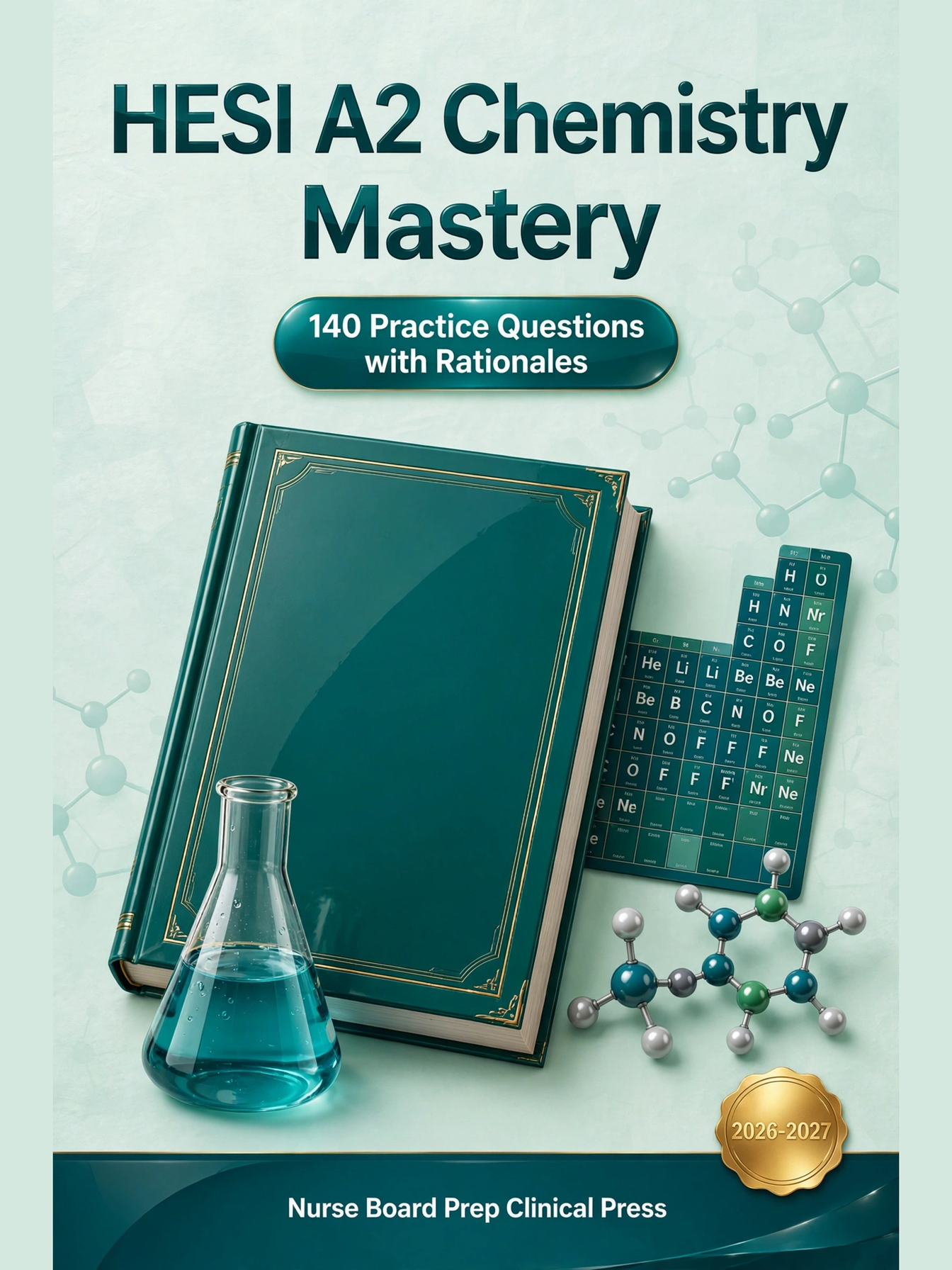
Inside the guides: HESI A2 Biology Mastery — 100 Practice Questions with Rationales (2026–2027), HESI A2 Chemistry Mastery — 140 Practice Questions with Rationales (2026–2027), HESI A2 Math, Grammar, Vocabulary & Reading Mastery — 200 Practice Questions with Rationales (2026–2027) — Biology 25 pages, Chemistry 33 pages, Math/Grammar/Vocabulary/Reading 46 pages.
Get the Biology guide on Payhip — $8.80 with the ChristmasDeal
Get the Chemistry guide on Payhip — $8.80 with the ChristmasDeal
Get the Math, Grammar, Vocabulary & Reading guide on Payhip — $8.80 with the ChristmasDeal
Also on Gumroad: HESI A2 Biology Mastery — 100 Practice Questions with Rationales (2026–2027), HESI A2 Chemistry Mastery — 140 Practice Questions with Rationales (2026–2027), HESI A2 Math, Grammar, Vocabulary & Reading Mastery — 200 Practice Questions with Rationales (2026–2027)
Not affiliated with HESI or Elsevier. Practice questions written for exam preparation; passing is never guaranteed by any book.