

Keywords: therapeutic communication NCLEX practice questions; restating reflecting feelings nursing; "why" questions nontherapeutic NCLEX; false reassurance nursing; therapeutic communication techniques; silence therapeutic; offering self
Table of Contents
- The Hook: The Exam Does Not Test What You Would Say in Real Life
- The Core Rule
- One Example — Try It Before You Read On
- Exam Trap Box: The Blockers That Close the Conversation
- What the Full PDF Holds
- Find This Pin on Pinterest
The Hook: The Exam Does Not Test What You Would Say in Real Life
It tests which response keeps the client talking. The warmest answer is very often the wrong one. "Everything will be fine" feels kind — on the NCLEX it is false reassurance, and it is a trap.
👉 Get the full communication chapter in the 39-page Psych-Mental Health PDF: https://payhip.com/b/V3ePt
The Core Rule
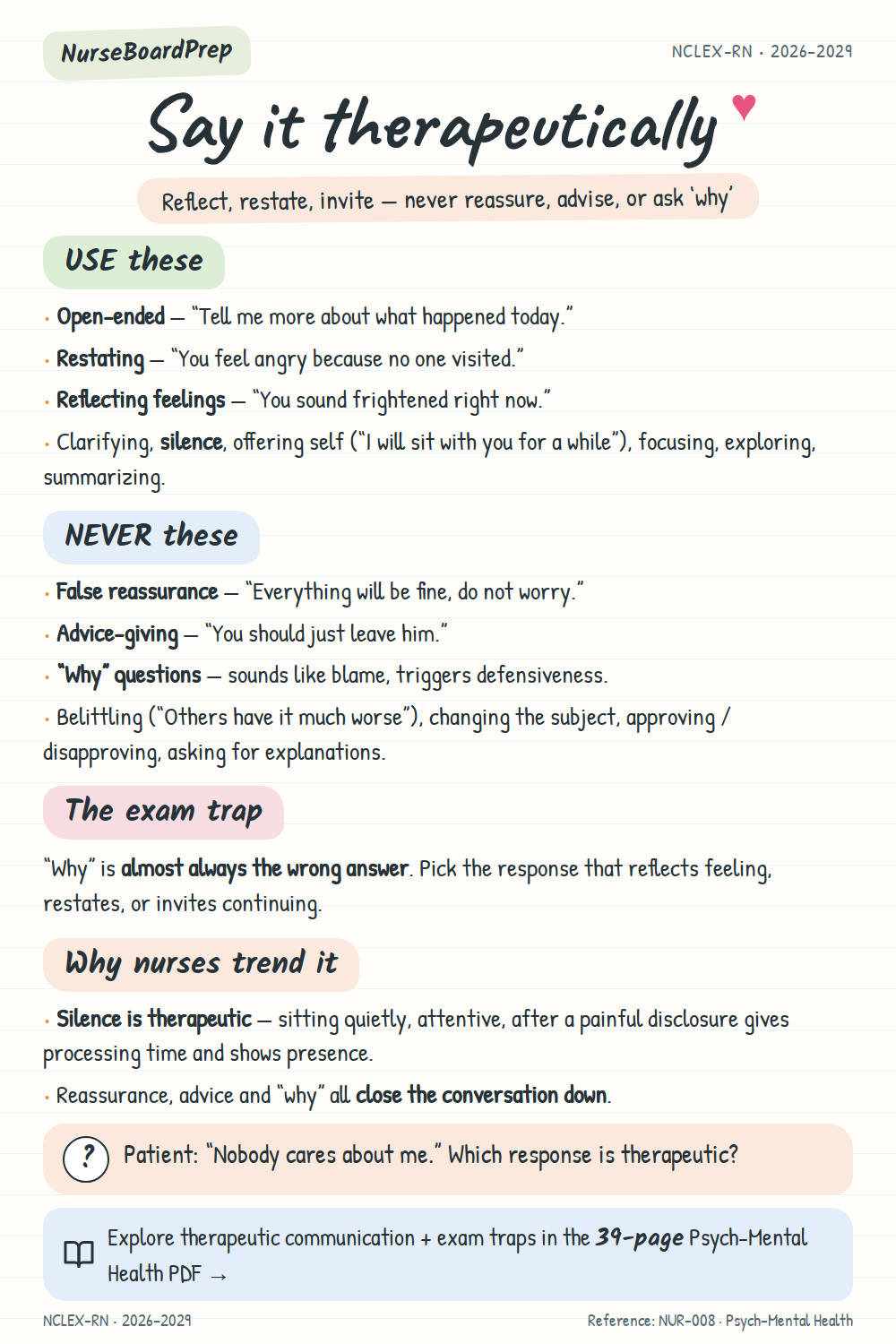
Reflect, restate, invite — never reassure, advise, or ask "why".
- USE: open-ended questions ("Tell me more about what happened today"), restating ("You feel angry because no one visited"), reflecting feelings ("You sound frightened right now"), clarifying, silence, offering self, focusing, exploring, summarizing.
- NEVER: false reassurance, advice-giving, "why" questions, belittling, changing the subject, approving or disapproving, asking for explanations.
And the trap to tattoo on your brain: "why" is almost always the wrong answer. It sounds curious. It reads as blame.
One Example — Try It Before You Read On
Patient: "Nobody cares about me." Which response is therapeutic?
Not "Of course people care, don't worry" — that is false reassurance, and it closes the conversation. The therapeutic move reflects the feeling or restates it, and invites the client to keep talking. The exam rewards the response that opens the door, never the one that shuts it.
👉 The complete USE/NEVER table, the silence technique, offering self, and every communication exam trap are inside the 39-page Psych-Mental Health PDF: https://payhip.com/b/V3ePt
Exam Trap Box: The Blockers That Close the Conversation
⚠ Reassurance, advice and "why" all close the conversation down. Eliminate the blockers first, then pick the response that focuses on the client's feeling.
False reassurance — Sounds like: "Everything will be fine, do not worry." Why it is wrong: Promises what the nurse cannot know; shuts down the feeling.
Advice-giving — Sounds like: "You should just leave him." Why it is wrong: Takes the decision away from the client.
"Why" questions — Sounds like: "Why did you stop taking your medicine?" Why it is wrong: Sounds like blame, triggers defensiveness.
Belittling — Sounds like: "Others have it much worse." Why it is wrong: Minimizes the client's experience.
Changing the subject / approving / disapproving — Moves away from the feeling.
And the technique students forget: silence is therapeutic — sitting quietly, attentive, after a painful disclosure gives processing time and shows presence. Offering self works the same way: "I will sit you for a while."
What the Full PDF Holds
The complete Chapter 2 — every therapeutic technique with its exact example line, every nontherapeutic trap with its rationale, and the worked cases — in the same 39-page Psych-Mental Health PDF that carries the whole psych course.
👉 Get the 39-page Psych-Mental Health PDF here: https://payhip.com/b/V3ePt
Find This Pin on Pinterest
See the pin for this article on Pinterest: Nurse Board Prep on Pinterest — board: "Next-Gen NCLEX RN Bible 2026-2029". Queue pin id: pin-newstyle-batch2-therapeutic. Pin URL to be added once the pin publishes.