
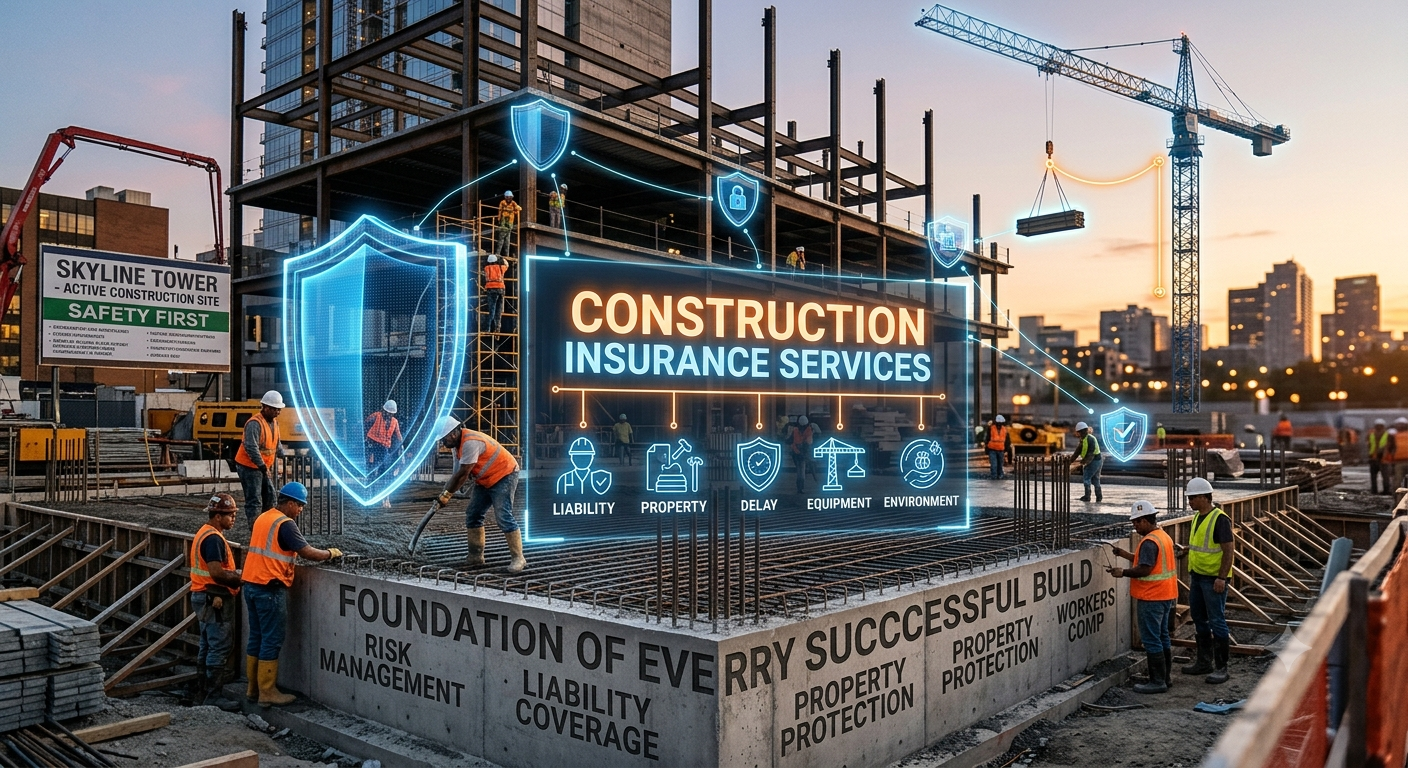
Picture this: a mid-sized contractor lands the biggest project of the year, crews mobilize, and three weeks in, a scaffolding accident sends a worker to the hospital. Within days, a subcontractor's equipment damages a neighboring property, and a client dispute over contract language threatens to unravel the whole job. None of this is hypothetical — it's a Tuesday in construction. The industry builds the physical world, but it also carries some of the highest occupational risk of any sector in the country. That's precisely why construction insurance services aren't a back-office formality. They're a core part of how a construction business survives, competes, and grows.
Construction remains one of the most hazardous industries in the United States, consistently recording the highest number of fatal work injuries of any private-industry sector. Falls, struck-by incidents, electrocution, and caught-in/between hazards — OSHA's so-called "Fatal Four" — are responsible for well over half of all construction worker deaths each year. Beyond the human toll, the financial exposure is staggering: serious nonfatal injuries alone cost the U.S. construction industry billions annually in medical care, lost productivity, and legal expenses. For business owners, that risk doesn't stay on the jobsite — it follows the company into every contract, every bid, and every balance sheet.
The Real Cost of Being Underinsured
Many contractors assume a general liability policy purchased years ago will cover whatever comes their way. In practice, construction risk is far more layered than that. A single project can expose a business to bodily injury claims, property damage, equipment loss, contractual liability, and workers' compensation obligations — often simultaneously. Without the right combination of coverage, one bad incident can wipe out a year of profit or, worse, end the business entirely.
This is where specialized construction insurance services earn their value. Generic policies aren't built around the specific realities of scaffolding work, heavy equipment operation, subcontractor networks, or state-specific labor laws. A knowledgeable insurance partner evaluates how a company actually operates — its projects, its crews, its contracts — before recommending coverage, rather than selling a one-size-fits-all package.
What Comprehensive Construction Insurance Services Should Include
Risk Management, Not Just Risk Transfer
The best construction insurance services start well before a policy is ever written. That means reviewing current operations, identifying where exposure is highest, and building a practical risk management plan around it — not simply handing over a certificate of insurance. Effective risk management also includes ongoing safety program support, since fewer incidents on-site translate directly into fewer claims and lower long-term premiums.
Contract Review and Indemnification Support
Construction is a contract-driven business, and indemnification language buried in a bid document can shift enormous liability onto a contractor without them realizing it. Strong insurance partners review contracts for indemnification clauses, supply sample provisions that protect the business, and provide ongoing review as new projects move through the bidding process. This kind of contractual risk transfer is one of the most overlooked — and most valuable — services a construction-focused broker can offer.
Workers' Compensation and Payroll Audits
Workers' compensation is often the single largest insurance line item for a construction company, and errors in payroll classification or audit reporting can lead to significant overpayment. Payroll and workers' comp audits, paired with overpayment recovery services, help contractors make sure they're not leaving money on the table simply because of a classification error.
Surety Bonds and Bid Support
Public and many private projects require contract surety bonds before a contractor can even bid. Having a partner who can supply insurance bid rates for job costing and issue certificates efficiently means fewer delays and a stronger competitive position when chasing new work.
Claims Management That Actually Moves
When an incident does happen, the speed and quality of claims handling can determine whether a project stays on schedule. Dedicated claims management — rather than a call-center queue — keeps disputes from spiraling and keeps crews working.
State Laws Make a Real Difference
Insurance requirements for builders, contractors, and developers vary significantly by state, and the gap between "compliant" and "actually protected" can be wide. New York, for example, enforces strict labor laws around gravity-related accidents involving scaffolding and flooring, making contractual risk transfer not just a best practice but a financial necessity for controlling claims and legal costs. A construction insurance partner familiar with these state-specific nuances can flag exposure that a generalist broker might miss entirely.
Actionable Steps for Contractors Right Now
- Audit your current coverage annually. Projects, payroll, and subcontractor relationships change constantly — your policies should be reviewed at the same pace.
- Get contracts reviewed before signing, not after. Indemnification language should be caught during the bidding phase, not after a claim.
- Invest in safety management. Lower incident rates directly reduce workers' comp costs and improve standing with carriers over time.
- Track certificates and certificate holders systematically. Automated certificate issuance and tracking prevents compliance gaps on multi-party projects.
- Work with a broker who specializes in construction, not one who treats it like any other commercial account.
Building With Confidence
Construction businesses are built on tight margins, physical risk, and complex contracts — which is exactly why generic insurance doesn't cut it. The contractors who protect their growth most effectively are the ones who treat construction insurance services as a strategic partnership, not a compliance checkbox. That means working with a team that understands job costing, labor law nuances, contractual risk transfer, and the day-to-day realities of running jobsites — not just underwriting policies from a distance.
The businesses that last in this industry are rarely the ones who avoid every incident. They're the ones who were properly protected when something inevitably went wrong. Getting the right construction insurance services in place isn't about predicting every risk — it's about making sure that when risk shows up, as it always does, the business is ready for it.