
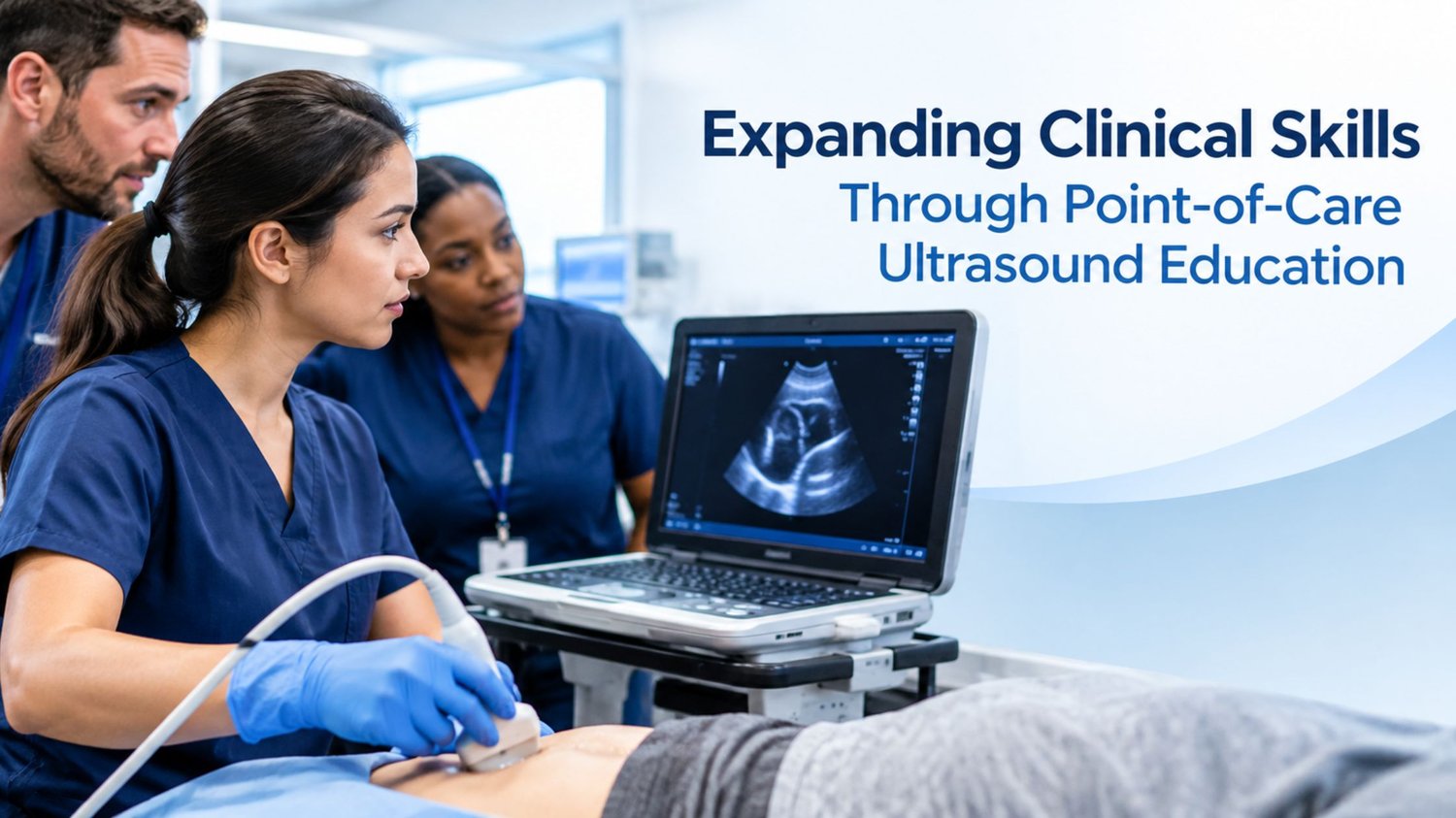
Point-of-care ultrasound can add another layer to bedside assessment by giving clinicians focused visual information during patient care. Learning to use this technology effectively requires more than becoming familiar with an ultrasound machine. Clinicians need opportunities to understand basic ultrasound principles, practice probe handling, obtain useful images, and connect findings with appropriate clinical questions. Well-structured point of care ultrasound education can support that development by bringing technical learning and clinical application together.
Understanding the Value of Practical Ultrasound Learning
Ultrasound education is most useful when learners can connect new concepts to situations they may encounter in clinical practice. A lesson on probe orientation, for example, becomes more meaningful when it is followed by an opportunity to identify anatomy and adjust the probe while viewing the resulting image.
This practical connection can help clinicians understand why technique matters. The quality of an ultrasound image can change with probe angle, pressure, depth, gain, and patient positioning. Learning how these factors interact gives practitioners greater control over the scanning process.
Education can also reinforce the role of POCUS as a focused assessment tool. Rather than treating every scan as a substitute for comprehensive imaging, learners can develop an understanding of when a focused examination may be useful and when additional evaluation may be appropriate.
Building Skills Through Guided Practice
Practical training gives learners opportunities to develop technical skills through repetition. An instructor can demonstrate a technique, observe the learner repeating it, and point out adjustments that may improve the resulting image. This type of feedback can help prevent small technical issues from becoming persistent habits.
Practice also gives learners a chance to work with normal anatomy before facing more difficult examinations. Recognizing expected structures and typical image patterns can create a useful reference point when clinicians later encounter anatomical variations or unexpected findings.
Making Training More Accessible
Access can influence whether clinicians have an opportunity to develop ultrasound skills. Time away from clinical duties, travel requirements, staffing limitations, and course costs can all affect participation.
For some learners and healthcare teams, affordable point of care ultrasound training can make structured education easier to pursue within existing professional and budget constraints. Cost, however, should be considered alongside the quality and depth of instruction. A lower price does not automatically mean that a program provides the practical experience, instructor interaction, or clinical relevance that learners need.
Flexible training formats can also improve accessibility. Programs that account for different schedules, clinical roles, and learning environments may help more healthcare professionals participate without separating education from the realities of clinical work.
Connecting Education With Clinical Questions
Effective POCUS learning should not focus only on producing technically clear images. Clinicians also need to understand what they are looking for and how the findings relate to the question that prompted the examination.
Training can encourage learners to begin with a focused clinical purpose. From there, they can select an appropriate examination, obtain relevant views, and consider whether the images provide enough information to address the original question.
This approach helps make ultrasound part of a broader clinical reasoning process. Findings can be interpreted alongside the patient's history, physical examination, and other available information rather than being considered in isolation.
Developing Confidence Through Repetition
Confidence with ultrasound usually develops over time rather than after a single session. Repetition helps learners become more comfortable with probe movements, machine controls, patient positioning, and the visual appearance of anatomical structures.
Continued practice can also improve the ability to recognize when an image is inadequate. A learner who has seen a range of examples is more likely to notice poor depth, incomplete visualization, or an incorrect scanning plane and make appropriate adjustments.
Reviewing images can strengthen this process. Comparing successful and unsuccessful views, discussing technical problems, and revisiting difficult scans can turn individual experiences into lessons that support future examinations.
Choosing Training Based on Learning Goals
Not every ultrasound learner needs the same educational experience. A clinician beginning with POCUS may need a stronger foundation in ultrasound physics and image acquisition, while someone with previous experience may benefit from focused work on specific applications.
Learning goals can guide training decisions. Important considerations may include the clinical setting, intended ultrasound applications, amount of hands-on practice, instructor support, and opportunities for feedback.
This becomes particularly relevant when evaluating the overall value of a course. The most useful program is not necessarily the one with the largest number of topics or the lowest cost. Instead, learners can consider whether the training matches their clinical needs and provides sufficient opportunities to develop practical skills.
Continuing Education Beyond the Initial Course
Initial training can provide a foundation, but ongoing education helps maintain and develop ultrasound skills. Regular scanning, image review, peer discussion, and additional instruction can support continued learning.
As clinicians gain experience, they may encounter increasingly varied patient presentations and more challenging examinations. Continued point of care ultrasound education can help reinforce proper technique, strengthen image interpretation, and encourage thoughtful use of focused ultrasound within an appropriate clinical scope.
Clinicians should also remain aware of the limitations of POCUS. Knowing when an examination is inconclusive or when comprehensive imaging is needed is an important part of using the technology responsibly.
Conclusion
Expanding ultrasound education is not simply about giving more clinicians access to equipment. It involves creating learning opportunities that combine clear instruction, hands-on practice, useful feedback, and clinical context. When these elements are brought together, learners can build skills that are more relevant to the demands of bedside care.
Accessible training can further support that development by reducing practical barriers without treating low cost as the only measure of value. With appropriate instruction and continued practice, clinicians can develop a stronger foundation for using focused ultrasound thoughtfully within their clinical roles.