

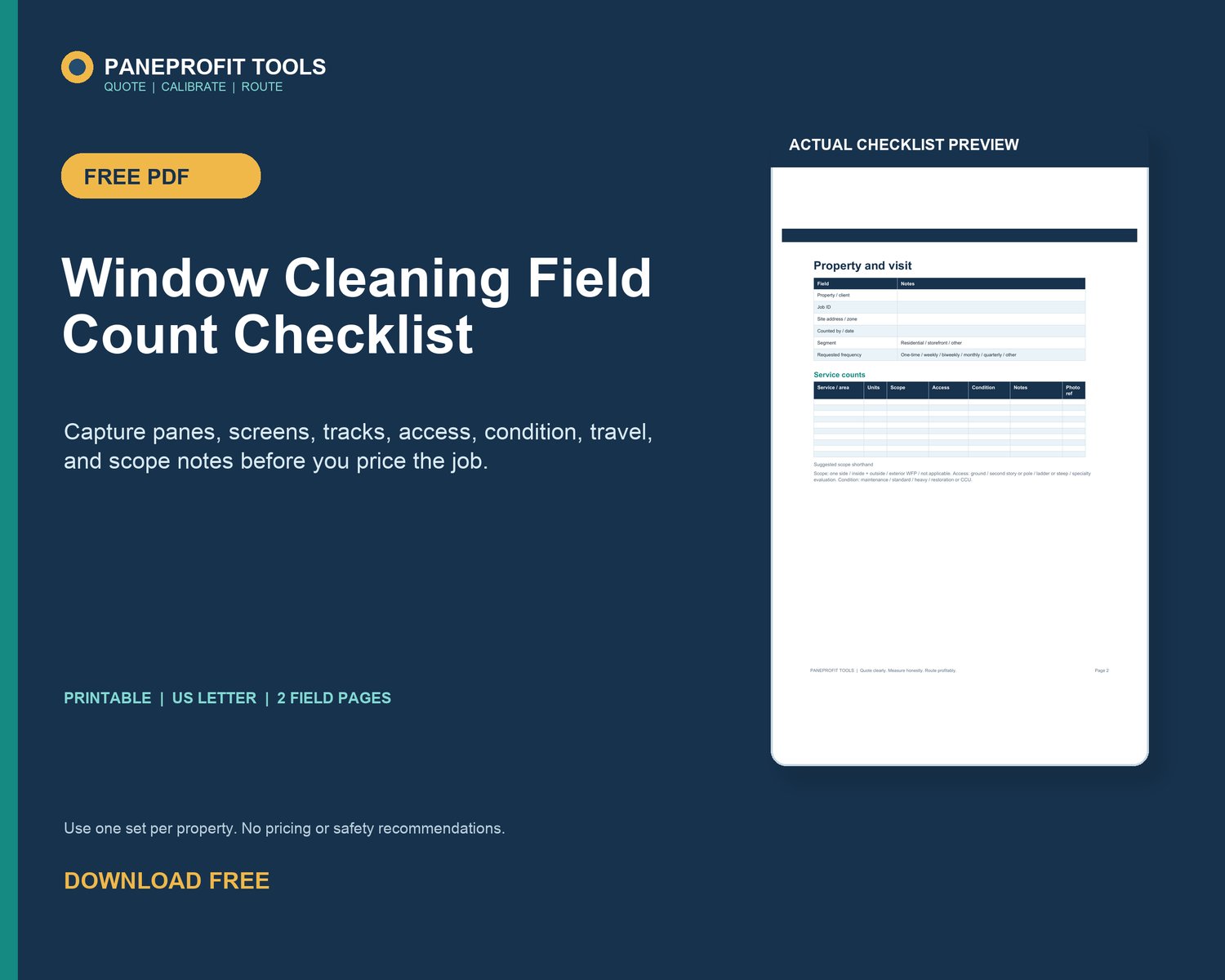
A consistent window cleaning quote starts before the calculator. It starts with a field record that captures the work clearly enough to review later.
When the walkthrough lives only in memory, small items can disappear between the property and the final price. Screens, tracks, ladder moves, awkward access, setup time, and travel may each look minor on their own. Together, they can materially change the work.
The workflow below keeps the count, the assumptions, and the final decision separate. It is designed for solo residential and small-storefront window cleaners who want a repeatable process without adding a field-service subscription.
1. Define what one count means
Decide what you are counting before you begin. A pane, window assembly, screen, track, or French pane is not interchangeable. Use the same unit definitions on the walkthrough and in your price book so the quote can be checked later.
Record exterior and interior scope separately when they differ. If a customer requests only selected areas, note the exclusions instead of relying on memory.
2. Give screens, tracks, and add-ons their own lines
Screens and tracks can add meaningful service time. Count them separately, then record add-ons such as hard-water review, post-construction debris, skylights, or interior partitions only when they are actually in scope.
A separate line does not force a particular price. It simply keeps the item visible when you apply your own rates and labor assumptions.
3. Record access and condition notes
Two properties with the same pane count can require very different work. Note story level, ladder or pole considerations, obstructions, parking, water access, fragile areas, and any condition that requires a separate safety or scope decision.
Only quote work you are equipped, insured, trained, and legally permitted to perform. A spreadsheet cannot determine whether a task is safe.
4. Estimate the whole route time
Service time is only part of the day. Include realistic estimates for travel, loading, setup, movement between work areas, cleanup, and payment or administrative handling when those activities apply.
This produces a more useful route-time estimate than dividing the quote by glass time alone. Keep uncertain inputs labeled as estimates and revise them when completed-job information becomes available.
5. Compare the price-book result with a modeled cost floor
A price book answers, “What do I normally charge for this scope?” A modeled cost floor asks whether the job can support the labor, supplies, vehicle allowance, overhead, payment fees, and business-profit assumptions you entered.
Neither result should make the decision automatically. Compare them, review unusually low margins or route-hour results, and adjust only after checking the underlying scope and assumptions.
6. Save one lesson after the job
After completion, record the quoted amount, estimated time, actual service and drive time, known direct costs, outcome, and one short lesson. Over several jobs, this creates a more relevant reference than a generic rate list because it reflects your routes, methods, customers, and service standard.
A compact walkthrough sequence
1. Define the service units.
2. Count panes or assemblies consistently.
3. Count screens, tracks, and approved add-ons separately.
4. Record access, condition, and scope notes.
5. Estimate travel, setup, service, and cleanup time.
6. Apply your own price book and economic assumptions.
7. Review the result before sending the quote.
Start with the free PaneProfit Field Count Checklist:
https://payhip.com/b/YdrmQ
Move the count into an editable Excel quote review with PaneProfit Quote Guard:
https://payhip.com/b/qu2Zp
For the complete quote, actual-job, and recurring-route workflow:
https://payhip.com/b/pnuPh
PaneProfit tools are estimators and recordkeeping aids. They do not replace an on-site inspection or professional tax, legal, accounting, insurance, or safety advice. Review every result and adapt all assumptions to your market and business.