

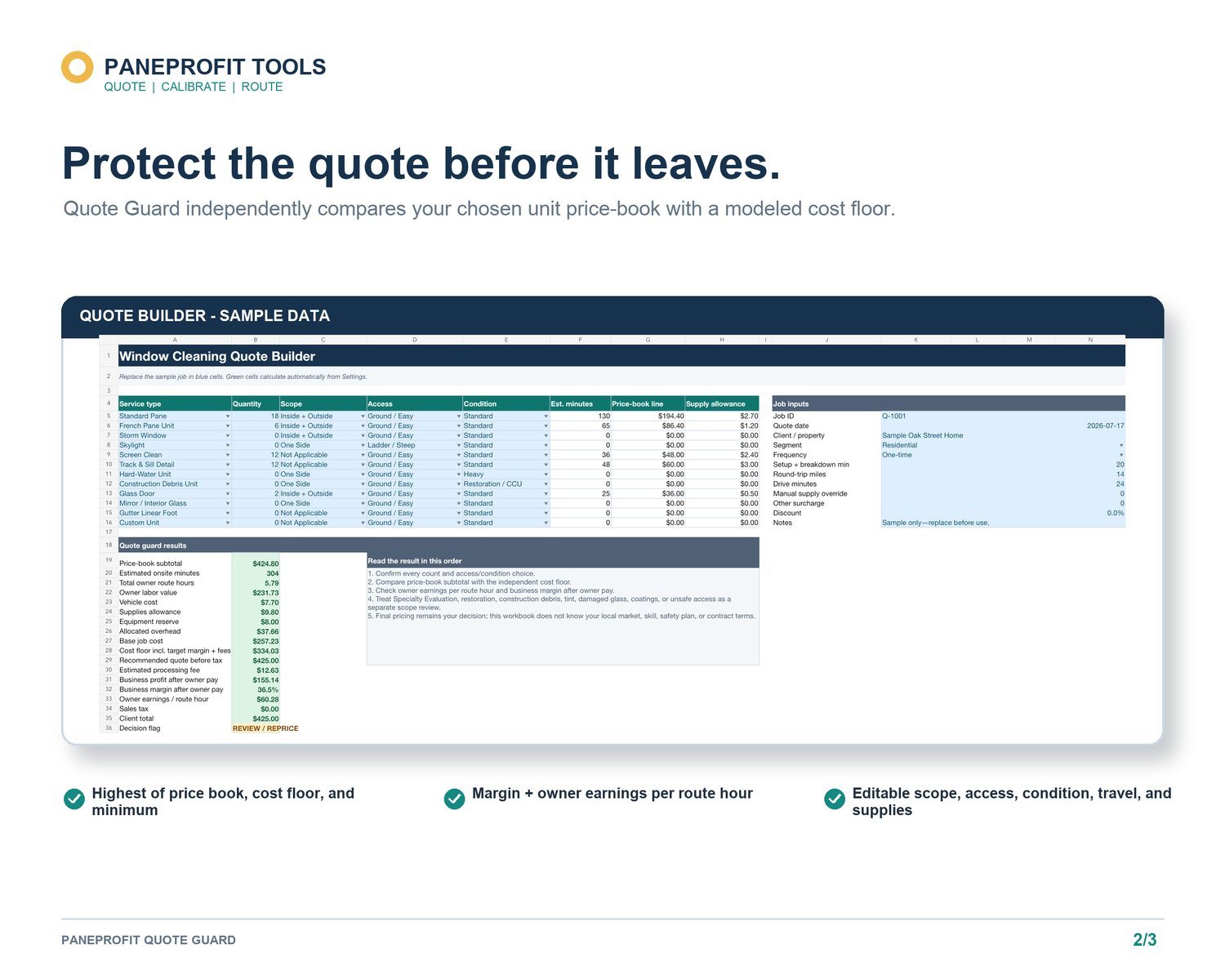
A window cleaning price book and a modeled cost floor answer different questions. A price book asks what your current unit rates produce for the scope you counted. A modeled cost floor asks whether the job can support the time, operating costs, payment fees, overhead, and business-profit assumptions you entered. Reviewing both is more useful than asking either one to produce a universally correct price.
This distinction matters because two jobs with similar pane counts can have different access, setup, travel, screen, track, or condition requirements. It also matters because a familiar unit rate can remain unchanged while fuel, supplies, owner-time targets, or payment costs change. A two-check process makes those assumptions visible before the estimate leaves your desk.
What belongs in a price-book total
A price book starts with consistent service units. Define whether a unit means a pane, an entire window assembly, a screen, a track, a door, or another item. Then use the same definition during the walkthrough and inside the pricing workbook.
Keep scope separate where the work differs. Exterior-only service is not the same as inside-and-out service. Screens, tracks, French panes, skylights, hard-water evaluation, and post-construction debris deserve their own lines when they are actually included. The goal is not to make a complicated menu. It is to avoid hiding meaningful work inside a mental total.
Your price-book result should therefore be easy to audit: counted quantity multiplied by the rate you chose, plus clearly identified add-ons or minimums. If the total surprises you, you can trace it back to a count or rate instead of guessing why the quote moved.
What belongs in a modeled cost floor
A modeled cost floor begins with time and cost assumptions rather than market rates. Estimate service minutes, setup minutes, and drive time. Add the owner-time or labor value you use for planning, expected supplies, vehicle or equipment allowance, overhead, and payment fees where applicable. Then include the business-profit or margin target you selected.
Every one of those inputs is an assumption, not an external fact supplied by a spreadsheet. Label estimates clearly and replace sample values before business use. If you are uncertain about an input, use a reasonable documented estimate and plan to review it after comparable completed jobs.
The result is a planning threshold created from your entries. It is not proof that a customer should accept the amount, that the work will produce a particular profit, or that the quote fits your local market.
Compare the two results instead of blending them silently
Place the price-book total and modeled floor side by side. If the price-book total is comfortably above the modeled floor, inspect the counts and scope once more, then apply your ordinary professional judgment. If the totals are close, review the most uncertain time and cost inputs before rounding the quote.
If the price-book total is below the modeled floor, do not automatically increase every unit rate. First identify the cause. The job may have unusual drive time, repeated setup, a small scope, difficult access, or a missing add-on. The minimum job assumption may be too low. Alternatively, a cost or time estimate may be unrealistic. Change the specific assumption that the evidence supports rather than editing several rates at once.
Use a short pre-quote review
Before sending the estimate, answer five questions:
1. Did the field count use the same unit definitions as the price book?
2. Are interior, exterior, screen, track, and add-on scopes separated correctly?
3. Does route time include realistic drive and setup minutes?
4. Are costs, fees, overhead, and margin assumptions current and labeled?
5. If the two results differ, can you explain the difference from the recorded inputs?
PaneProfit Quote Guard keeps the price-book and modeled-floor views together in an offline Excel workbook:
Start with the free field-count sheet if you need a repeatable walkthrough record:
https://payhip.com/b/YdrmQ
For Quote Guard plus completed-job calibration and recurring-route planning:
https://payhip.com/b/pnuPh
PaneProfit tools are estimators and recordkeeping aids. They do not replace an on-site inspection or professional tax, legal, accounting, insurance, or safety advice. Review every result and adapt all assumptions to your market and business.