

A lost window cleaning quote is a result, not an automatic instruction to lower your price. The customer may have changed the timing, reduced the scope, chosen another provider, decided to do the work themselves, or stopped responding. If you record a reason that the customer never gave, you can turn a guess into a bad pricing decision.
Start with three clear outcome states
Use Won when the customer accepted the quoted scope. Use Lost when you know the opportunity will not proceed. Use Open while a decision is still pending. Keep expired or withdrawn as separate notes only when those labels help your workflow.
A consistent status matters because an unanswered quote is not the same as a confirmed rejection. Moving every quiet lead into Lost can make the results look more negative than the evidence supports. Pick a follow-up window that fits your business, apply it consistently, and record the date of the last real contact.
Record only the reason you actually know
When a customer gives a reason, capture it in their words or a short neutral category. Useful categories might include timing, scope changed, scheduling conflict, selected another provider, price concern, property access, or no decision reported.
Do not fill a blank reason with too expensive just because the quote was declined. Price may have mattered, but the log should separate a reported reason from an internal assumption. If you want to preserve your own hypothesis, label it clearly as a note instead of a customer statement.
Keep the quote inputs beside the outcome
The status becomes more useful when it stays connected to the job you actually priced. Record the quoted amount, service type, counted units, estimated service time, drive and setup assumptions, important add-ons, and the date sent. That context lets you compare similar opportunities instead of mixing a small exterior-only stop with a large inside-and-out job.
For won work, add the actual service time and direct costs after the job is complete. A won quote can still reveal an estimating problem if the work took much longer than planned. A lost quote can still be reasonable if the scope and cost assumptions were sound.
Look for a pattern before changing a rate
Review a group of comparable quotes rather than reacting to one outcome. Ask whether losses cluster around a particular service type, minimum-job situation, travel zone, access condition, or follow-up delay. Check whether known price concerns appear repeatedly or only once. Also look at completed jobs: a higher acceptance rate is not helpful if the work consistently misses the time or cost assumptions you need.
Change one input at a time when the evidence supports it. You might clarify the scope language, improve the walkthrough questions, revise a time allowance, adjust a minimum, or update a unit rate. Recording the change date makes the next review more meaningful.
Use a five-question quote review
1. Is the outcome Won, Lost, or still Open?
2. Is the loss reason reported, unknown, or clearly labeled as an internal note?
3. Are the scope, count, time, and travel assumptions attached to the quote?
4. For completed work, did actual time and costs differ from the estimate?
5. Is there a repeated pattern across comparable jobs before you change an input?
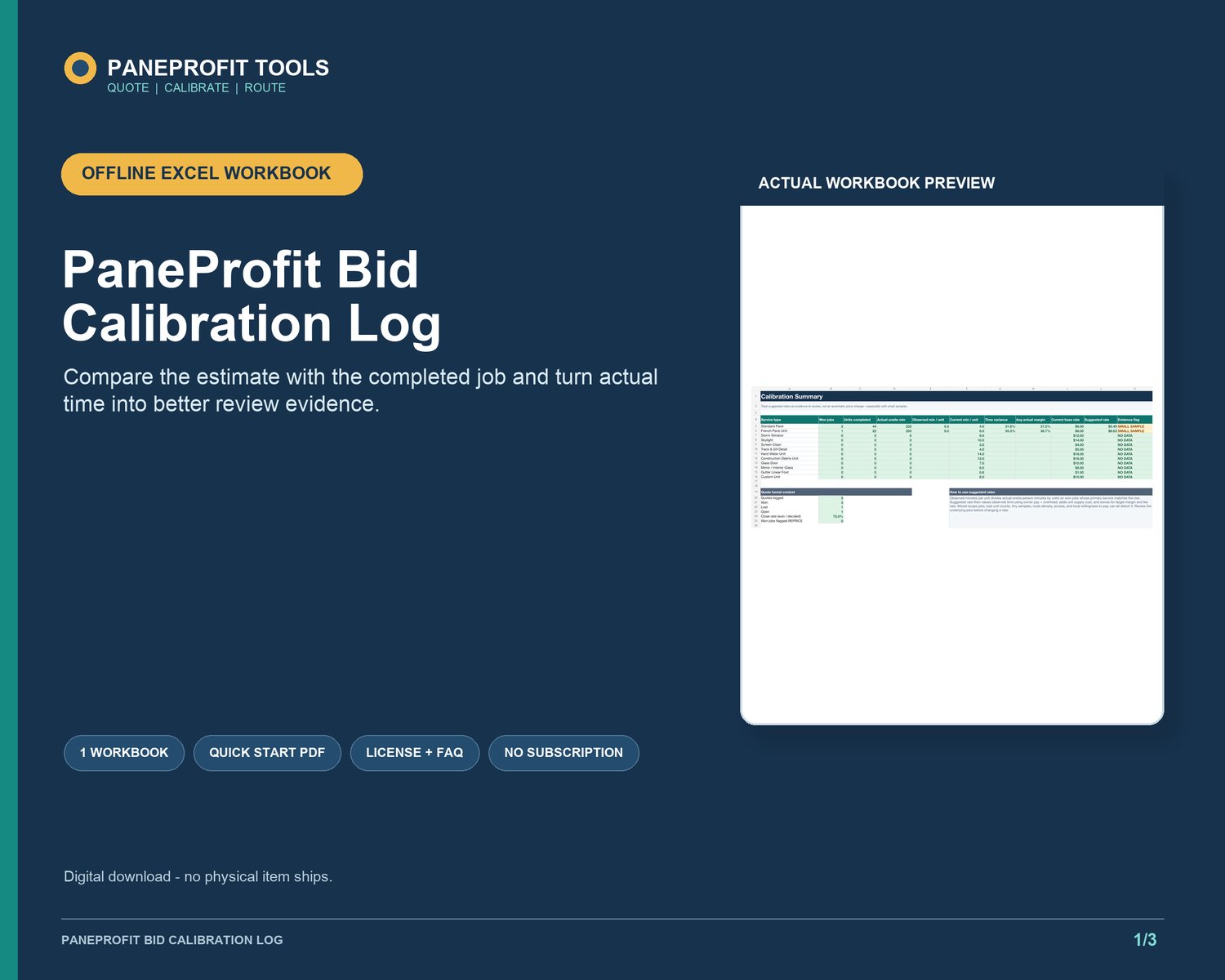
PaneProfit Bid Calibration Log keeps opportunity status, quote assumptions, estimated-versus-actual details, and review notes together in an offline Excel workbook:
https://payhip.com/b/WO7HB
PaneProfit tools are estimation, planning, and recordkeeping aids. They do not supply local market rates, decide which work to accept, guarantee outcomes, or replace professional tax, legal, accounting, insurance, or safety advice. Review every entry and adapt the workflow to your business.