
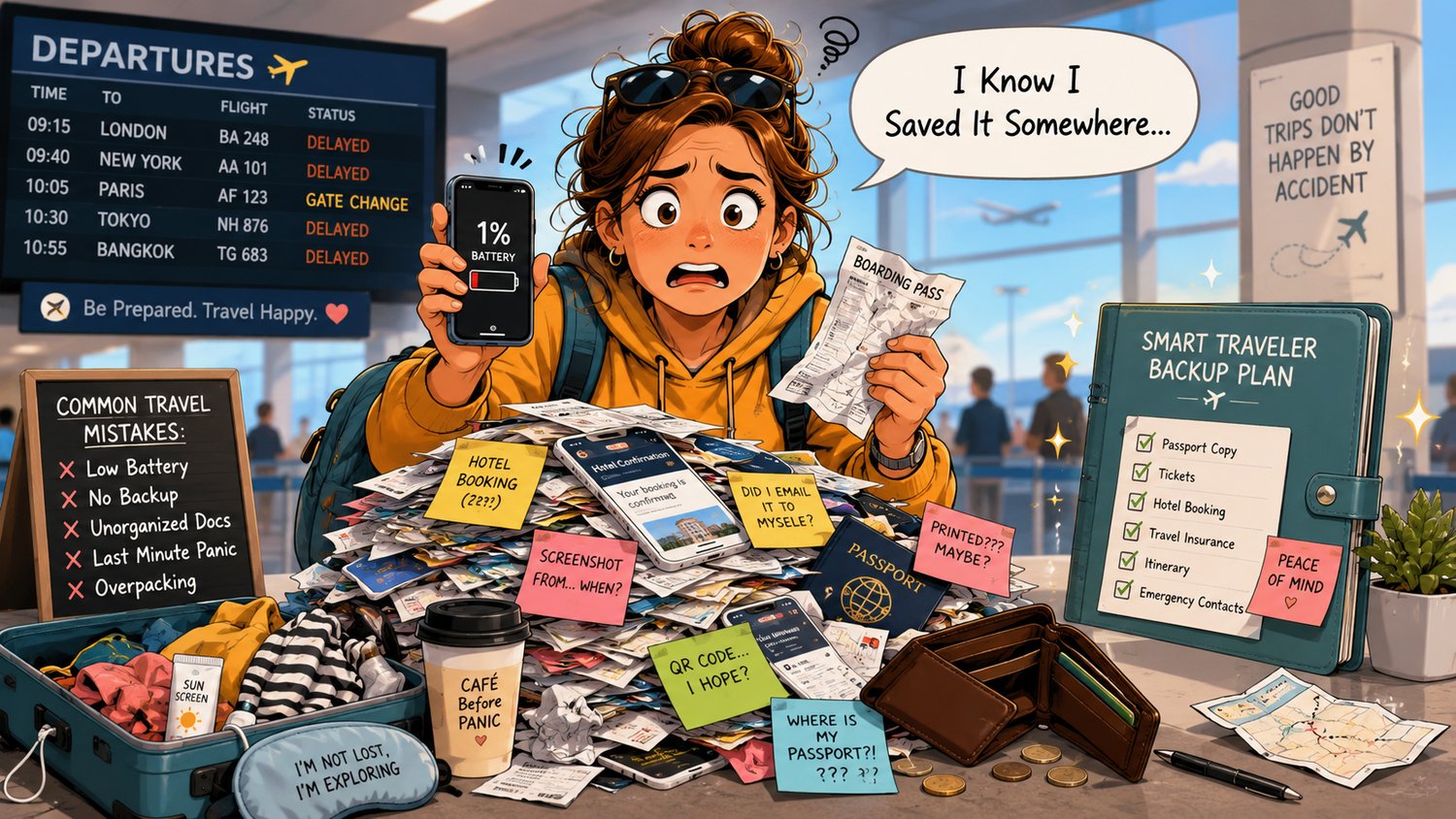
Simple, practical travel habits that help you avoid expensive mistakes, airport chaos, packing regret, and the kind of vacation stress nobody posts about on Instagram.
Travel is supposed to make you feel alive.
Not broke, late, sweaty, confused, hungry, and quietly fighting with a suitcase that suddenly feels like it was packed by a raccoon during a power cut.
But let’s be honest: most travel problems do not begin at the airport. They begin weeks earlier, when we assume everything will magically work itself out.
We book the cheapest flight without checking baggage fees.
We save hotel names in random screenshots.
We tell ourselves, “I’ll sort the itinerary later.”
We pack like we are moving abroad permanently, then still forget the one charger we actually need.
And then the trip arrives.
Suddenly your phone is dying, your taxi driver does not understand your hotel name, check-in is three hours away, your suitcase is overweight, and your “budget trip” has started behaving like a luxury hostage situation.
The good news?
You do not need to be a professional travel influencer, spreadsheet wizard, or airport ninja to travel smarter. You just need a few simple systems that save money, time, and mental energy.
Here are 17 smart travel tips that can help you enjoy the trip instead of surviving it.
1. Check the baggage rules before you book the “cheap” flight
Cheap flights are wonderful.
Until your bag gets involved.
Some budget airlines make the ticket look affordable, then charge extra for cabin bags, checked bags, seat selection, snacks, oxygen, emotional support, and possibly blinking too loudly.
Before booking, check exactly what is included.
Can you bring a carry-on?
Is a personal item included?
What are the weight limits?
How much does checked baggage cost?
Are airport baggage fees higher than online fees?
A flight that looks cheaper at first may become more expensive once you add the bags you actually need.
The smart move is simple: compare the total travel cost, not just the ticket price.
That means flight + bags + seat selection + airport transfer + arrival time convenience.
Because sometimes the “cheap” flight landing at midnight in a city two hours away from your hotel is not a bargain. It is a trap wearing sunglasses.
2. Build a real travel budget before you go
Most people budget for flights and accommodation.
Then they forget everything else.
Food.
Transport.
Attractions.
Tips.
Data roaming.
Souvenirs.
Emergency snacks.
That one “small coffee” at the airport that somehow costs the same as a family dinner.
A travel budget does not need to be complicated. You just need to know what your trip will realistically cost.
Break it down into simple categories:
Flights
Accommodation
Transport
Food
Activities
Shopping
Travel insurance
Emergency money
Extras and surprises
The goal is not to suck the joy out of your trip. The goal is to stop pretending money does not exist until your bank app starts sending you judgmental notifications.
A simple budget helps you decide where to spend and where to save.
Maybe you skip the overpriced tourist restaurant but splurge on the sunset boat tour.
Maybe you choose a cheaper hotel so you can book better experiences.
Maybe you realize that “just winging it” is not a financial plan. It is a cry for help with Wi-Fi.
3. Always check the full price, not the pretty price
Travel websites love showing you the most attractive number first.
Then you click.
Then fees appear.
Then taxes appear.
Then cleaning fees appear.
Then resort fees appear.
Then service fees appear.
Then your soul briefly leaves your body.
This happens with hotels, flights, vacation rentals, car rentals, tours, and even some booking platforms.
Before you fall in love with a deal, check the final checkout price.
Also look out for:
Cleaning fees
City taxes
Resort fees
Deposit requirements
Late check-in charges
Cancellation fees
Card payment fees
Insurance add-ons
Fuel charges for car rentals
This one habit can save serious money because it stops you from comparing fake prices.
The cheapest option is not always the cheapest option. Sometimes it is just the sneakiest.
4. Keep all your travel plans in one place
A trip becomes stressful fast when your information is scattered everywhere.
Your flight confirmation is in your email.
Your hotel address is in a screenshot.
Your transfer booking is in WhatsApp.
Your packing list is in your notes app.
Your budget is in your head, which is frankly a dangerous neighborhood.
Before you travel, gather everything in one place.
Your flights.
Accommodation details.
Check-in times.
Transport plans.
Emergency numbers.
Passport information.
Packing list.
Budget.
Daily itinerary.
Important addresses.
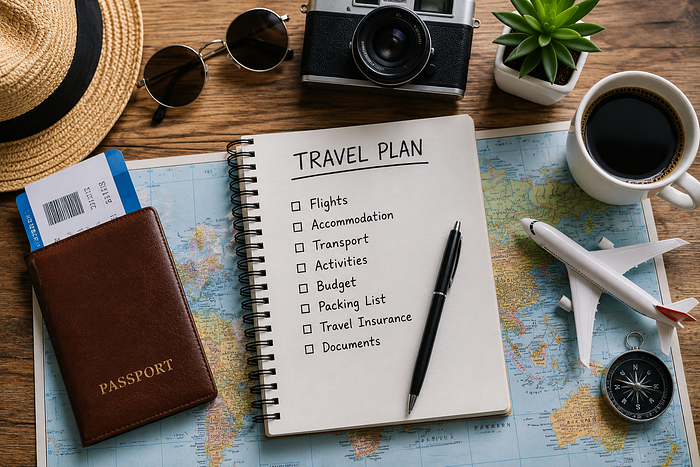
This can be a notebook, a spreadsheet, a printable planner, or a digital travel planner. The tool does not matter as much as the system.
The point is to stop relying on seventeen screenshots and blind optimism.
A ready-made travel planner can make this much easier because the structure is already done for you. You just fill in the blanks: flights, hotels, expenses, packing, itinerary, notes, and emergency details.
It is not about becoming overly organized. It is about giving future-you a fighting chance when current-you is standing in an airport queue with 12% battery.
5. Plan the first 24 hours properly
You do not need to plan every second of your trip.
But you absolutely should plan the first 24 hours.
That first day is when you are tired, slightly confused, carrying luggage, possibly hungry, and operating on airplane sleep, which is not real sleep. It is just unconscious discomfort.
Before you arrive, know:
How you will get from the airport to your hotel
What time you can check in
Where you can leave your bags if you arrive early
Where you can eat nearby
How to access local transport
What to do if your phone has no signal
The address of your accommodation in the local language, if needed
This one step removes so much stress.
Your first day should not feel like an escape room designed by a taxi company.
Give yourself an easy landing.
6. Do not overbook your itinerary
This is one of the biggest travel mistakes.
You get excited. You start researching. Suddenly every attraction seems essential.
So you build an itinerary that looks impressive on paper and insane in real life.
Museum at 9.
Walking tour at 11.
Famous market at 12:30.
Train to another area at 2.
Temple at 3.
Sunset viewpoint at 5.
Dinner reservation at 7.
Night market at 9.
Emotional collapse at 10:15.
Travel takes longer than expected. Always.
You will get lost. You will stop for coffee. You will want photos. Public transport will confuse you. Your feet will file a formal complaint.
A good itinerary has breathing room.
Choose one or two main things per day, then add optional extras nearby.
That way, if you have energy, great. If not, you still had a successful day.
Remember: you are not trying to complete a country like a video game.
7. Pack by outfit, not by panic
Panic packing is how you end up with four jackets, three “maybe” outfits, two pairs of uncomfortable shoes, and no toothbrush.
Instead of throwing random clothes into your suitcase, pack by outfit.
Think about your actual days.
Airport outfit
Walking day outfit
Dinner outfit
Beach outfit
Cold weather layer
Comfortable travel clothes
Sleepwear
Backup outfit
Then check if items can be mixed and matched.
Neutral basics are your friend. Comfortable shoes are your best friend. That dramatic outfit you pack “just in case” is usually dead weight unless you actually have a plan to wear it.
Also, always pack one emergency outfit in your carry-on if you are checking luggage.
Lost luggage is not common enough to fear constantly, but it is common enough to prepare for. And nobody wants to spend day one of a dream trip wearing yesterday’s airport clothes while pretending everything is fine.
8. Use a packing checklist every single time
Do not trust your brain.
Your brain is busy imagining sunsets and hotel breakfasts. It does not care about plug adapters.
A packing checklist saves you from forgetting small but important things:
Phone charger
Power bank
Travel adapter
Medication
Toiletries
Passport
Travel insurance details
Comfortable shoes
Sunglasses
Basic first aid
Copies of documents
Swimwear
Weather-appropriate layers
The funny thing about packing is that you usually remember the big things.
You rarely forget pants.
But you absolutely might forget the tiny thing that ruins your morning, like contact lens solution, a phone cable, or the medication you cannot casually replace in another country.
Use a checklist. Every trip. Even short ones.
Especially short ones, actually, because that is when people get cocky.
9. Research transport before you arrive
Airport transport can either be smooth and simple or wildly expensive and confusing.
Before you land, know your options.
Is there a train from the airport?
Is there a reliable bus?
Are taxis safe and regulated?
Does the city use ride-hailing apps?
Do you need cash?
Is there a transport card worth buying?
How much should the journey cost?
This can save you money and stress immediately.
Nothing says “fresh tourist” like standing outside arrivals with luggage, no plan, and the facial expression of someone who has just realized the airport is nowhere near the city.
A little transport research also helps during the trip. You will know whether to use metro passes, walking routes, local buses, taxis, rental cars, ferries, or trains.
Transport is one of the easiest places to overspend when you are unprepared.
10. Save offline maps before you leave
Do this before every trip.
Download offline maps for the area you are visiting. Save your hotel, airport, key attractions, restaurants, train stations, and meeting points.
Why?
Because data fails. Batteries die. Wi-Fi disappears. Roaming acts weird. And sometimes your phone decides to become a decorative rectangle at the exact worst moment.
Offline maps can help you:
Navigate without internet
Find your hotel
Check walking routes
Avoid looking completely lost
Save mobile data
Feel less panicked in unfamiliar places
Also take screenshots of key addresses and booking details.
Yes, screenshots are not a full travel system, but they are useful as backups.
The goal is simple: never let your entire trip depend on one internet connection and a hopeful attitude.
11. Keep emergency money separate
Do not keep all your money and cards in one place.
That is not travel. That is gambling with scenery.
Keep a backup bank card and some emergency cash separate from your wallet. You can store it in a hidden pouch, a different bag, or your hotel safe if appropriate.
If your wallet is lost, stolen, or eaten by the mysterious black hole that lives inside travel backpacks, you still have options.
Also consider:
Having a small amount of local cash
Knowing your bank’s international contact number
Using cards with low foreign transaction fees
Notifying your bank before travel if needed
Keeping emergency funds accessible
You do not need to travel in fear. Just travel like someone who understands that pockets are not legally binding security systems.
12. Watch out for roaming and data costs
Phone costs can sneak up on travelers.
One minute you are checking directions. The next, your mobile provider is charging you like you personally streamed a movie to the moon.
Before your trip, check your roaming options.
You may be better off using:
A local SIM card
An eSIM
A travel data package
Hotel Wi-Fi
Offline maps
Messaging apps over Wi-Fi
Also turn off automatic updates and background data if roaming is expensive.
Nothing ruins a travel budget quite like discovering your phone spent money without asking you.
Your apps do not need to update themselves internationally like they are on a luxury retreat.
13. Eat smart without ruining the fun
Food is one of the best parts of travel.
It is also one of the easiest ways to accidentally destroy your budget.
You do not need to eat cheap noodles in your hotel room while staring sadly at a wall. But you also do not need to eat every meal in the most tourist-heavy square in the city.
Try this:
Eat breakfast from a bakery or grocery store sometimes
Choose local spots away from major attractions
Check menus before sitting down
Ask locals where they eat
Have one special food experience planned
Keep snacks in your bag
Avoid getting so hungry you make expensive decisions
Hunger makes bad travel choices.
Hungry-you will pay anything for food. Hungry-you believes airport sandwiches are reasonable. Hungry-you cannot be trusted.
A simple food plan keeps you comfortable and helps you spend where it actually matters.
14. Leave space in your luggage
Most people pack their suitcase full before the trip.
Then they buy things.
Then they sit on the suitcase like they are trying to defeat it in combat.
Leave space.
Even if you do not plan to shop, you might pick up gifts, souvenirs, snacks, clothes, books, local products, or one weird item that makes perfect sense on vacation and no sense at home.
Leaving space also makes your travel days easier.
You can pack faster.
Your clothes are less crushed.
You avoid overweight baggage fees.
You do not have to perform suitcase wrestling in front of hotel staff.
A half-organized suitcase is peaceful.
A suitcase filled to the point of danger is a portable nervous breakdown.
15. Read recent reviews, not just pretty descriptions
Photos lie.
Descriptions exaggerate.
Reviews tell you things the listing forgot to mention.
Before booking accommodation, tours, restaurants, or transport, read recent reviews. Not just the five-star ones. Read the three-star reviews too, because those people usually sound tired but fair.
Look for patterns.
Is the hotel noisy?
Is the area unsafe at night?
Is the Wi-Fi terrible?
Are rooms smaller than expected?
Is the tour rushed?
Are there hidden costs?
Is the location actually convenient?
One bad review does not mean disaster. Some people complain because the ocean was “too wet.”
But repeated complaints are useful.
If ten people mention the same issue, believe them.
16. Plan for things to go wrong
This sounds negative, but it is actually freeing.
Things go wrong during travel.
Flights get delayed.
Rain happens.
Museums close.
Shoes hurt.
Restaurants are full.
Trains are confusing.
People get tired.
Phones die.
Plans change.
A smart traveler does not expect perfection. A smart traveler builds flexibility.
Have backup options.
A rainy day activity.
A second restaurant choice.
An emergency transport plan.
Extra time between connections.
Copies of important documents.
A small first-aid kit.
Travel insurance.
A relaxed attitude when the plan changes.
Some of the best travel moments happen when the original plan falls apart.
But only if the basics are handled.
There is a big difference between “spontaneous adventure” and “we have no idea where we are sleeping tonight.”
17. Give yourself permission to rest
This might be the most underrated travel tip of all.
You do not have to see everything.
You do not have to photograph every landmark.
You do not have to wake up at sunrise every day.
You do not have to turn your trip into proof that you used every minute productively.
Rest is part of travel.
Sit at a café.
Walk slowly.
Take a nap.
Spend an hour people-watching.
Have a lazy morning.
Go back to the hotel before you become a public safety concern.
A trip should give you memories, not just a schedule.
You are allowed to enjoy the place you came all this way to visit.
Sometimes the smartest travel move is not booking another activity. It is sitting down, breathing, and realizing you are actually there.
Final Thoughts: Travel Smarter, Not Harder
Travel does not have to be perfect to be amazing.
In fact, it never will be perfect.
There will always be a delayed flight, a strange bathroom, a confusing train platform, a meal that looked better in the photo, or a moment where you ask yourself why your suitcase suddenly weighs as much as a small piano.
But smart planning makes the chaos manageable.
When your budget is clear, your documents are saved, your first day is planned, your packing list is ready, and your itinerary has breathing room, travel becomes much easier to enjoy.
You spend less time panicking and more time actually experiencing the trip.
That is the whole point.
Not to travel like a machine.
But to travel like a human who would prefer not to cry near airport security.
So before your next trip, take a little time to get organized. Use a checklist. Build a simple budget. Keep your bookings together. Plan the first 24 hours. Leave space for surprises.
Your future travel self will thank you.
Probably while eating something delicious, wearing comfortable shoes, and not desperately searching for a charger.

Comments ()