


Travel planning usually starts beautifully.
You imagine the beach, the food, the hotel balcony, the old streets, the markets, the sunsets, the “I’m never coming home” moment, and the very dramatic airport coffee you’ll buy even though it costs more than a small appliance.
You plan the outfits.
You save the restaurants.
You watch the videos.
You screenshot the views.
You tell yourself you are going to pack light this time, which is adorable.
But here’s the travel truth most people only learn the hard way:
The fun part of travel gets all the attention.
The boring part is what saves the trip.
Because if everything goes right, you’ll barely notice your backup plan. But if something goes wrong, lost passport, dead phone, missed booking, stolen wallet, medical issue, airport confusion, hotel address missing , suddenly the “boring stuff” becomes the most important thing you packed.
And no, “I know I saved it somewhere” is not a travel strategy.
It is the opening scene of a panic documentary.
The Problem With Modern Travel Planning
Today, most of us don’t really “organize” our travel information. We scatter it across our digital life like confetti.
Your flight confirmation is in your email.
Your hotel address is in a screenshot.
Your airport transfer is in WhatsApp.
Your travel insurance PDF is somewhere in your downloads folder.
Your passport copy might be in your cloud storage, unless that was the old passport, or maybe your partner has it, or maybe it was on the phone you upgraded two years ago.
Then the trip begins and suddenly your entire vacation depends on battery percentage, Wi-Fi signal, and your ability to remember which app has the thing you need.
That works fine until it doesn’t.
Your phone dies.
The hotel asks for a booking reference.
Your bag goes missing.
Your wallet disappears.
You need your insurance number.
You have to fill in an emergency form.
You need a passport copy.
You need your accommodation address but the internet is acting like it has taken a personal day.
That is when organized travelers become calm travelers.
Everyone else starts sweating through their airport outfit.
The Travel Backup Plan Nobody Talks About
A travel backup plan is not about being negative. It’s not about expecting disaster. It’s about giving yourself options.
It is the travel version of carrying a spare charger, checking the weather, or bringing comfortable shoes even though the cute shoes were clearly trying their best.
A good travel backup plan answers simple but important questions:
Where are my important documents?
Who do I contact if something goes wrong?
What is my travel insurance number?
Where am I staying tonight?
What do I do if my passport is lost?
Do I have copies of my bookings?
Can I access my information without internet?
Can someone help me if my phone is gone, dead, or locked?
None of this sounds glamorous.
But neither is crying next to a charging station at an airport while trying to log into an email account you haven’t used since 2017.
What Every Traveler Should Organize Before Leaving
You do not need to create a military-grade travel operations center. You just need the important information in one place.
Here’s what belongs in your travel backup plan.
Passport, ID, and Visa Information
Your passport is the king of the travel documents. Everything else is basically part of the royal court.
Before you leave, make sure you have:
Your passport details
A copy of your passport photo page
Visa information, if needed
Driver’s license or international driving permit details
National ID details, if relevant
A note of where the originals are packed
A backup copy stored securely online
The goal is not to walk around with your passport number tattooed on your arm. The goal is to make sure that if your passport is lost or stolen, you are not starting from zero.
A copy will not magically replace your passport, but it can make the replacement process easier and faster.
Also, double-check expiry dates early. Passport expiry dates love to sit quietly in the background and then ruin your life dramatically three days before departure.
Booking Confirmations
Your bookings are the bones of your trip.
Flights, hotels, transfers, trains, ferries, tours, rental cars, attraction tickets, restaurant reservations — all of these should be listed somewhere easy to find.
Not just “somewhere in my inbox.”
A proper booking tracker should include:
Date
Time
Booking name
Reference number
Company name
Address or meeting point
Contact number
Payment status
Cancellation notes
Important instructions
This is especially useful when you’re tired, jet-lagged, hungry, and trying to explain to a taxi driver where you’re going while your brain is still somewhere over the Atlantic.
Travel Insurance Details
Travel insurance is one of those things people buy, file away, and immediately forget exists.
Until they need it.
Keep these details handy:
Insurance provider
Policy number
Emergency assistance number
Claim contact details
Medical coverage notes
Trip cancellation coverage
Lost luggage information
Important exclusions
How to make a claim
This is not the section you want to search for while stressed, sick, or standing at an airline counter trying to understand what “delayed indefinitely” means.
Also, make sure someone at home knows where your insurance information is. Future-you may be very grateful.
Emergency Contacts
Your emergency contact list should include more than just “Mom” and “that one friend who answers calls.”
Add:
Main emergency contact
Secondary emergency contact
Travel companions
Accommodation contact
Local host or tour operator
Doctor or medical contact
Bank card emergency numbers
Travel insurance emergency number
Embassy or consulate details
If you’re traveling with family, especially children, this becomes even more important.
The boring little contact page can become incredibly useful when you least expect it.
Medical and Medication Information
You don’t need to publish your medical history like a dramatic memoir, but you should have key details written down.
Include:
Medications
Dosage instructions
Allergies
Medical conditions
Doctor contact details
Pharmacy notes
Prescription copies, if needed
Emergency medical notes
This matters even more if you travel internationally, take prescription medication, have allergies, or are traveling with someone who may need assistance.
And yes, “I’ll remember everything” sounds confident until you’re stressed, tired, and trying to pronounce a medication name in another country.
Write it down.
Accommodation Details
This sounds obvious, but many travelers don’t have their accommodation information easily available offline.
Keep a simple list of:
Hotel or rental name
Address
Phone number
Check-in time
Booking reference
Host contact
Directions or transport notes
Backup accommodation notes
You may need this for airport forms, taxi drivers, immigration, late-night check-in, or that special travel moment when your phone decides now is the perfect time to have 2% battery.
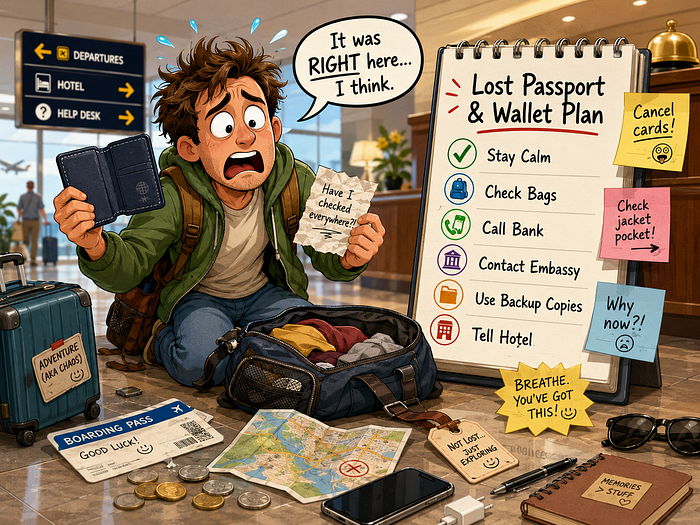
Lost Passport and Lost Wallet Plan
Nobody wants to think about losing a passport or wallet.
Unfortunately, passports and wallets do not care about your emotional boundaries.
You should know the basic steps before something happens:
Stay calm
Check your bags and recent locations properly
Report theft or loss if required
Contact your accommodation
Contact your embassy or consulate
Contact your bank to block cards
Contact travel insurance
Use your backup copies
Write down important case or reference numbers
The goal is not to memorize an emergency manual. The goal is to have a simple action plan so you don’t waste the first hour panicking in circles.
Panic is understandable.
But organized panic is better.
Offline Access
This is where many travelers get caught.
They have everything saved, but only online.
That’s fine until there’s no signal, no Wi-Fi, no battery, no roaming, or the airport internet wants you to create an account, verify your email, solve a puzzle, and sacrifice your last piece of patience.
Before you travel, save offline copies of:
Flight bookings
Hotel bookings
Travel insurance
Passport copy
Emergency contacts
Transport details
Important addresses
Tour confirmations
Medical notes
Keep one copy on your phone, one in secure cloud storage, and one printed copy of the most important pages.
Printed backups may feel old-fashioned, but so does being stranded without information.
A Phone Lock Screen Emergency Note
This one is simple but clever.
Create a temporary travel lock screen with basic emergency information, such as:
“If found, please contact…”
Emergency contact number
Hotel name
Travel companion contact
Insurance emergency number
Do not put highly sensitive information directly on your lock screen, but a simple contact note can help if your phone is lost or you are separated from your group.
It is one of those tiny things that can make a surprisingly big difference.
A Wallet Emergency Card
A small printed card in your wallet, passport holder, or day bag can be incredibly useful.
It can include:
Emergency contact
Accommodation name
Travel insurance number
Allergy note
Medical alert
Secondary contact
Basic destination address
Again, keep it practical and safe. You don’t need your entire life story on a card. Just enough information to help in a problem.
The 15-Minute Travel Backup Plan
If this sounds like a lot, don’t worry. You can start with a very simple version.
Set a timer for 15 minutes and collect the following:
Passport copy
Flight confirmation
Hotel details
Travel insurance policy number
Emergency contact list
Medical notes, if needed
Booking references
Embassy or consulate contact
Bank emergency numbers
Offline copies on your phone
That alone puts you ahead of a shocking number of travelers.
You don’t need perfection. You need access.
A beautiful itinerary is wonderful. But when something goes wrong, access to the right information matters more than whether your travel notes are aesthetically pleasing.
Though, to be fair, it’s nice when they are both useful and pretty.
Why This Matters Even More for International Travel
International travel adds more moving parts.
Different languages.
Different emergency numbers.
Different transport systems.
Different medical systems.
Different document rules.
Different time zones.
Different “why is this form asking me for that?” moments.
You may be completely fine, and most trips go smoothly. But when you are far from home, small problems feel bigger.
A missing booking confirmation at home is annoying.
A missing booking confirmation in a foreign country at midnight is a spiritual test.
Having your travel details organized gives you confidence. It also helps family members, travel companions, or emergency services if they need to assist you.
It is not dramatic. It is responsible.
Responsible, but with better snacks and nicer views.
The Best Travel Planning System Has Three Parts
A strong travel system is not just one thing. It has three layers.
1. The Itinerary
This is the plan.
Where you’re going, what you’re doing, how much it costs, where you’re staying, what you’re eating, and how you’re getting around.
This is your practical roadmap.
2. The Journal
This is the memory keeper.
The moments, the meals, the funny stories, the views, the little details, the people, the lessons, the “I never want to forget this” parts.
This is your emotional souvenir.
3. The Travel Vault
This is the backup plan.
Documents, emergency info, insurance, bookings, medical notes, copies, contacts, lost passport steps, and safety details.
This is the part you hope you don’t need urgently, but you’ll be very glad to have if you do.
Together, these three pieces make travel feel calmer, smarter, and more organized.
Plan the trip.
Enjoy the trip.
Protect the trip.
That’s the real system.
A Quick Word About Travel Anxiety
Some people love travel planning. Some people feel like every trip comes with a side order of anxiety.
Both are normal.
Travel has a lot of moving parts, and your brain knows it. That’s why organizing important information can be so calming. It turns vague worry into clear action.
Instead of thinking, “What if something goes wrong?” you can say, “If something goes wrong, I know where my information is.”
That doesn’t remove every possible problem. Nothing does.
But it gives you a safety net.
And sometimes peace of mind is the most underrated thing you can pack.
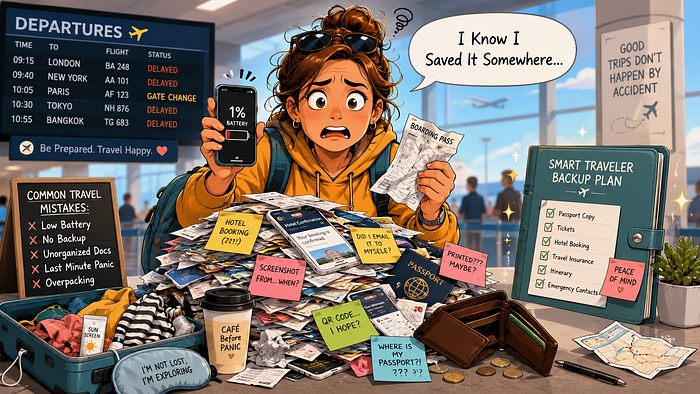
Common Travel Mistakes This Helps Avoid
Here are a few travel problems that become easier when you have a backup plan:
Forgetting where you saved a booking confirmation
Not knowing your travel insurance number
Having no offline copy of your hotel address
Losing access to your email
Running out of phone battery at the worst time
Not knowing who to contact in an emergency
Forgetting medication details
Misplacing passport copies
Not having bank card emergency numbers
Not knowing your embassy or consulate details
Depending entirely on screenshots
Depending entirely on one person in the group
That last one is important.
Every group trip has one person who becomes the unofficial travel admin. They have the bookings, the times, the tickets, the restaurant names, the transport details, and the emotional burden of everyone asking, “What are we doing next?”
Give that person a break.
Organize the trip properly.
Your Pre-Travel Backup Checklist
Before you leave, make sure you have:
A passport copy
Visa details, if needed
Travel insurance details
Emergency contacts
Accommodation addresses
Flight and transport confirmations
Tour and activity booking references
Medical and medication notes
Bank emergency numbers
Embassy or consulate info
Offline copies saved to your phone
Cloud backups saved securely
A printed copy of key information
A wallet emergency card
A simple lost document action plan
This may sound like a lot, but once you create the system, it becomes quick.
And after one trip using it, you’ll probably wonder why you ever traveled without it.
The Soft Little Sales Pitch, Because This Is Actually Useful
This is exactly why I created the Passport & Pages Travel Vault.
It’s a printable and digital travel document organizer designed to keep your emergency contacts, travel insurance details, bookings, document notes, medical information, lost passport plan, wallet emergency card, and trip safety checklist in one organized place.
It is not the glamorous part of travel.
It will not make your hotel room nicer, your plane seat wider, or your airport coffee cheaper. Sadly, no printable can do that.
But it can make your trip feel calmer, safer, and better organized.
And if something goes wrong, it may become the most useful thing you brought with you.
Final Thought
Travel should feel exciting, not chaotic.
Of course, some chaos is part of the adventure. You may get lost in a beautiful street, order something you can’t pronounce, take the wrong exit, or discover that your “short walk” is actually a mountain audition.
That’s fine.
That’s travel.
But lost documents, missing bookings, emergency confusion, dead phones, and inaccessible information? That’s the kind of chaos you can prepare for.
So plan the fun part.
Choose the destination. Save the restaurants. Build the itinerary. Pack the outfits. Dream about the views.
But also build the backup plan.
Because the best travelers are not the ones who expect everything to go wrong.
They are the ones who know what to do if it does.
Plan the trip. Enjoy the trip. Protect the trip.
Comments ()