
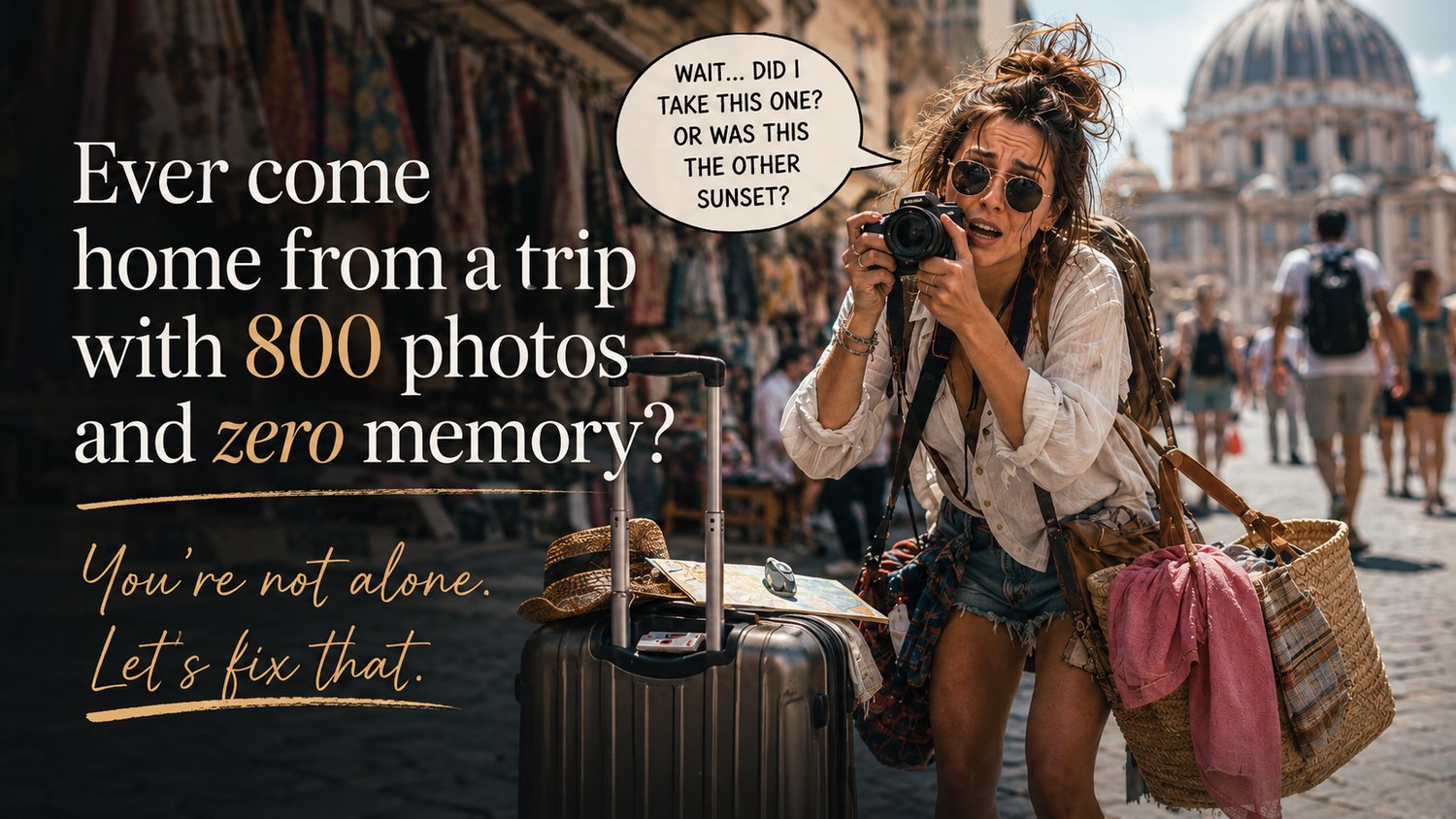
There is a strange little sadness that happens after a holiday.
Nobody talks about it properly.
You spend weeks planning the trip.
You check flights. You check hotels. You check the weather as if your staring at the forecast will personally intimidate the clouds into behaving.
You pack.
You repack.
You remove three shirts because you are “travelling light now.”
Then you add them back because apparently you need wardrobe options for a beach, a market, a dinner, a walk, a dramatic balcony moment, and the possibility of becoming a completely different person overseas.
Then the holiday finally happens.
You eat food you cannot pronounce.
You take photos of the hotel room before anyone puts a suitcase on the bed.
You photograph the view.
You photograph the coffee.
You photograph the street.
You photograph the food.
You photograph the food again because the first angle did not fully explain your emotional relationship with the prawns.
You take sunset photos as if the sun has never done this before.
And then, somehow, it is over.
You come home.
The suitcase lands on the floor like a defeated animal.
There is sand in places sand had no legal right to enter.
The fridge is empty.
The laundry is judging you.
Your bank account is quietly asking for privacy.
And the day after your holiday, you open your phone and realize something terrible.
You have hundreds of photos.
But the trip already feels messy.
Not gone exactly.
Just scattered.
A beach here.
A meal there.
A hotel room.
A random street.
A blurry laugh.
A sunset.
Another sunset.
A sunset that looks suspiciously like the previous sunset but apparently needed its own moment.
And somewhere inside that pile is the actual story of your holiday.
The problem is that the story is trapped inside your camera roll, being held hostage between screenshots, WhatsApp downloads, receipts, memes, and that one photo of your parking spot at the airport.
The Day After the Holiday Feeling
The day after a trip is weird.
Yesterday you were walking somewhere beautiful, eating something delicious, or watching the evening light hit a place you may never see again.
Today you are back home wondering why there is one sock in your hand luggage and why your charger smells faintly like hotel carpet.
People ask, “How was the trip?”
And suddenly your brain becomes useless.
You say things like:
“It was amazing.”
“So beautiful.”
“The food was great.”
“We did so much.”
Which is true, but also completely useless.
Because that does not capture it.
It does not capture the tiny café you found by accident.
It does not capture the hotel view.
It does not capture the meal you still keep thinking about.
It does not capture the funny moment when someone got lost, blamed the map, and then somehow blamed everyone else too.
It does not capture the one quiet morning that was not planned but became one of the best parts of the trip.
You spent real money on that holiday.
Flights are not free.
Hotels are not free.
Meals are not free.
Tours, taxis, snacks, sunscreen, airport water, suspiciously expensive sweets, and that one “small souvenir” that somehow required bubble wrap — none of it is free.
So after spending all that money, time, and energy, the memory deserves better than being buried under 734 random photos.
A holiday should not just be something you survive, post, and forget.
It should become something you can return to.
A Holiday Should Feel Like a Story
A good trip has chapters.
The arrival.
The hotel.
The first proper meal.
The place that surprised you.
The thing that disappointed you but became funny later.
The best view.
The food you would eat again immediately.
The street you wandered down by mistake.
The photo that still feels warm.
The moment you wish you could step back into.
That is what makes a trip matter.
Not just the photos.
The story around the photos.
Because a picture can show you what something looked like, but it does not always remind you how it felt.
That is why travel memories need a little structure.
Not a school assignment.
Not a boring travel report.
Not a “Dear Diary, today we walked 11,423 steps and drank water” situation.
Just enough structure to catch the day before it disappears.
Passport Pages Presents: The Digital Travel Memory Book
Wouldn’t it be nice if there was a simple way to open your trip, add the details, choose the photos that matter, and build the story while the memories are still fresh?
That is where the Passport Pages Digital Travel Memory Book comes in.
It is a browser-based digital travel memory book builder designed to help turn a trip into something you can keep, revisit, and share.
No printing.
No scrapbook mess.
No complicated app install.
Just open it, start your trip, add your memories, save your backup file, and build the story day by day.
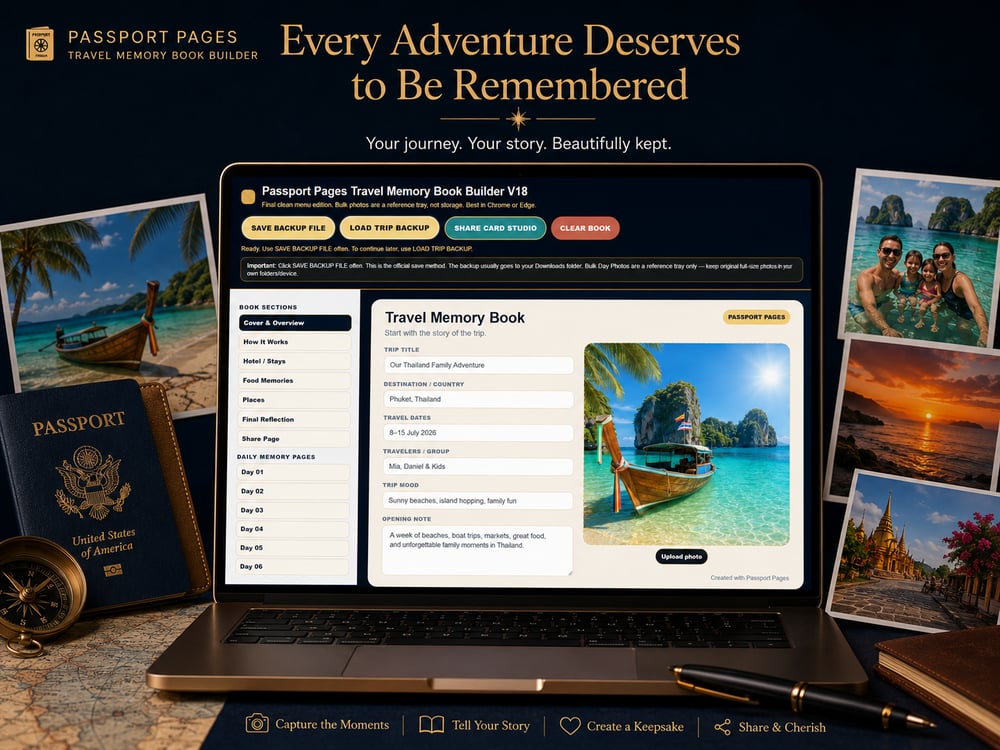
This is where the trip gets its identity.
Trip title.
Destination.
Dates.
Travelers.
Mood.
Opening note.
Cover photo.
In other words: this was not just “some photos from Thailand” or “that Greece folder I’ll sort out one day.”
This was a trip.
It had a name.
It had a beginning.
It had a feeling.
And now it has a place to live.
The Hotel Counts Too
People always remember the big landmarks, but the hotel is often where the trip actually starts to feel real.
The first time you open the curtains.
The room view.
The balcony.
The bed after a long travel day.
The breakfast.
The pool.
The lobby.
The “this looked bigger online” moment.
The place you stayed becomes part of the memory whether you planned it or not.
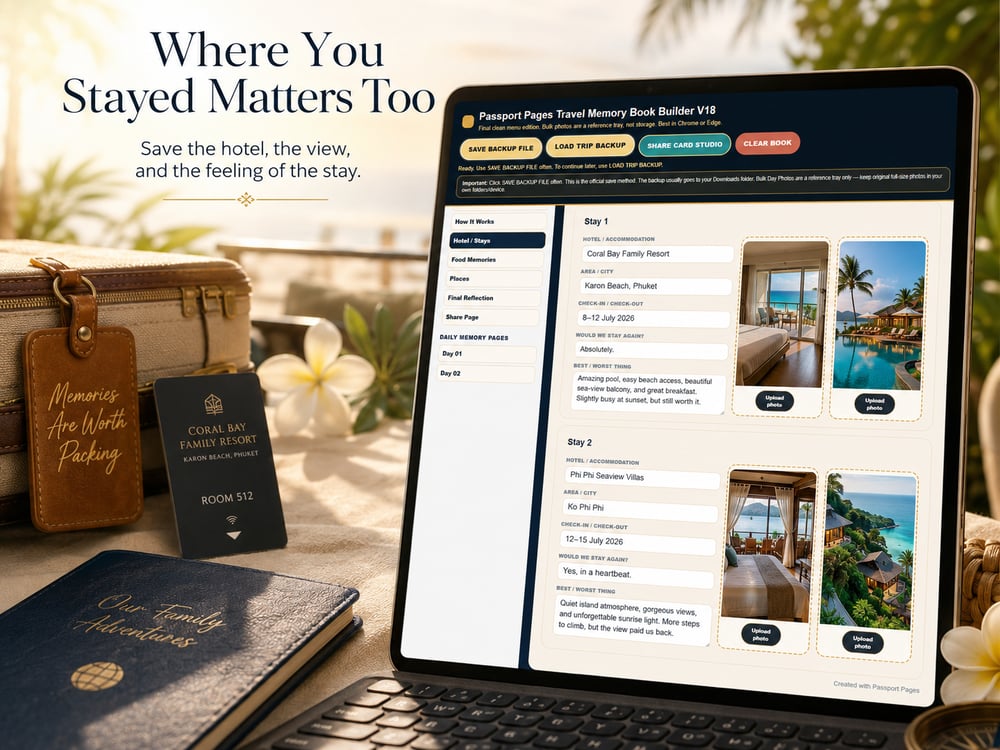
That is why it makes sense to record it.
Not because anyone wants to write a hotel inspection report.
Because five years later, you may not remember the exact name of the place, but you will remember the view, the room, the area, and whether you would go back.
And if the hotel was terrible, that also deserves a place in history.
Some memories are beautiful.
Some are warnings.
Both are useful.
Four Photos Can Save a Day
Modern travel has a photo problem.
We do not take photos anymore.
We launch a full documentary production.
One beach becomes 46 photos.
One meal becomes a food magazine shoot.
One sunset becomes a spiritual emergency.
And then later, when we want to remember the day, we have to scroll through all of it like an unpaid museum curator.
That is why the 4 hero photo idea works so well.
Pick the four photos that tell the day best.
The view.
The food.
The people or moment.
The favorite memory.
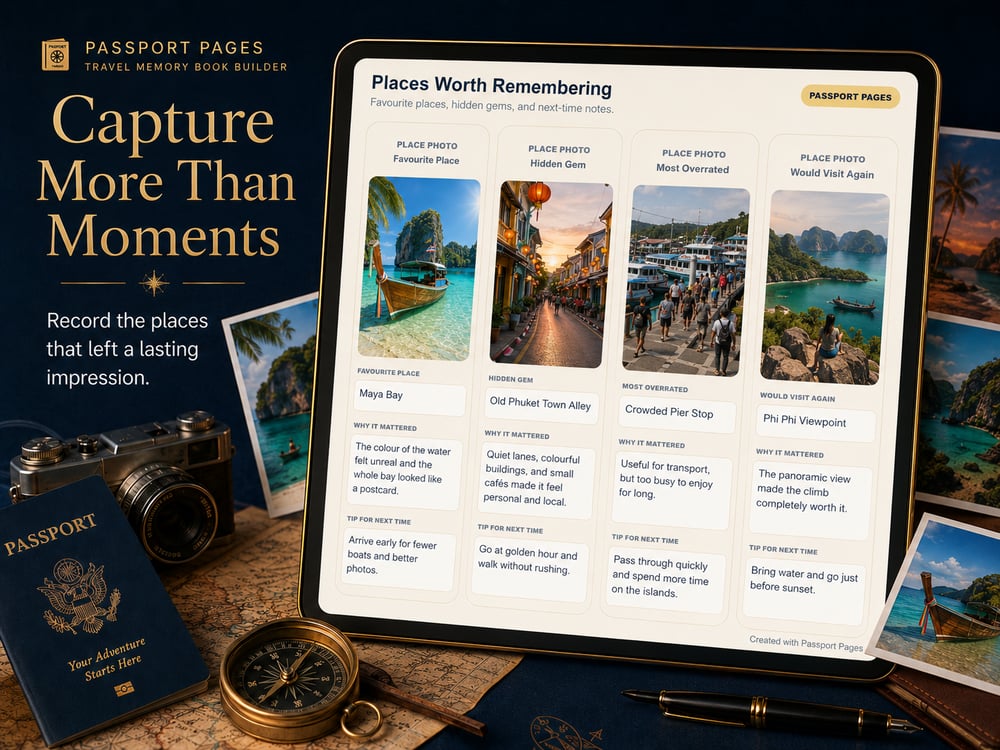
That is enough to bring the day back.
You do not need every single angle of the boat.
You need the photo that makes you feel the boat again.
You do not need thirteen pictures of lunch.
You need the one that makes you remember the taste, the place, and who was sitting across from you.
This is how the memory stops being chaos and starts becoming a story.
The Bulk Tray Is for the Chaos
Of course, nobody comes back from a travel day with only four photos.
Let us not pretend we are emotionally stable.
We take the extra photos.
We take the backup photos.
We take the “just in case” photos.
We take the photo before the food is touched, after the food is touched, and sometimes while someone is chewing because apparently dignity goes on holiday too.
So the builder has a bulk photo tray.
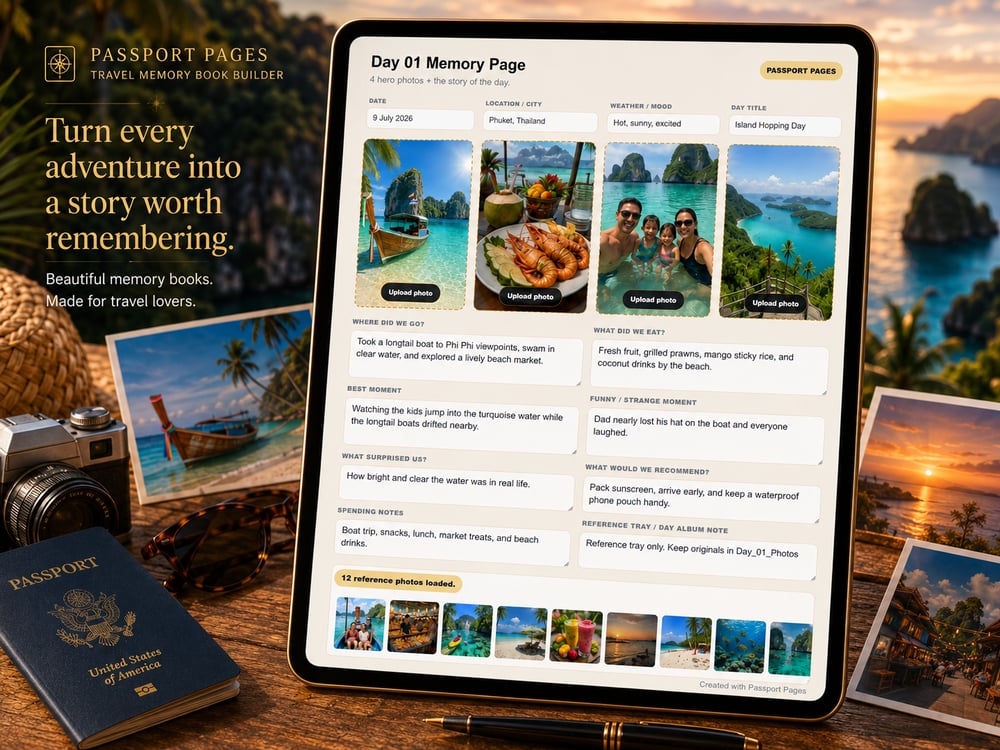
This is not the memory book itself.
This is the sorting table.
Drop the day’s photo chaos there, look through it, choose the best ones, and send them into the hero slots.
That is the difference between organizing your memories and pretending your camera roll is a personality.
Food Deserves Its Own Shrine
Some travel memories are not views.
They are meals.
That one breakfast.
That one seafood plate.
That one street snack that looked suspicious but became the best thing you ate all week.
That drink on the beach.
That dessert you still think about like a lost romance.
Food is one of the fastest ways a holiday comes back to life.
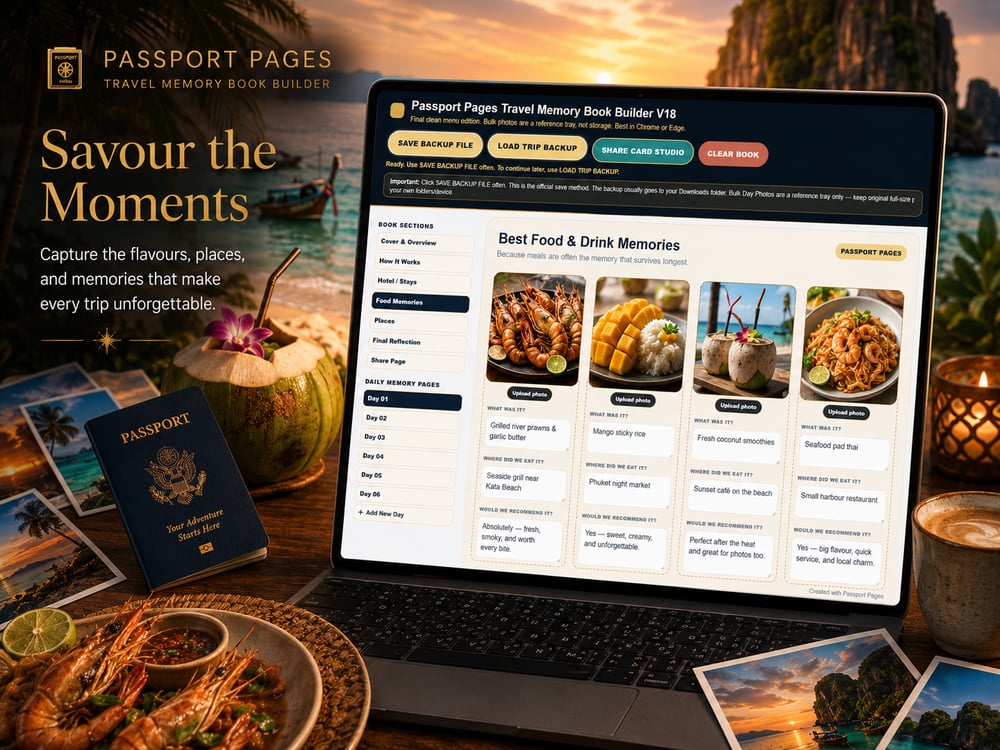
You may forget the exact street.
You may forget the name of the restaurant.
But you will remember the meal.
And if you write it down with the photo, the whole day comes back faster.
That is why food memories deserve their own space.
Not because we are dramatic.
Because food is memory with sauce.
Some Places Deserve More Than a Pin Drop
Every trip has places that stay with you.
The favorite place.
The hidden gem.
The place you would visit again.
The place everyone hyped up that was, let us be honest, not worth the emotional build-up.
The place you found by accident.
The place you wish you had spent more time in.
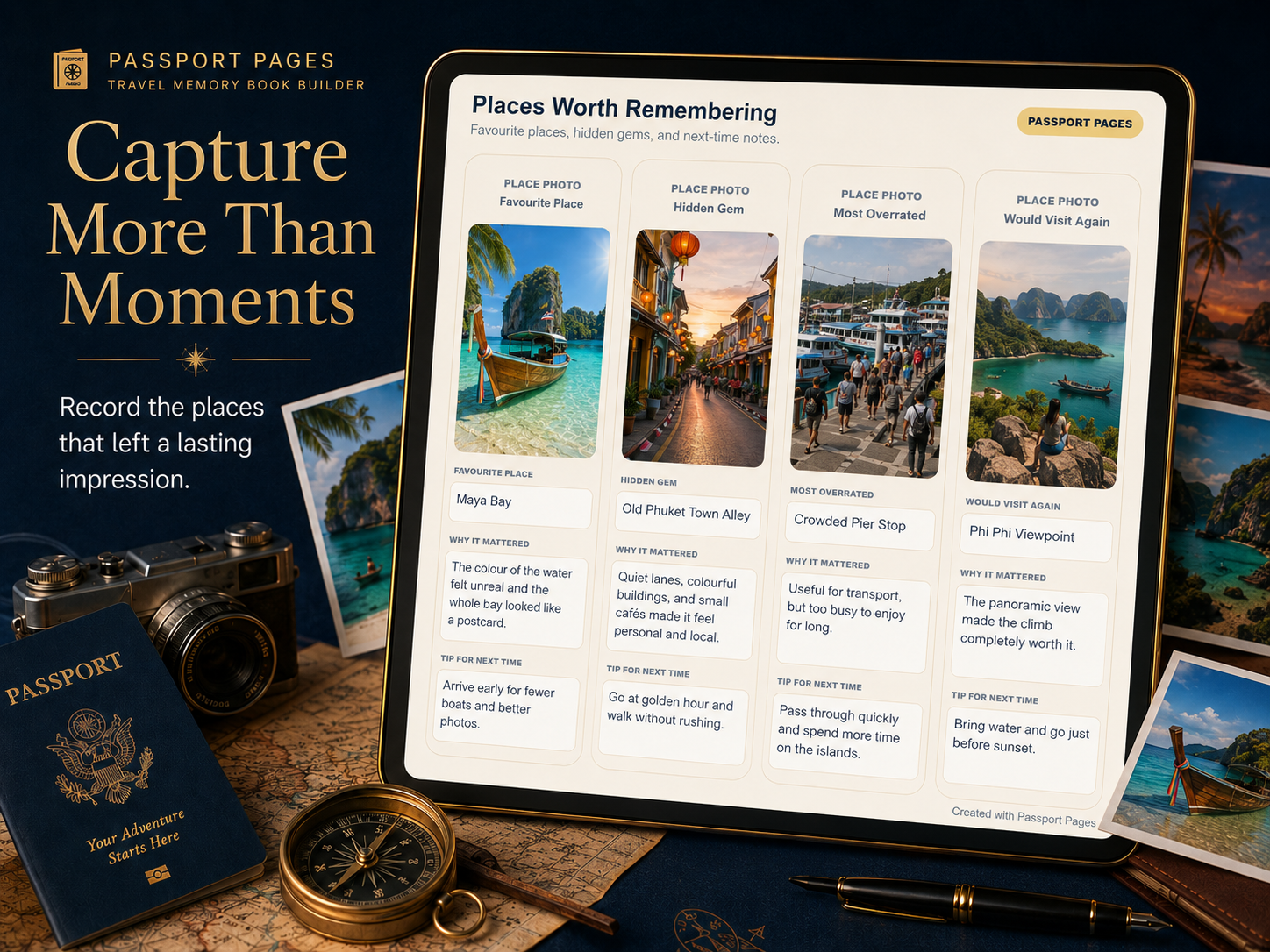
This is where the trip becomes personal.
Not just where you went.
What mattered.
What surprised you.
What you would recommend.
What you would skip next time.
Because travel advice from your own past self is underrated.
Future you deserves better than, “I think that was the nice beach? Or maybe the other beach? Wait, was that before or after the prawns?”
Finish the Trip Properly
Most people finish a holiday badly.
Not the actual trip.
The memory of it.
They come home, dump the suitcase, upload a few photos, maybe post one caption, and then the rest of the trip gets swallowed by ordinary life.
Emails return.
Laundry returns.
Bills return.
Someone asks what is for dinner.
And suddenly your beautiful trip is fighting for attention against a grocery list.
The final reflection matters because it catches the whole thing before it fades.
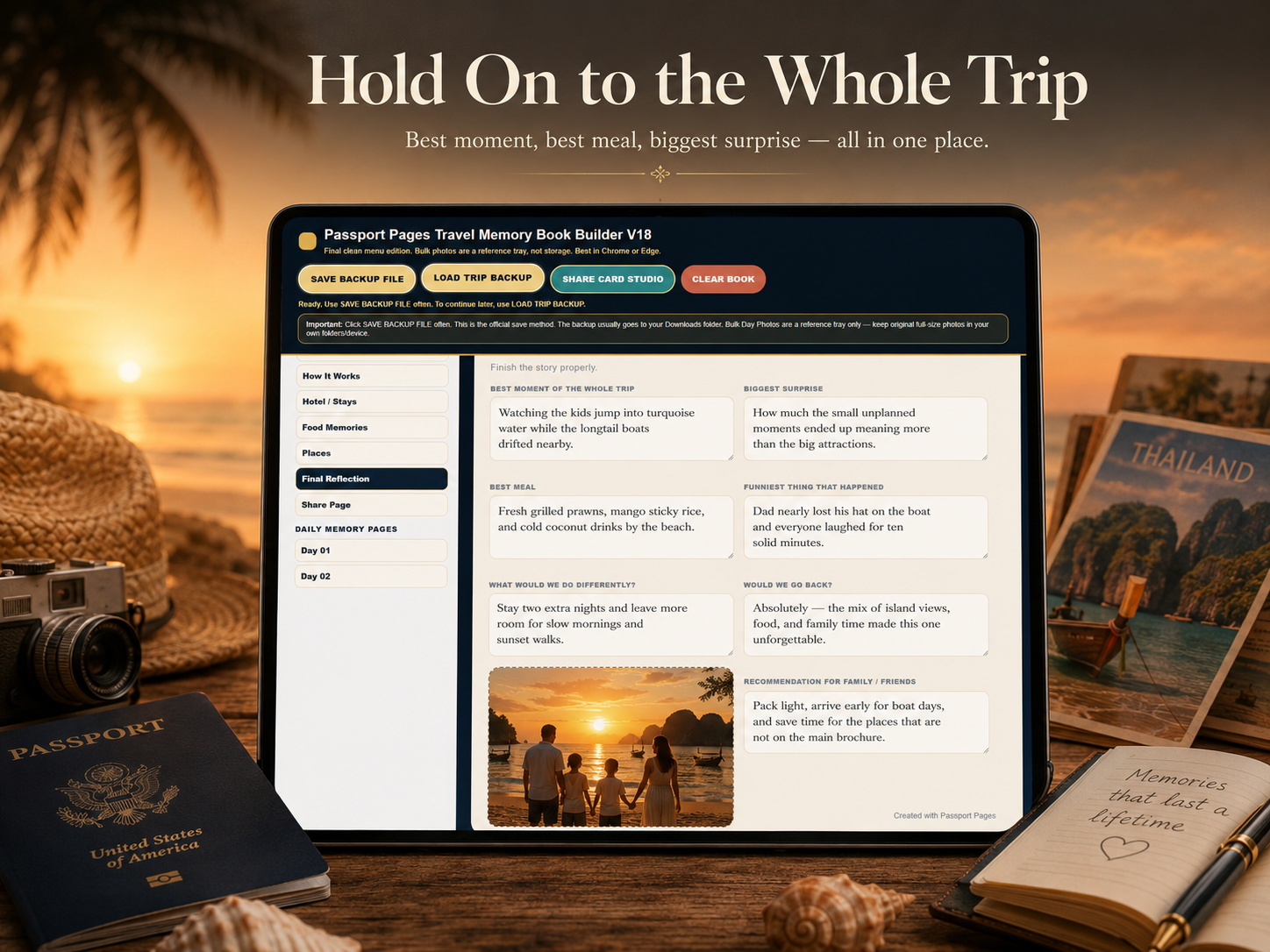
Best moment.
Biggest surprise.
Best meal.
Funniest thing.
Would you go back?
What would you do differently?
What would you recommend to family or friends?
This is the part that says:
Before life eats this memory, let us finish it properly.
And Then You Can Share the Best Parts
Not every memory needs to become a social media performance.
But some moments deserve to be shared beautifully.
That is where the Share Card Studio comes in.
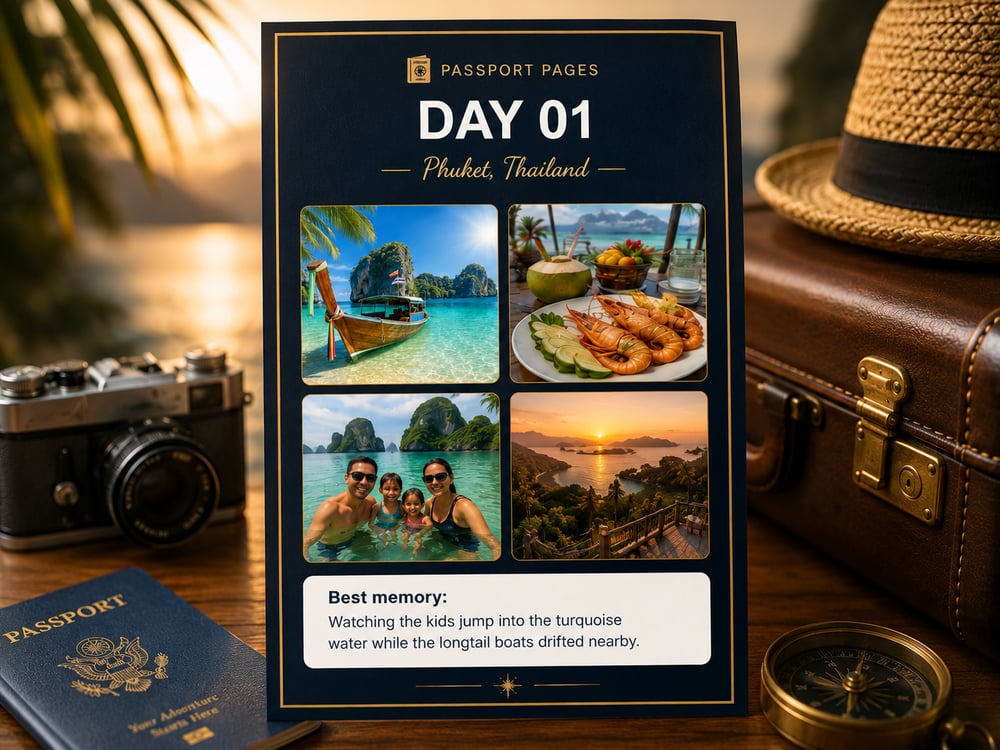
Choose a day.
Create a share card.
Download it.
Send it to family.
Post it if you want.
Keep it for yourself if you don’t.
The point is not to scream, “Look at me, I went somewhere.”
The point is to make the memory look as good as it felt.
Now Let Us Talk About the People Who Do Not Do This
We all know these people.
They come back from a beautiful holiday with 900 photos and zero plan.
Their entire trip lives in a camera roll called “Recent.”
They say, “I’ll sort them out this weekend.”
They will not.
They say, “I’ll make an album later.”
They will not.
They say, “I know where everything is.”
They do not.
Six months later they are scrolling like a detective in a crime drama, trying to find one photo of that amazing restaurant, while accidentally passing screenshots of boarding passes, blurry night markets, ten identical palm trees, and one mysterious picture of a ceiling fan.
This is not a memory system.
This is digital wilderness.
A holiday should not need a search party.
The Camera Roll Is Not a Memory Book
The camera roll is useful.
But it is not a memory book.
It does not know what mattered.
It does not know which day was special.
It does not know which meal surprised you.
It does not know which view made everyone go quiet.
It does not know which hotel you would book again.
It does not know why that random street photo still makes you smile.
It just stores everything.
Mercilessly.
Equally.
The masterpiece, the mistake, the duplicate, the screenshot, the accidental foot photo — all living together in one chaotic democracy.
That is not memory keeping.
That is storage.
And storage is not the same as remembering.
Why This Is a Must-Have
A travel memory book is not about being fancy.
It is about respect.
Respect for the money you spent.
Respect for the time you took.
Respect for the people you travelled with.
Respect for the days that will not happen exactly that way again.
Because after the holiday, the details fade first.
The name of the café.
The hotel view.
The little street.
The thing someone said.
The meal.
The funny disaster.
The beach that looked better in real life than any photo could explain.
Those little things are the trip.
And if you do not catch them while they are fresh, they start slipping away.
That is why a memory book matters.
It gives the trip a second life.
Not just on your phone.
Not just in your head.
But in a place you can open again.
This Is Not About Being Organized. It Is About Keeping the Feeling.
Some people hear “organize your photos” and immediately become tired.
Fair.
Nobody wants homework after a holiday.
But this is not about creating a perfect archive for the Royal Institute of Vacation Documentation.
This is about saving the feeling.
The hot day.
The salty hair.
The meal.
The laugh.
The view.
The weird little moment that somehow became the thing you still remember most.
The reason this works is because it does not ask you to preserve everything.
It asks you to choose what mattered.
Four photos.
A few notes.
A few memories.
The hotel.
The food.
The places.
The final reflection.
That is enough to make the trip feel alive again.
Bring the Trip Home Properly
Your holiday deserves better than disappearing into your camera roll.
The places you saw.
The food you ate.
The hotel you stayed in.
The views, the jokes, the surprises, the tiny details, the moments that made the whole thing worth it.
They deserve a home.
The Passport Pages Digital Travel Memory Book gives them one.
No heavy system.
No complicated setup.
No printing.
No scrapbook chaos.
Just a clean digital way to capture the trip, save it, load it again later, and share the best parts beautifully.
Open it in five years, and the trip should not feel like a forgotten folder.
It should feel like a story you can step back into.
Comments ()