
Need a smaller first step? Start free with the 3-Minute Grounding Card: https://payhip.com/b/bErJ3
Saying no can feel harder than doing the thing you do not have the time, energy, money, or willingness to do.
That is often where overexplaining begins. We keep adding reasons because we hope the other person will finally agree that our boundary is reasonable. But every extra reason can become a new opening for negotiation: “What if we change the date?” “Could you do only half?” “Why is that such a big deal?”
A boundary does not need to be impossible to dislike. It needs to be clear, honest, and something you can follow through on.
If the answer is no, let the no appear near the beginning.
“Thank you for asking. I’m not available.”
“I can’t take that on.”
“That doesn’t work for me.”
Warmth is welcome. A hidden answer is not. Long introductions can make both people wait for the sentence that matters.
You are allowed to give context, especially in relationships where explanation supports trust. The aim is not to become cold or secretive. It is to notice when context turns into a defence brief.
“I can’t come tonight. I need a quiet evening at home.”
That is different from listing every demand on your week in the hope that no one can challenge the decision. One honest sentence is usually enough.
An alternative can make a boundary collaborative:
“I can’t take that on, but I can send you the template I used.”
“I’m not available tonight. I could talk for twenty minutes on Saturday.”
But an alternative is optional. Do not offer a smaller yes just to make the no easier for someone else to hear. If you do not have a real alternative, end the sentence.
Some requests do not need an immediate yes or no. A pause is a boundary too.
“I can’t decide today. I’ll answer by Friday.”
“Let me check my capacity and get back to you tomorrow.”
Name a specific time for your answer, then keep that promise. This turns delay into a clear process instead of avoidance.
Ordinary pushback does not automatically mean your first answer failed. Sometimes the clearest response is a calm repetition:
“I understand that this is disappointing. My answer is still no.”
“I’ve shared what I can offer.”
“I’m not going to keep discussing this decision.”
This is not about winning. It is about refusing to turn your capacity into a debate.
You may decide that your tone was sharper than you wanted, or that you waited too long to communicate. You can repair that without abandoning the limit:
“I’m sorry I was abrupt. I should have said it sooner. I’m still not available.”
Responsibility means owning how you communicated. Guilt does not require you to say yes when the answer is no.
A simple three-part formula
Try:
“Thanks for thinking of me. I can’t volunteer this weekend because I need the recovery time. I can share the sign-up link instead.”
Then stop. Silence after a clear answer is not a mistake.
A note about safety
These scripts are designed for ordinary disagreement. If saying no could lead to threats, coercion, financial control, retaliation, stalking, or violence, the priority is safety—not perfect wording. Consider trusted support and qualified local services that can help you plan for your circumstances.
Practice before the high-stakes moment
Boundaries become easier when they are not invented under pressure. Write down the requests that reliably trigger an automatic yes. Decide what Yes, No, and Not Now sound like in your own voice. Rehearse one sentence until it feels ordinary.
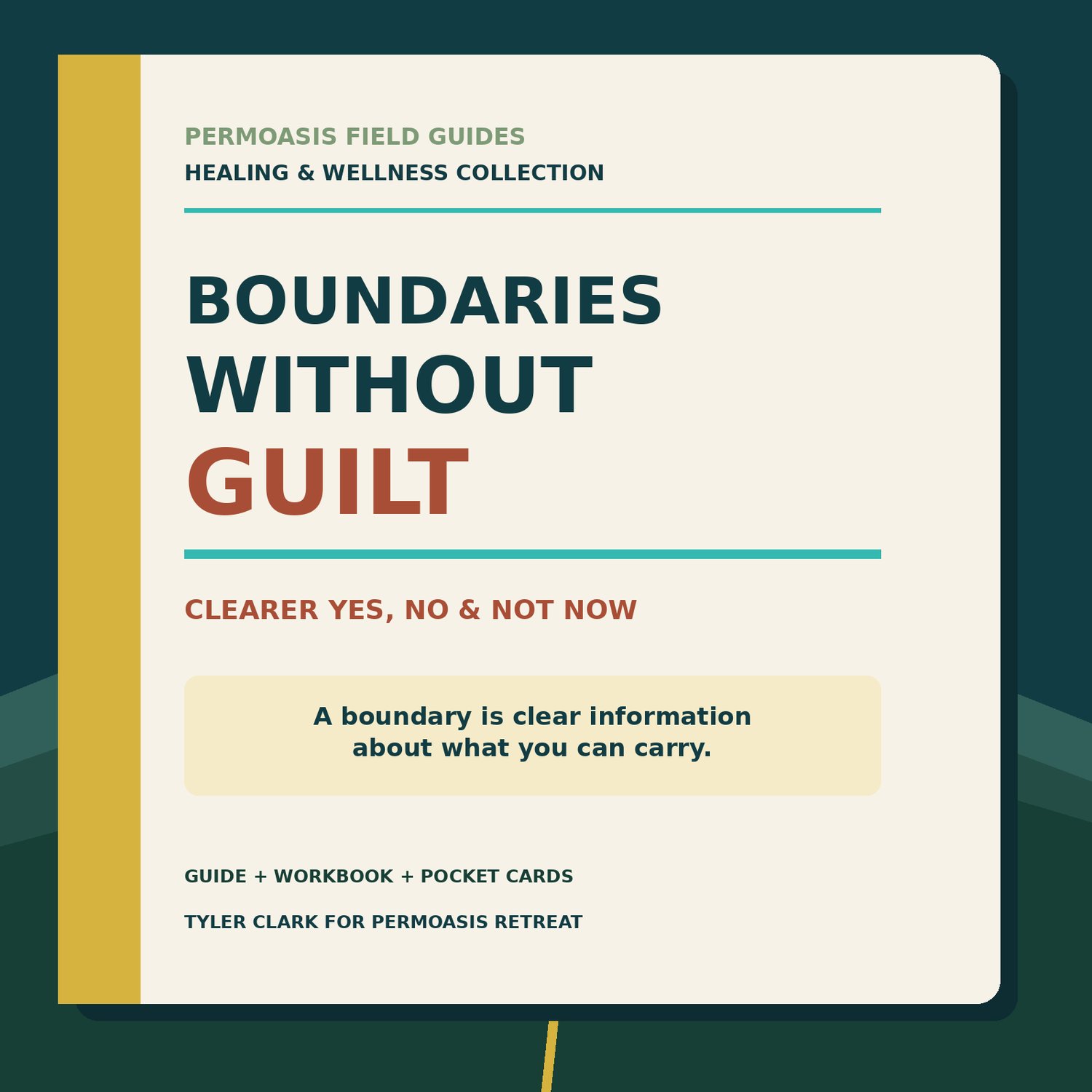
Boundaries Without Guilt was created for that practice. The toolkit includes practical scripts for time, family, work, money, and digital access; six boundary audits; a Yes / No / Not Now worksheet; a pushback plan; a seven-day practice; and pocket cards.
Launch price: CA$15.
Explore Boundaries Without Guilt: https://payhip.com/b/zIkH8
Created by Tyler Clark for PermOasis Retreat.
This is general educational wellness material. It is not therapy, crisis care, legal or workplace advice, or individualized safety planning.