

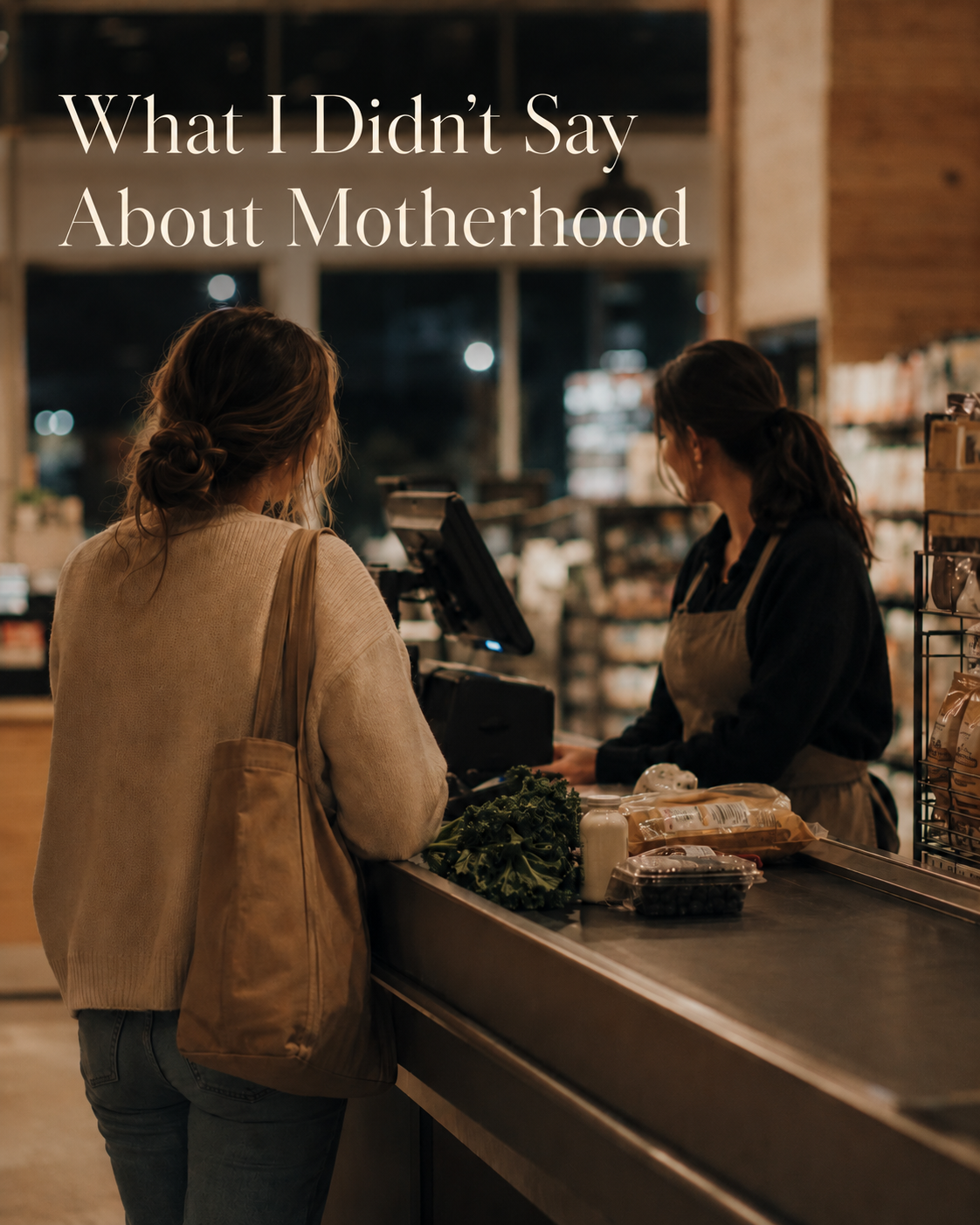
Yesterday evening, I was at the grocery store.
It was late, and the store was quiet. There was only the checkout lady, another customer ahead of me, and myself. The two of them were talking, and I must have thought I understood the conversation well enough to naturally join in. So I did.
Quickly, based on their reaction, I realized I was not talking about the same thing they were.
It was fine. Slightly awkward, but fine.
The other customer finished and left, and then it was my turn. I’m familiar with the checkout lady. We’ve chatted casually before, so it wasn’t unusual for her to continue the conversation with me.
Then she said something that stayed with me. “I wish more people reacted like she did when I say I don’t want to have children.” And immediately, my heart hurt a little.
Not because I know her personally. I don’t. Not really.
But there are some people you encounter and you just get a feeling about them. You see a warmth, a steadiness, a tenderness, a capacity for care. And for whatever reason, I’ve always had the feeling that she would make a good mother.
But I didn’t say that. Instead, I listened.
She went on to explain that her brother tells her having children is “a duty.” And I almost scoffed the same way she did. Because duty is the wrong word.
Even from my own biblical worldview, even believing deeply in God’s design for family, motherhood, sacrifice, and fruitfulness, I still think “duty” is a terrible way to explain motherhood to someone who already has serious reservations about becoming a parent.
Duty may describe many good and necessary things. But it does not capture motherhood. Not fully. Not rightly. Not in a way that would ever make a hesitant woman want to step toward it.
And I could feel the weight of the moment.
I had so many thoughts running through my mind. I thought, This is an opportunity to speak truth.
I could have said something deeply theological. I could have tried to explain God’s design. I could have spoken about the beauty of motherhood, the sanctifying work of it, the way children change us, the way sacrifice becomes less like loss and more like love.
But I didn’t.
I stayed reserved.
I simply said something like:
“You know, I used to say the same thing. I really meant it. I felt it to my core that I didn’t want children. But then motherhood was thrown at me—unplanned, and in terrible circumstances. And even then, I became the thing I thought I never wanted to be. I went forward. I was a single mom for years. It was very hard. But through all of it, I was a mom. And being a mom has been the best thing that ever happened to me.”
She looked at me and said, “Thank you for sharing your story.”
And then I left.
On the drive home, I replayed the whole conversation in my mind. I thought of all the things I wished I had said.
I wished I had told her that motherhood is not merely an obligation, or a role, or a burden someone should be talked into carrying.
I wished I had told her about the privilege of it.
About the beautiful sacrifices that somehow do not always feel like sacrifices once love has rearranged your heart.
About the way motherhood changes a person from the inside out.
About the natural submission to the work of caring for someone who needs you.
About the strange and holy way a task becomes a calling.
About the glory it brings into ordinary life.
About the way God uses children to pull selfishness out of us and replace it with something softer, stronger, and more eternal.
I wished I had said all of that.
But maybe I didn’t need to.
Maybe sometimes the whole argument for motherhood is not an argument at all.
Maybe sometimes it is simply a woman standing in a grocery store saying:
“I thought I didn’t want this either. But it became one of the greatest gifts of my life.”
Maybe my story said more than my explanation could have.
Maybe it carried the truth quietly enough for her to receive it.
And maybe that was enough for a late evening conversation with a woman I only know through small talk at the checkout line.
A woman who may never remember every word I said.
But maybe, someday, she will remember that motherhood was not described to her as a duty.
It was described as a gift.