

Hola,
I hope that you had a wonderful festive season. Mine was very different, as I usually spend the majority of it alone. This year, it was spent with family, and it was delightful.
Happy new calendar year, the reason I say that is that I don't choose to celebrate the man-made new year. It was Julius Caesar who reformed the Roman calendar in 46 BCE, partly to honour Janus, the Roman god of beginnings. In truth, however, this was about stabilising administration, taxation and political control. The Gregorian calendar (the one that we use now) continued this structure. Before this, the New Year was based upon natural cycles that followed the moon, astrological markers, seasons or agricultural cycles. So what we celebrate is a constructed date that disconnects us from nature's natural rhythms.
Ancient Mesopotamia, home to civilisations such as the Sumerians and Akkadians, marked the New Year at the spring equinox, aligning renewal with the land's awakening. The Egyptian New Year was centred on Sirius, the most important star in the sky, and its first appearance after a period of invisibility coincided with the annual flooding of the Nile. This event renewed the land and made agriculture possible.
Many cultures today still choose to celebrate the new year in line with nature rather than an empire. The Persian New Year is celebrated at the Spring equinox, marking cosmic balance. The Jewish New Year is celebrated in early Autumn in line with the lunar and spiritual cycle. The Chinese celebrate their new year in late January/early February, in line with the lunar cycle and seasonal transition, and many other cultures worldwide celebrate in various months, in line with lunar calendars, agricultural cycles, or religious traditions.
What interests me most is not whether 1 January is “right” or “wrong,” but what happens when we unquestioningly align our lives to systems designed for control rather than care. When time is reduced to deadlines, quarters, and productivity cycles, we lose the intimacy of living with the Earth rather than on top of it.
Nature does not reset on command. Trees do not suddenly begin again because a number has changed. Seeds do not sprout because we decided this is the moment for “new goals.” In the Northern Hemisphere, January is a time of deep rest, dormancy, and inwardness. The land is quiet. Roots are gathering strength beneath frozen soil. Yet culturally, we demand reinvention, discipline, and relentless forward motion.
We push ourselves to bloom in the depths of Winter, we measure our worth by output rather than alignment, by momentum rather than by meaning. We often fall short of these artificial expectations; we call it failure rather than recognising exhaustion. We make resolutions that we frequently fail to keep because our bodies are in tune with nature, even if our calendars are not.
Resolutions demand immediate transformation at a time when everything in the natural world is still conserving energy. They are rooted in force, willpower, and the belief that change must be wrestled into existence. They often arise from a place of self‑critique, a sense that we must fix, improve, or discipline ourselves into worthiness, but maybe intentions belong to a different rhythm entirely.
Intentions are not declarations of war against our own habits. They are quiet orientations, gentle leanings toward the person we are becoming. They emerge from listening rather than striving. They honour timing rather than override it. Intentions recognise that growth is not linear, and that beginnings do not always happen on command. Nature teaches us this. A seed holds its intention long before it breaks the soil. It does not rush. It does not apologise for waiting. It germinates when the conditions are right, when warmth returns, when light increases, when the Earth signals that it is time.
This is why the spring equinox has always felt like the true New Year to me. It is the moment when the world itself begins again. Light and dark stand in perfect balance. The land stirs, buds swell, and the birds return. There is a natural momentum toward renewal, not forced, not scheduled, but arising from the deep intelligence of the Earth. What would it mean to let our own beginnings follow that same wisdom? To allow January to be a month of rest rather than reinvention. To let our intentions form slowly, like roots gathering strength underground. To begin again, not because a calendar demands it, but because something inside us and around us is ready. Perhaps the invitation is not to abandon the idea of a New Year, but to reclaim it. To choose a moment that aligns with our bodies, our landscapes, and our inner seasons. To shift from resolutions that punish to intentions that nourish, because when we honour the natural rhythms of renewal, we stop forcing ourselves to bloom in winter and we begin to grow in ways that are sustainable, soulful, and intensely alive.
I get excited about Spring when nature returns and begins the journey to its glory. When colour creeps back into gardens and hedgerows, when the air softens and the light returns, that is when my body feels the spark of possibility. I don't get excited at this time of year, when it's cold, often dark, dull, and there is a heaviness in the air. Perhaps that is the point; we aren't meant to leap into transformation when the world around us is still sleeping. Maybe you feel it too?
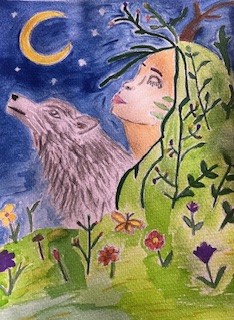
It's the wolf moon tomorrow, the first of the four supermoons of the year. My sleep pattern has been crazy. I never sleep well during a full moon. Last night I woke at exactly midnight, which is said to be a powerful time to connect to our ancestors or the divine if you believe in that sort of thing. I was awake for four hours before I could sleep again. Eve, the kitten, was also awake, so we spent the time looking into things of interest.
The moon has its own timing, its own pull, and perhaps that’s the reminder: we do too.
Muchos love until next time, when I hope to have good news to share. x