
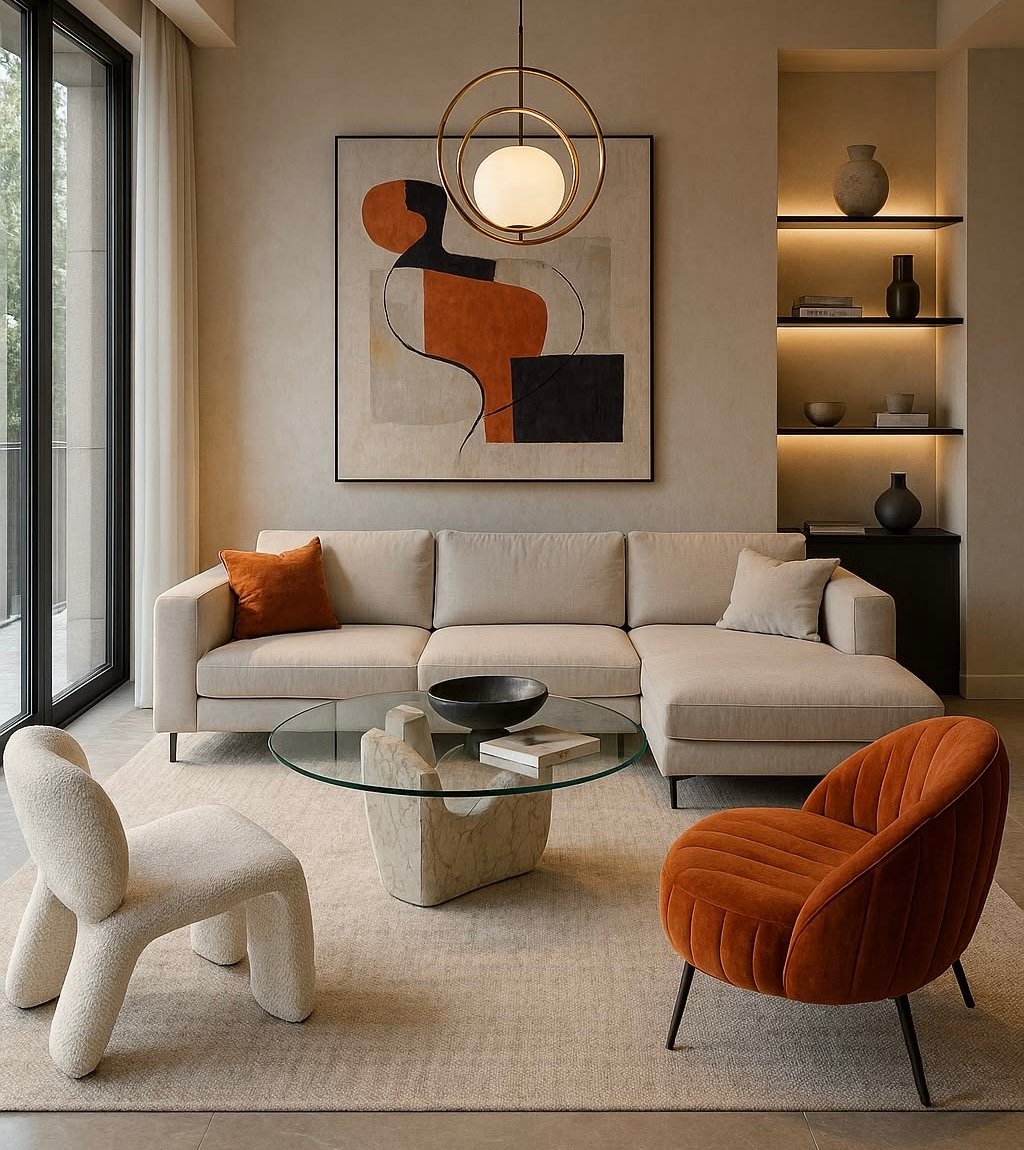
Walk into any furniture showroom — whether it's a high-street retailer in London, a design boutique in Dubai, or a lifestyle store in New York — and you are looking at a room full of products that almost certainly began their journey in one place: China. The labels might differ, the branding might be premium, and the price tags will almost certainly reflect none of that. But the factory? In the majority of cases, it's Chinese.
This is not a secret, exactly. But most consumers have never stopped to think about what that actually means for the price they are paying — or what becomes possible when you remove the middlemen entirely.
China and the Global Furniture Industry: What the Numbers Actually Say
China is not just a major player in global furniture manufacturing. It is, by a significant margin, the dominant force. China's total furniture exports reached approximately $64 billion in 2025, accounting for 30.8% of the global furniture export market share. To put that in perspective, nearly one in three pieces of furniture traded across international borders originates in China.
The global furniture market was valued at $597.71 billion in 2025, with Asia Pacific — led overwhelmingly by China — holding a 49.06% share of global market revenue. That is not a regional advantage. That is a structural dominance that has been built over decades of manufacturing expertise, supply chain investment, and a production infrastructure that no other country has come close to replicating at the same scale and price point.
The China furniture market alone was valued at $160.53 billion in 2025, and is projected to grow from $169.23 billion in 2026 to reach $220.17 billion by 2031. This is an industry that is not only large — it is accelerating.
Much of this production is concentrated in specific regional clusters, each specialising in particular categories and price points. South China, centred around Foshan and Dongguan in Guangdong Province, leverages export-oriented strategies and a mature industrial chain, with large factories possessing extensive import and export experience, emphasising design alongside excellent cost-performance ratios. Industrial clustering here provides price advantages and shorter manufacturing cycles compared to other global production regions. Foshan, in particular, is widely considered the furniture capital of the world — a city where you can walk from one end of a district to the other and see every stage of furniture production happening in real time.
How Chinese Furniture Factories Actually Work
Understanding how Chinese furniture is priced requires understanding how the factories themselves operate, because the economics are quite different from what most Western buyers assume.
Chinese furniture manufacturers — particularly those in the major export hubs — operate at a scale that creates significant cost efficiencies at every stage of production. Raw materials are purchased in enormous volumes, keeping input costs low. Labour, while no longer as inexpensive as it was two decades ago, remains considerably more affordable than in Europe, North America, or Australia. And because these factories produce for export markets around the world, they have become highly efficient at customisation — adapting designs, materials, finishes, and dimensions to suit the specific requirements of international buyers.
Wholesale pricing from a Chinese factory reflects this efficiency. A sofa that leaves a Guangdong factory with a wholesale price of $300 might be a genuinely well-crafted piece — solid frame, quality upholstery, built to a specific brief. That same sofa, by the time it has passed through an importer, a distributor, and a retailer, will typically be priced at something very different indeed.
The Journey From Factory to Shop Floor — and What It Costs You
This is where the numbers become genuinely eye-opening for most people.
Furniture retailers often apply markups ranging from 20% to 400% over the wholesale cost, a broad range that accounts for operational expenses, desired profit margins, and market positioning. At the lower end, that markup covers the basics — import duties, freight, warehousing, and the cost of running a retail operation. At the higher end, particularly for pieces positioned as premium or designer, the markup has considerably more to do with branding and perceived value than with the actual cost of production.
The average gross furniture profit margin for retailers is over 40%, though that figure drops to between 3% and 6% after accounting for marketplace fluctuations pre-tax. What this tells us is that a very large portion of the retail price of any given piece of furniture is being absorbed by the chain of businesses between the factory and your home — not by the quality or craftsmanship of the piece itself.
Keystone pricing — the practice of setting the retail price at double the wholesale cost — is the standard rule of thumb in furniture retail, used as a fast first pass across the industry. In plain terms, this means that the furniture you are browsing in a showroom is, in many cases, priced at roughly twice what the retailer paid for it — before you factor in that the retailer themselves bought it from a distributor or importer who added their own margin on top of the factory price.
By the time a piece of furniture reaches your home through a traditional retail channel, it may have passed through three or four separate businesses, each adding their own percentage. The factory price — the actual cost of skilled human hands turning raw materials into a finished product — can represent as little as a quarter of what you ultimately pay.
The Advantage of Going Direct to the Source
Sourcing furniture directly from Chinese manufacturers cuts through this entire chain. When you work with the factory directly — or through a sourcing partner who operates at that level — you are accessing the same quality of product that ends up in showrooms around the world, but at a price that reflects the actual cost of making it rather than the cost of moving it through multiple layers of commerce.
The advantages extend beyond price. Working directly with manufacturers means genuine customisation is on the table in a way it simply isn't in a retail environment. Dimensions, materials, finishes, hardware, upholstery — all of these can be specified to your exact requirements, because you are working with the people who actually make the piece, not a sales team selling you what's already been made. Customisation flexibility has risen to second place among the factors international buyers prioritise when selecting a Chinese furniture manufacturing partner, overtaking quality certifications for the first time in the 2025 to 2026 survey cycle. The global market has recognised what savvy buyers have known for years: the real power of sourcing from China is not just the price — it is the ability to get exactly what you want.
Approximately 30% of global furniture supply chains continue to depend on Asian imports, particularly from China, and this includes some of the world's most recognised furniture brands — brands that then repackage and resell that production under names that carry significant retail premiums. Direct sourcing simply asks the question: why pay for the name when you can have the product?
Our End-to-End Furniture Sourcing Service
This is exactly the gap our team has built a service around — and the results, for our clients, have been transformative.
We work with clients across the residential, commercial, and hospitality sectors who want beautiful, bespoke furniture without the retail markup and without the complexity of navigating Chinese manufacturing on their own. Our service is genuinely end-to-end, which means you do not need prior experience, industry contacts, or knowledge of how Chinese manufacturing works. That is our job.
Here is how the process works. It begins with your idea — a vision, a reference image, a design concept, or simply a description of what you are looking for. From there, our team does the work: identifying the right manufacturers for your product category, requesting samples, reviewing quality, negotiating pricing, and making sure that what is being produced matches your original vision at every stage.
Once the production is signed off, we manage the logistics — shipping, customs, and delivery — so that your furniture arrives safely, on time, and exactly as expected. Every detail is handled with the kind of attention that prevents the costly mistakes that can happen when sourcing internationally without the right guidance. We know which factories deliver consistent quality, how to communicate specifications clearly across language and cultural differences, and how to protect our clients at every point in the process.
We are currently working with hundreds of clients sourcing bespoke furniture through our service, from individual homeowners furnishing a single room to property developers outfitting entire buildings. The common thread is that all of them wanted something specific, at a price that made sense, without the headache of doing it alone. See an example of our typical projects here: Bespoke Series
Whether you are designing a home, developing a short-let property, building out a restaurant or hotel, or simply looking for pieces that feel personal and considered rather than mass-produced, affordable bespoke furniture from China — sourced correctly — is one of the most powerful options available to you right now.
Ready to Get Started?
If you have a project in mind, or even just an idea you have been turning over for a while, we would love to hear about it. To begin, find instructions on how to work with us.
We’re ready to take on your dream project! Are you?
Meta Description: Discover how China's furniture factories produce the world's finest pieces at wholesale prices — and how sourcing directly can save you thousands. Learn how our end-to-end service takes you from idea to delivery.
Keywords: affordable bespoke furniture, source furniture from China, China furniture manufacturers, wholesale furniture pricing, custom furniture sourcing, bespoke furniture supplier, furniture direct from factory