
A deposit dispute. A change order nobody signed. An HOA fine with a hearing date attached. The paperwork problems that cost people money, time, and sleep almost never announce themselves as emergencies — they arrive as a deadline you didn't know was running.
This post takes one of the most-searched of those deadlines and answers it completely: how long a landlord actually has to return a security deposit, what missing that deadline costs, and how a new kind of kit — a Drop-In AI Kit — turns the whole job into something you finish in one sitting. The landlord example is specific. The pattern works on every problem in our catalog.
The short answer: it depends on your state — and the range is wide
There is no federal deadline. Every state sets its own, and they range from 10 days to 60 days after the tenant moves out:
- 30 days is the most common deadline — about a third of states use it.
- 14 days in a smaller group of states (New York and Hawaii among them), sometimes split: 14 days if you're returning everything, longer if you're deducting.
- 21 days in several states, including California.
- 45 to 60 days at the long end (Alabama and Arkansas allow 60).
- One state, Tennessee, has no statutory deadline at all — which doesn't mean "take forever"; it means the lease and the courts decide.
Two traps hide inside those numbers. First, a few states count business days instead of calendar days (Arizona is the notable one), which quietly moves your real deadline. Second, in a few states your lease can extend the deadline up to a cap (Colorado: 30 days, or up to 60 if the lease says so) — but a lease can never override the state statute. If your lease says 90 days and your state says 30, the state wins.
Missing the deadline costs more than the deposit
This is the part landlords learn the hard way:
- In a number of states, if you miss the deadline — or fail to send the required itemized statement of deductions — you forfeit the right to keep any of the deposit at all, even for genuine damage.
- In many states, a tenant who has to sue can recover two to three times the amount wrongfully withheld, plus court costs, on top of the deposit itself.
- Almost every state requires the refund (or what's left of it) to arrive with a written, itemized statement — not a text message, not a verbal "the carpet was ruined." No statement, no defense.
So the real question isn't just "how long do I have?" It's "can I produce a defensible, itemized, on-time packet for every move-out?" That is a paperwork problem — and paperwork problems are exactly what Drop-In AI Kits are built for.
How to find your exact deadline
- Search your state's landlord-tenant statute for "security deposit" — the deadline, the itemization requirement, and the penalty are usually in the same section.
- Trust the official source (your state legislature's site or a .gov page) over any summary, including this one — rules change, and summaries drift.
- Write the deadline down the day the tenant gives notice, not the day they hand back the keys, and work backwards from move-out day.
The routine that hits the deadline every time
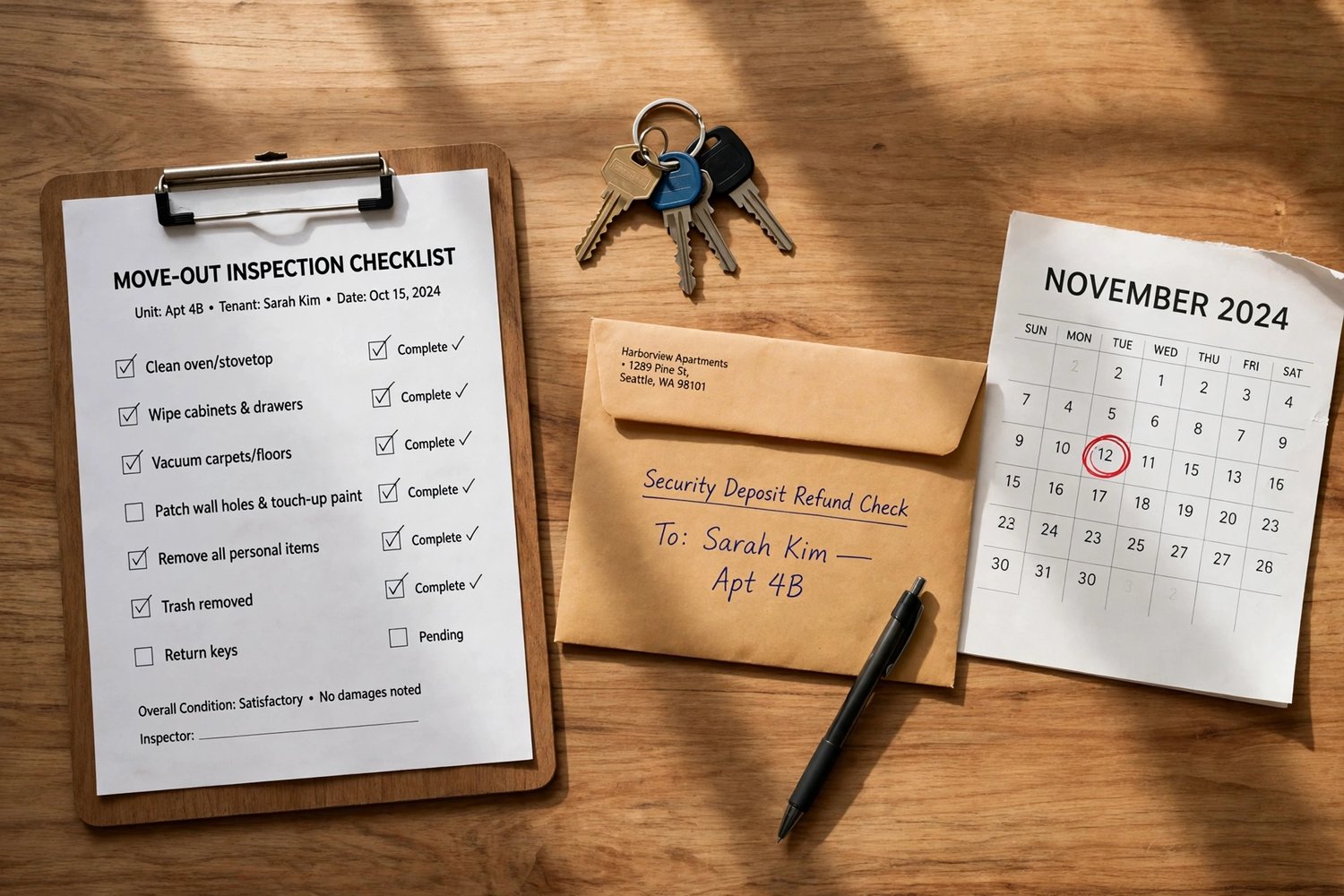
Landlords who never pay penalties run the same five steps at every turnover: signed move-in and move-out reports, room by room; timestamped photos at both ends; a wear-versus-damage standard applied the same way to every tenant; an itemized deduction statement built from the reports and receipts; and a deadline tracker counting from move-out day to the state's deadline. The steps aren't hard. Remembering and assembling them under time pressure is.
What a Drop-In AI Kit does with all of this
A Drop-In AI Kit is a portable PDF that carries its own instructions. You drop it into the AI assistant you already use — no new app, no subscription — paste the starter prompt printed inside, and the kit takes over: it interviews you section by section, looks up your own state's current deposit rules, does the deadline math from your move-out date, checks the totals, drafts your letters, and fills in the real forms. What comes back is the finished packet: reports, photo log, itemized statement, deadline already calculated.
Our Landlord Security Deposit & Move-Out Evidence Kit is built exactly this way — move-in/move-out reports, a photo log, a wear-vs-damage guide, the itemized deduction statement, deposit return letters, and a state deadline tracker, all in one AI-Ready kit: payhip.com/b/DJYdO
Print it. Sign it. Done. The best app is no app — drop it in, get it done.
Practical Guides Co kits are general information and organization tools — not legal advice. Deposit rules vary by state and change over time; verify your state's current statute or consult a licensed attorney for your specific situation.
Practical Guides Co makes Drop-In AI Kits for the paperwork that costs you money, time, or sleep. See how they work at practical-guides-co.netlify.app.