
We talk about growing our glutes all the time.
We choose exercises, follow programmes, and push through demanding sets. But what are we actually trying to change?
The answer is muscle tissue.
When the goal is glute growth, we are trying to increase the size of the gluteal muscles through an adaptation called hypertrophy. Understanding that process gives every training decision a clearer purpose.
What actually gets bigger?
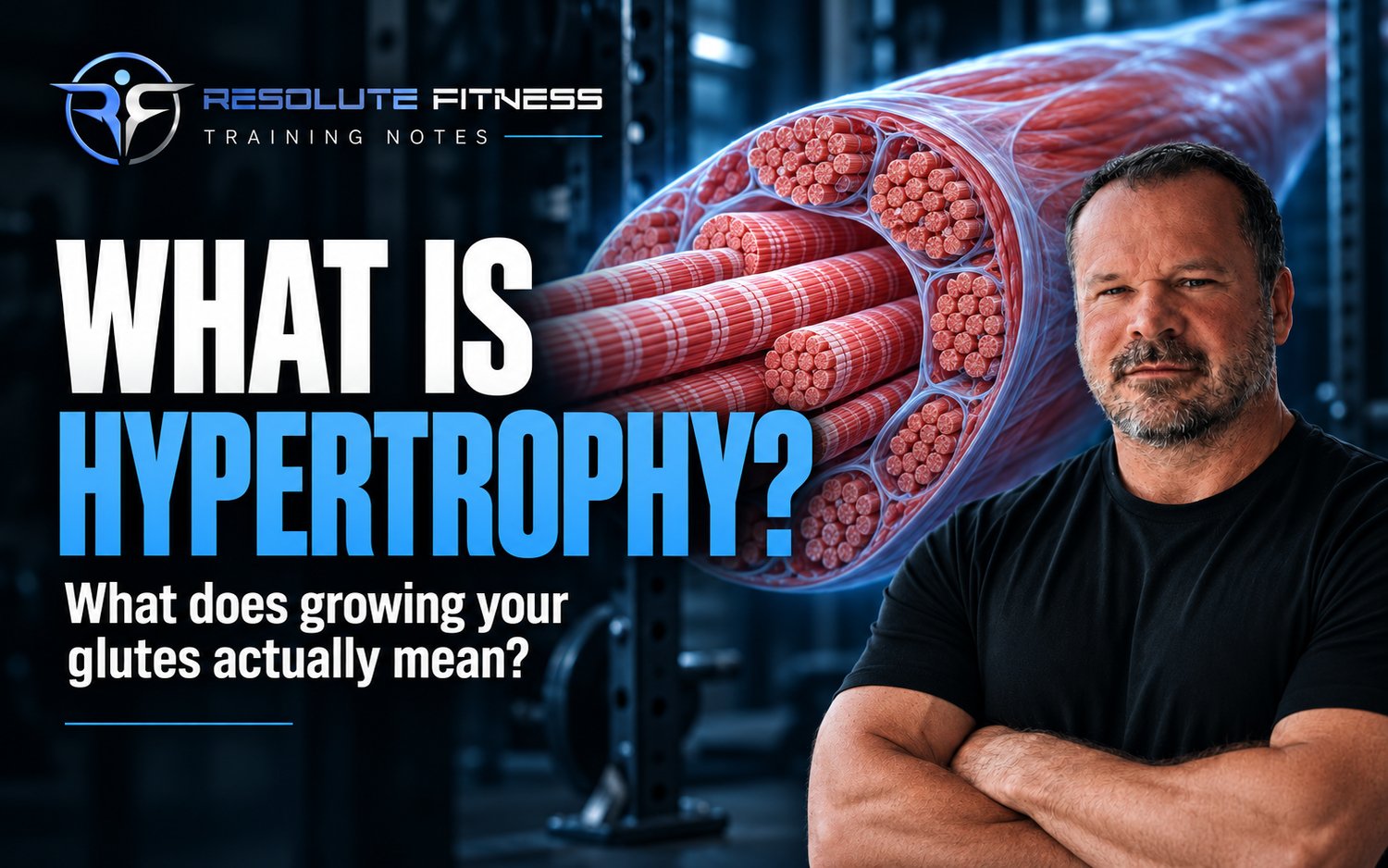
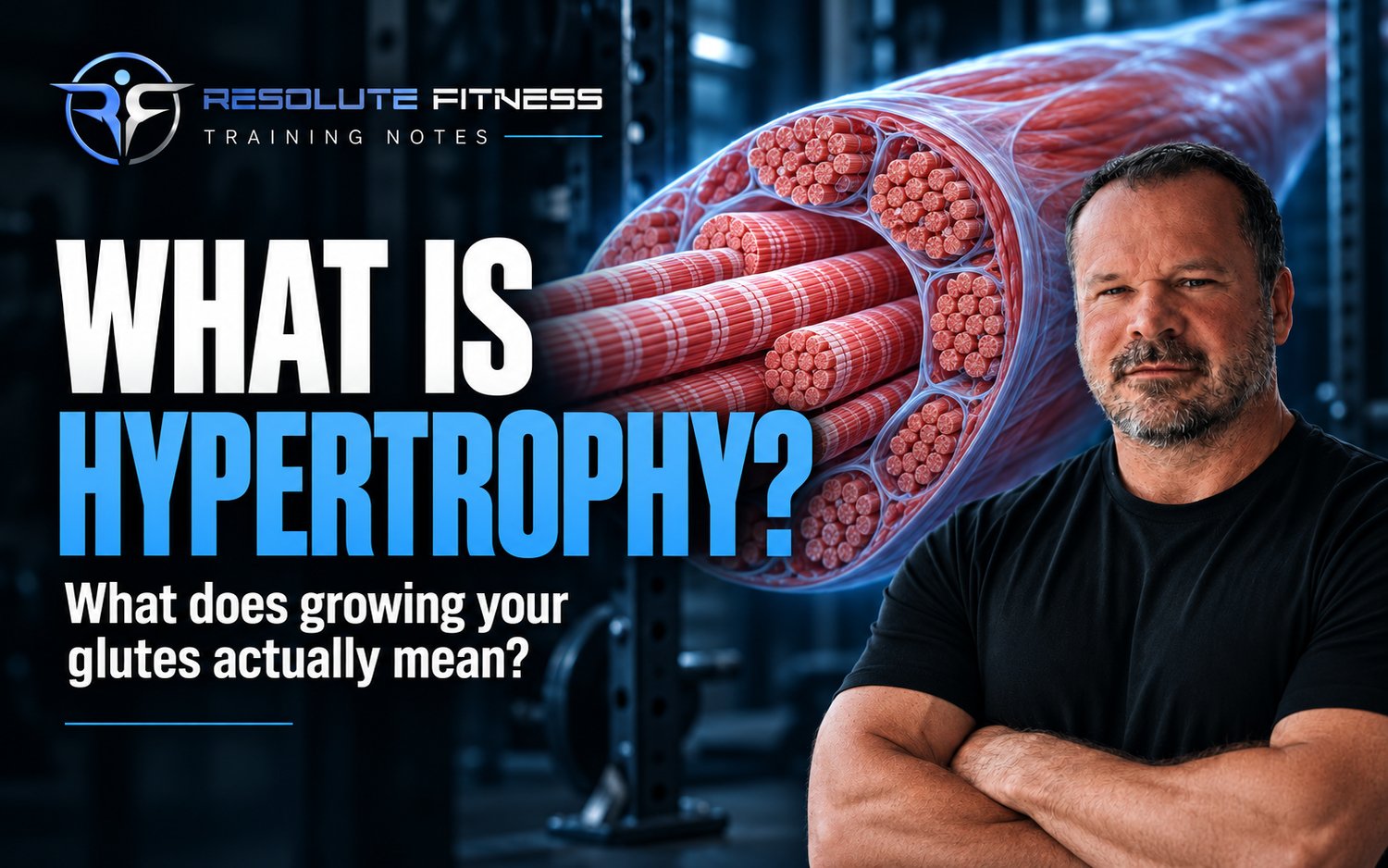
Muscles are made up of bundles of muscle fibres. Each fibre is a specialised cell containing structures that produce force.
With resistance training, those existing fibres can increase in size. Over time, enlargement across many fibres contributes to a larger muscle. That is the basic meaning of muscle hypertrophy.[1]
For glute development, we are targeting the muscles around the back and sides of the hips. The gluteus maximus is the largest, with the gluteus Medius and minimus also contributing to hip function.
We are trying to build more muscle tissue in this region. The visible change is an outcome of that biological adaptation.
How does training start that process?
Mechanical tension is the force experienced by muscle fibres when they produce force against resistance or resist being lengthened. The muscle senses this loading and initiates signals involved in adaptation.[2,9]
It is not simply the weight on the bar, a strong squeeze or how long a set lasts. The relevant demand is within the muscle tissue.
Heavier loads can create substantial force demands early in a set. With lighter loads, fatigue means additional motor units may be recruited to continue the task. This is one reason sufficiently challenging sets across different rep ranges can support growth.[6]
Higher-repetition work still involves mechanical tension. We should not treat heavy training and “pump training” as two separate biological growth pathways.
This is why exercise selection and execution matter.
A weight on the bar tells us the external load. It does not tell us exactly how much demand reaches the glutes. Joint positions, range of motion, leverage and the contribution of other muscles all affect the task.
My coaching question is: Are the glutes doing enough demanding work for this exercise to serve the goal?
A split squat that ends because you lose your balance presents a different programming problem from one that ends because you cannot complete another controlled repetition. Both can be difficult, but the limiting factor matters when deciding how useful the exercise is for you.
What happens inside the muscle?
Muscle tissue is continually being broken down and rebuilt. The process of making new muscle proteins is called muscle protein synthesis.
Resistance training can increase this activity. Some of it supports repair and remodelling; a rise after a workout does not automatically mean an equivalent amount of new muscle has been built.[1,3]
For lasting growth, the repeated process must result in a net accumulation of muscle tissue over time. That requires a useful training stimulus, supported by nutrition and recovery.
Think of each session as a contribution to the process. The changes accumulate through repeated training and recovery across weeks and months.
Do we need to damage the muscle to make it grow?
You will often hear that training “tears the muscle” and it repairs itself bigger.
That explanation puts too much emphasis on damage. Unfamiliar resistance training can cause muscle damage, but maximising that damage is not the objective. Research shows that early increases in protein synthesis can be associated with repair, while their relationship with hypertrophy becomes clearer as damage subsides with repeated training.[3]
In practice, I want clients to train hard enough to create a useful stimulus and recover well enough to repeat it.
Soreness can inform how we manage the next session. It cannot tell us how much muscle we have grown.
What is the pump, and does it matter?
The pump is the temporary fullness that develops during training, associated with increased blood flow and fluid shifts in the working muscle. Your glutes can look larger immediately after a session without having accumulated a meaningful amount of new muscle tissue.[1,9]
The sensation is real. It may accompany useful training and can be satisfying, but the size of the pump is not a validated measure of how much growth a session will produce.
Some research has found an association between acute swelling and later muscle growth. That does not establish that swelling caused the growth, or that deliberately maximising the pump improves results.[9,10]
It also does not tell you that you have stimulated sarcoplasmic hypertrophy. Temporary fullness and lasting expansion of the fibres' surrounding components are different outcomes.
The same principle applies to “feeling” an exercise. Sensation can help you assess execution, but it is not a direct measurement of growth. In one nine-week study, hip thrusts produced greater initial glute electrical activity than squats, yet the two programmes produced similar glute growth in previously untrained participants.[4]
My coaching approach is to use sensation as supporting feedback while evaluating the exercise through execution, progression, tolerance and longer-term results.