
Why This Matters for HR Leaders, Banking Professionals, Back-Office Employees, AI Transformation Teams and Emerging Market Organisations
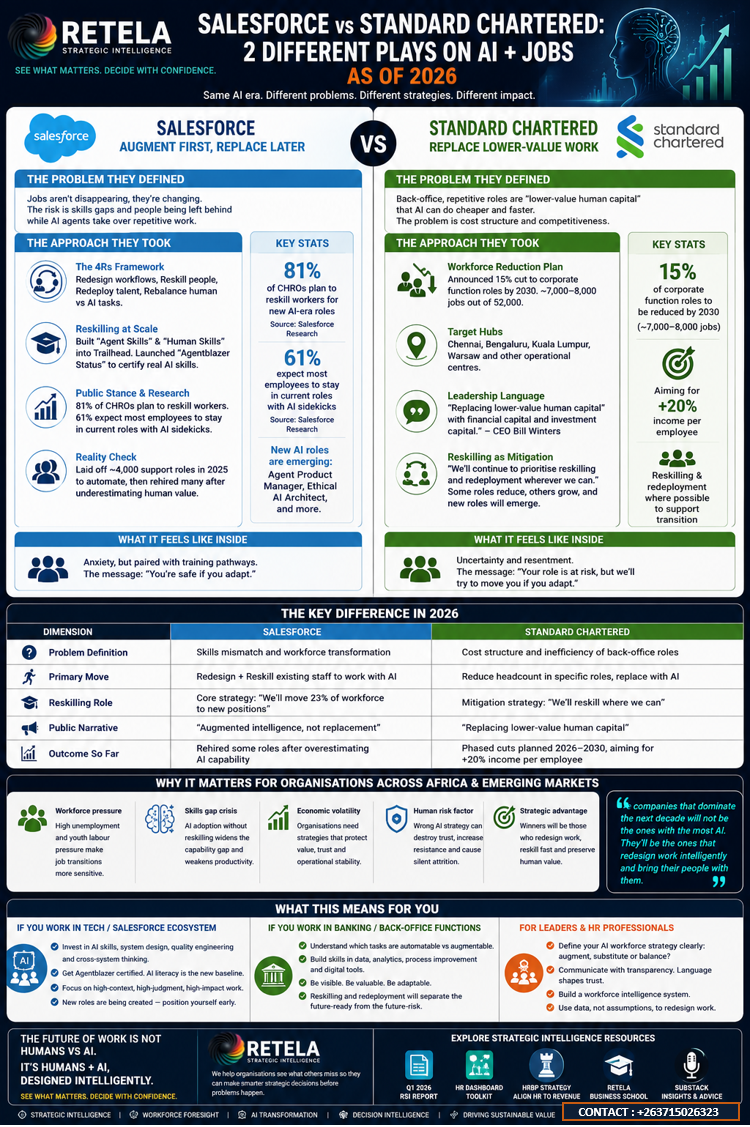
Salesforce believes artificial intelligence should augment workers first and reskill them into higher-value roles.
Standard Chartered believes AI should replace lower-value repetitive work to improve operational efficiency, workforce productivity and long-term cost structure.
That difference changes everything.
Because most organisations still think:
“AI and jobs” is one conversation.
It isn’t.
There are actually TWO completely different strategic models emerging globally:
⚡ The Workforce Augmentation Model
vs
⚡ The Workforce Substitution Model
And companies across:
🌍 Africa
🌍 South Africa
🌍 Zimbabwe
🌍 Kenya
🌍 Nigeria
🌍 India
🌍 Southeast Asia
🌍 Europe
🌍 the Middle East
will increasingly be forced to choose between them.
━━━━━━━━━━━━━━━
🔹 SALESFORCE:
“Redesign work. Reskill people.”
Salesforce defined the problem as:
👉 workforce adaptation in the age of AI agents.
Their concern was not simply reducing labour costs.
It was:
“How do we prevent workers from becoming obsolete while AI reshapes workflows?”
So their response focused on:
✔ AI workforce reskilling
✔ digital workforce transformation
✔ AI-human collaboration
✔ employee redeployment
✔ AI certification programs
✔ organisational redesign
They launched:
📌 Trailhead AI learning pathways
📌 Agentblazer certifications
📌 AI-agent workforce training systems
Their workforce strategy revolved around:
The 4Rs:
→ Redesign
→ Reskill
→ Redeploy
→ Rebalance
And according to Salesforce-linked workforce research:
📊 81% of CHROs plan to reskill employees for AI-era jobs
📊 61% believe most workers will remain in current roles but work alongside AI agents
📊 New positions like AI Agent Product Manager and Ethical AI Architect are already emerging globally
But reality hit hard.
Salesforce reportedly cut around:
📉 4,000 customer support roles
…then later rehired many after discovering AI struggled with:
❌ undocumented workflows
❌ emotional nuance
❌ context-heavy interactions
❌ complex customer judgment calls
That is the AI transformation J-curve most companies still underestimate.
Short-term automation optimism.
Long-term operational reality.
━━━━━━━━━━━━━━━
🏦 STANDARD CHARTERED:
“Replace repetitive work.”
Standard Chartered approached AI from a completely different angle.
Their problem definition was:
👉 operational cost structure and efficiency.
Not workforce evolution.
Not AI-human augmentation.
But:
“How do we reduce lower-value repetitive labour costs?”
So the bank announced plans to reduce approximately:
📉 15% of corporate-function roles by 2030
That potentially affects:
📊 7,000–8,000 jobs
Key operational hubs:
🌍 Chennai
🌍 Bengaluru
🌍 Kuala Lumpur
🌍 Warsaw
And the language used by leadership mattered enormously.
CEO Bill Winters described the strategy as:
“Replacing lower-value human capital with financial capital and investment capital.”
That phrasing triggered backlash because employees globally interpreted the message as:
“You are a cost category first.”
Not:
“You are part of workforce transformation.”
Huge psychological difference.
━━━━━━━━━━━━━━━
⚠️ THIS IS THE REAL AI WORKFORCE BATTLE OF 2026
Not:
“Humans vs AI.”
But:
👉 AI-enabled workforce redesign
vs
👉 AI-driven labour substitution
And many organisations still do not understand the difference.
Especially in emerging economies.
Because AI workforce strategy in:
🌍 Africa
🌍 Latin America
🌍 South Asia
🌍 frontier markets
cannot simply copy Silicon Valley models.
Why?
Because these economies already face:
📉 high unemployment
📉 youth labour pressure
📉 fragile middle-class growth
📉 digital skills gaps
📉 economic volatility
📉 operational inefficiency
📉 workforce anxiety
Which means poorly designed AI transformation strategies could:
❌ weaken organisational trust
❌ accelerate disengagement
❌ destroy institutional knowledge
❌ increase silent resistance
❌ reduce workforce adaptability
And this is where many boards are dangerously underprepared.
━━━━━━━━━━━━━━━
🧠 THE STRATEGIC INTELLIGENCE SIGNAL MOST PEOPLE ARE MISSING
AI is no longer just:
✔ a technology discussion
✔ an automation discussion
✔ a software discussion
It is now:
⚡ a workforce strategy discussion
⚡ a leadership communication discussion
⚡ a human capital investment discussion
⚡ an operational redesign discussion
⚡ a decision intelligence discussion
Because organisations are discovering something uncomfortable:
The hardest part of AI transformation is not the AI.
It is:
👉 redesigning humans, workflows, incentives, operating models and decision systems around it.
That is why the next generation of competitive advantage will not come from:
“who has the most AI.”
But from:
✅ who redesigns work intelligently
✅ who reskills fastest
✅ who preserves strategic human value
✅ who interprets workforce signals correctly
✅ who understands where AI fails
✅ who balances automation with institutional intelligence
That is the real strategic battlefield now.
At Retela Strategic Intelligence, these are exactly the kinds of organisational shifts we analyse through:
✔ workforce intelligence
✔ strategic foresight
✔ operational intelligence
✔ AI transformation analysis
✔ decision intelligence systems
✔ human capital strategy
✔ emerging market business intelligence interpretation
— helping organisations understand not just:
“What AI can do…”
…but:
“What AI transformation actually means operationally, financially and strategically.”
Because modern organisations no longer fail from lack of data.
They fail from:
❌ poor interpretation
❌ disconnected intelligence
❌ weak workforce redesign
❌ delayed strategic adaptation
For leaders exploring these shifts further:
• Retela Strategic Intelligence
• Q1 2026 RSI Strategic Intelligence Report
• New HRBP Strategy — Aligning HR to Revenue Generation
Business Advise With Retela (Substack)
The future of AI and jobs will not be decided by technology alone.
It will be decided by how organisations redefine human value.
#ArtificialIntelligence
#FutureOfWork
#AIJobs
#Salesforce
#StandardChartered
#WorkforceTransformation
#AITransformation
#HumanCapitalStrategy
#PeopleAnalytics
#DecisionIntelligence
#StrategicIntelligence
#EmergingMarkets
#AfricaBusiness
#HRTransformation
#DigitalTransformation
#OperationalExcellence
#LeadershipStrategy
#BusinessTransformation
#AIInBusiness
#RetelaStrategicIntelligence
Comments ()