

The next AI advantage will not come from adding more tools. It will come from building better systems around the tools businesses already use.
Businesses spent the last few years asking whether they should use AI.
That question is quickly becoming irrelevant.
AI is already inside the business.
Employees are using it to write emails, create marketing content, analyze information, summarize meetings, generate images, research competitors, assist customers, write code, organize projects, and increasingly complete multi-step workflows.
Now AI agents are moving beyond answering questions and toward actually doing work.
And that creates a very different problem.
Who decides what the AI is allowed to do?
What information can it access?
Which sources should it trust?
What requires human review?
What happens when the output is wrong?
Who is responsible for checking it?
And how does the business know whether the AI stayed inside the rules?
Those questions are becoming some of the most important AI implementation questions businesses need to answer.
The AI conversation is changing
Several developments in the AI industry in September 2026 point in the same direction.
The conversation is moving from:
“How powerful is the model?”
to:
“How do we safely and reliably operate increasingly powerful AI systems?”
Axios recently advised CEOs to establish companywide AI governance standards before broadly expanding AI use across the organization.
That recommendation comes at a time when agentic AI adoption is accelerating dramatically.
ServiceNow's 2026 Enterprise AI Maturity Index found that 59% of surveyed organizations are already using agentic AI, with another 30% piloting it.
But widespread agent adoption does not mean businesses have successfully redesigned how work gets done.
Only 5% of organizations in the study were redesigning work around autonomous workflows, and none had reached what the report describes as a cross-functional, self-improving agentic operating system.
In other words:
Businesses are getting AI faster than they are building the systems required to manage it.
Small businesses have the same problem — with fewer resources
This is not only an enterprise issue.
Small businesses are rapidly increasing their AI use as well.
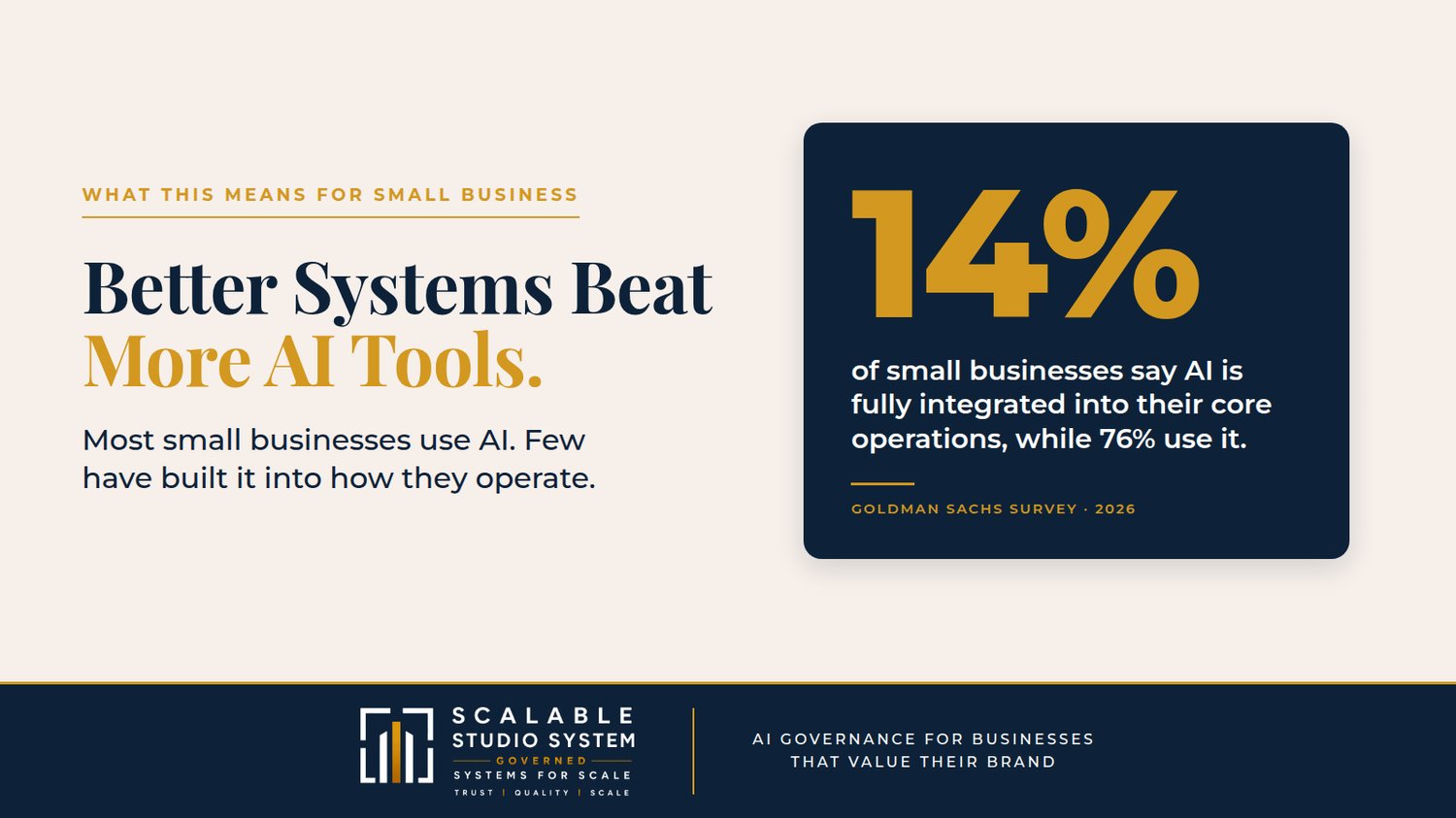
A 2026 Goldman Sachs survey found that 76% of participating small businesses were already using AI and 93% of those users reported a positive business impact.
But only 14% said AI was fully integrated into their core operations.
Seventy-three percent said additional training and resources would help them implement AI successfully.
Research from the Federal Reserve Bank of San Francisco identified similar barriers among smaller businesses, including limited time, staff capacity, training requirements, implementation knowledge gaps, costs, and concerns about accuracy and intellectual property.
This is the implementation gap.
Small businesses are not necessarily struggling to access AI.
They are struggling to turn AI into a structured business capability.
There is a significant difference.
Using AI is not the same as having an AI system
Imagine a business where the founder uses ChatGPT.
The marketing assistant uses Claude.
Someone creates images with another AI platform.
A contractor has built a few automations.
Customer information lives in several systems.
Prompts are saved in random documents.
Different people give AI different instructions about the company.
Some outputs are reviewed carefully.
Others are copied directly into customer-facing work.
Technically, this company is highly active with AI.
Operationally, it may be creating a mess.
There may be no shared source of truth.
No defined permissions.
No review standards.
No ownership.
No documentation.
No clear process for correcting outdated information.
No consistency in how the brand is represented.
And no way to determine which AI-generated decisions should have required human approval.
That is not an AI strategy.
It is unmanaged AI activity.
More capable AI makes governance more important, not less.
The newest AI systems make this distinction increasingly important because they can perform more actions independently.
Anthropic recently announced Enterprise Frontier Safeguards, developed with more than 100 enterprise customers. The system is specifically designed around issues such as monitoring agent behavior, detecting abnormal activity, customer-controlled review, and managing sensitive information.
Google has also expanded observability capabilities for enterprise AI agents, including views that track latency, errors, request volume, and how agents are performing operationally.
These developments reveal something important.
The major AI companies are no longer thinking only about what an AI model can produce.
They are building infrastructure around:
monitoring
permissions
visibility
auditability
security
human oversight
Businesses need to start thinking the same way.
Not necessarily with enterprise-scale infrastructure.
But with the same operating principles.
Small-business AI governance does not need to be complicated
The word governance can make this sound like something requiring compliance departments and fifty-page policies.
It does not.
For a smaller company, practical AI governance can begin with a few basic questions.
1. What is AI allowed to do?
Define where AI can operate.
Writing an internal draft is very different from sending a customer response.
Brainstorming marketing ideas is different from publishing them.
Summarizing information is different from making a financial, legal, hiring, or customer decision.
Different activities require different levels of control.
2. What information should AI use?
AI outputs depend heavily on the context they receive.
Businesses need authoritative sources for information such as:
brand standards
product information
services
pricing
policies
processes
customer communication standards
operating procedures
When those sources conflict, the AI needs a hierarchy that determines which information wins.
Otherwise, businesses end up trying to fix consistency through increasingly complicated prompts.
The underlying problem is not the prompt.
It is the information architecture.
3. Where is human review required?
AI should not automatically become the final decision-maker simply because it can complete a task.
Businesses need defined review points.
The more consequential the output, the stronger the review requirement should generally become.
Human review is especially important where AI output affects customers, reputation, money, sensitive information, contractual commitments, or the public representation of the brand.
4. Who owns the AI workflow?
Every important AI workflow needs an owner.
Someone should know:
what the workflow is supposed to accomplish
which information it uses
which tools are involved
where outputs go
where human review happens
how problems are corrected
Otherwise, AI workflows slowly become invisible infrastructure.
Everyone depends on them.
Nobody actually manages them.
5. How will the system change?
AI tools change constantly.
Business information changes too.
Products evolve.
Services change.
Policies change.
Brand standards change.
Employees and contractors change.
Governance therefore cannot be a document created once and forgotten.
It needs change control.
When an authoritative source changes, the AI system needs a defined way to inherit that change.
Stop measuring AI maturity by the number of tools you use
There is another trend worth watching.
As AI agents become easier to create, people are beginning to build increasingly large collections of specialized agents.
But even within the current enthusiasm around personal AI agents, there is growing skepticism about treating the number of agents as evidence of productivity.
The better measurement is whether those systems produce meaningful business outcomes without creating additional management overhead.
That distinction matters.
A business with three well-designed AI workflows can be considerably more AI-mature than a business with thirty disconnected agents.
AI maturity is not:
How much AI do we have?
It is:
How reliably does AI support the way this business operates?
The next phase of AI will be operational
AI adoption is no longer the interesting part.
The harder work is beginning now.
Businesses have to determine how AI fits inside their actual operating systems.
Not as another tab.
Not as another subscription.
Not as an employee experimenting independently.
As infrastructure.
That means connecting AI to:
authoritative information
clear operating rules
defined workflows
appropriate permissions
human review
accountability
change control
The companies that do this well will not necessarily be the companies using the newest model every week.
They will be the companies that can adopt new AI capabilities without creating new chaos every time the technology changes.
Because the real competitive advantage is not simply having access to powerful AI.
Everyone is getting access.
The advantage is building a business that knows how to use it.
Where to Start
Before adding another AI tool, agent, or automation, examine the AI already operating inside your business.
Ask:
What does it know?
Where did that information come from?
What rules is it following?
What is it allowed to do?
Who reviews its work?
Who owns the system?
If those answers are unclear, the next investment probably should not be another AI tool.
It should be a better system.
Scalable Studio System
Structured AI workflows. Clear operating systems. AI implementation built for the way real businesses work.