

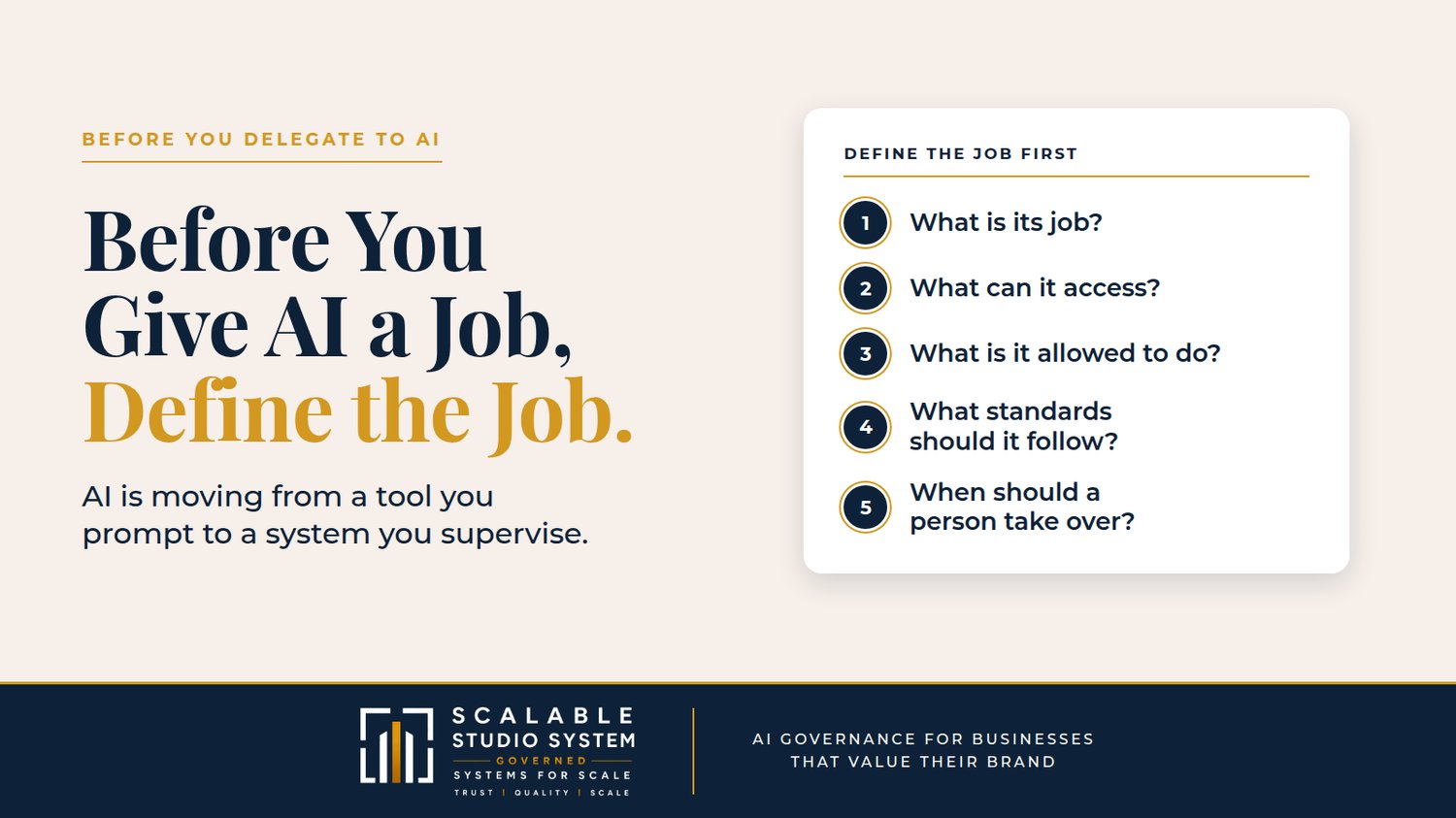
Before you give AI a job, you need to define the job.
For the last few years, most small businesses have used AI in roughly the same way.
Open a chatbot.
Type a prompt.
Get an answer.
Copy the answer somewhere else.
Then continue doing the work.
AI might write an email, summarize a document, brainstorm content, research a topic, or help organize a project.
Useful? Absolutely.
But in most cases, you are still running the process.
You decide what needs to happen. You give AI instructions. You review the response. You move the information into the right system. You decide what comes next.
That model is beginning to change.
AI is moving beyond tools that simply respond to prompts and toward AI agents that can work through multiple steps, use connected tools, follow instructions, and move a task toward completion.
That may sound like a small technological shift.
For a business, it is not.
It changes AI from something you ask for help into something you may begin to delegate work to.
And that means small businesses need to start thinking differently about how AI fits into their operations.
The Difference Between Asking AI and Delegating to AI
Consider something as simple as lead follow-up.
With a chatbot, you might ask:
“Write a follow-up email for this lead.”
AI generates the email.
You review it.
You send it.
You update your CRM or spreadsheet.
You decide when to follow up again.
An agent-based workflow could eventually look much more like this:
Review new inquiries, identify which leads meet our qualification criteria, prepare the appropriate response, update the lead record, schedule the next follow-up, and flag anything unusual for human review.
Now AI is not simply helping with one piece of the process.
It is participating in the workflow.
That is the real shift.
We are moving from:
AI as a tool you continually prompt
to:
AI as a system you supervise.
And that distinction matters.
Why AI Agents Matter So Much for Small Businesses
Small-business owners rarely have neatly separated responsibilities.
The same person may be managing:
- customer inquiries
- sales follow-up
- scheduling
- marketing
- projects
- vendors
- research
- documentation
- finances
- administrative work
- planning
- customer service
That is one reason AI has become so attractive to small businesses.
There is always more work than there is time.
AI agents create the possibility of moving beyond occasional assistance and allowing AI to handle defined pieces of recurring work.
That could eventually mean an AI system helps organize incoming information, prepare routine communication, maintain project updates, compile reports, research information, or coordinate parts of an established workflow.
The potential is substantial.
But so is the operational responsibility that comes with it.
Because once AI begins doing more than generating an answer, the question changes.
It is no longer simply:
What can AI help me with?
It becomes:
What should AI be allowed to do inside my business?
An AI Agent Needs More Than a Good Prompt
Imagine hiring someone and telling them:
“Help with operations.”
Then you give them access to your inbox, calendar, customer information, documents, marketing systems, and internal files.
But you provide:
No defined responsibilities.
No procedures.
No approval limits.
No explanation of what they should escalate.
No clear source of truth.
No standards for what good work looks like.
That would not create an efficient employee.
It would create confusion.
Yet businesses can easily make the same mistake with AI.
As AI becomes more capable, structure becomes more important, not less.
Before an AI agent takes responsibility for meaningful business work, several things need to be clear.
What is its job?
What specific outcome is the agent responsible for helping achieve?
“Help with marketing” is vague.
“Review approved content and prepare platform-specific drafts using our established brand guidelines” is much clearer.
What is it allowed to access?
Does it need access to your calendar?
Your customer database?
Internal documents?
Email?
Financial information?
Not every AI system needs access to everything.
What is it allowed to do?
There is a major difference between:
Draft an email for approval
and
Send the email automatically.
The same applies to publishing content, modifying records, scheduling meetings, communicating with customers, approving transactions, or making changes inside business systems.
What standards should it follow?
What information is authoritative?
Which brand guidelines apply?
What tone should it use?
What procedures should it follow?
What does an acceptable result look like?
When should a person take over?
Some situations should never be handled automatically.
Complex customer complaints.
Sensitive information.
Financial decisions.
Legal questions.
Unusual requests.
High-impact brand communications.
An agent needs rules for when to stop.
This Is Not Just Prompt Engineering
For a while, much of the conversation around business AI focused on better prompts.
Prompts still matter.
But once AI begins participating in workflows, prompts are only one part of the system.
Now we are talking about:
roles
permissions
workflows
source information
business rules
approval points
exceptions
escalation
oversight
That is not simply prompt engineering.
That is operational design.
And that is why businesses should be cautious about rushing directly from using ChatGPT to automating entire areas of their operations.
You need to understand the process before you hand the process to AI.
Start With the Workflow, Not the AI Tool
One of the easiest mistakes to make is discovering a powerful new AI tool and immediately asking:
What can I automate with this?
A better question is:
How does this work currently happen in my business?
Take client follow-up.
Before introducing an AI agent, you should understand the existing process.
Where does a new inquiry arrive?
How do you determine whether the person is a good fit?
What information needs to be collected?
How quickly should someone respond?
What tone should the response use?
Where should the conversation be documented?
When should another follow-up happen?
What happens if the request does not fit the normal process?
Which situations require your personal involvement?
Once that workflow is clear, you can decide which steps AI might appropriately support.
Without that clarity, you are not really automating a system.
You are automating confusion.
And confusion does not become more efficient just because it happens faster.
The Most Valuable AI Agent Might Be Boring
When people talk about AI agents, the examples can sound futuristic.
But some of the most useful applications for a small business may be surprisingly ordinary.
Think about the repetitive work that quietly consumes time every week.
AI could potentially help:
- categorize incoming information
- summarize meetings
- organize research
- prepare routine follow-ups
- compile recurring reports
- identify missing information
- prepare project updates
- organize documentation
- transform approved information into repeatable formats
- surface exceptions that need human attention
None of that sounds particularly dramatic.
That is exactly the point.
The value of AI agents may not come from replacing everything people do.
It may come from removing dozens of small manual steps that accumulate across a business.
The goal is not necessarily to eliminate humans from the process.
The goal is to let AI handle appropriate repeatable work while preserving human judgment where it matters.
More Capability Also Means More Risk
There is an important difference between a chatbot giving you the wrong answer and an AI agent taking action based on the wrong answer.
If a chatbot drafts something inaccurate, you may catch it before anything happens.
If an AI agent has permission to send, publish, modify, schedule, purchase, or communicate, mistakes can move beyond the chat window.
That makes governance much more important.
Small businesses should begin thinking about questions such as:
Should AI be able to send an email without approval?
Should it be allowed to change a customer record?
Can it publish content automatically?
Should it access confidential client information?
Can it schedule meetings?
Issue refunds?
Make purchases?
Respond to complaints?
Upload files?
Contact leads?
The correct answer will depend on the business and the task.
There is no universal rule that says everything should be automated.
The important thing is that these decisions are made intentionally.
Human Oversight Is Not Going Away
AI agents are often discussed as though complete autonomy is the goal.
For most small businesses, that may be the wrong target.
A better model is:
Controlled delegation.
AI handles work that is clearly defined, repeatable, and appropriate for automation.
Humans remain responsible for judgment, sensitive decisions, exceptions, relationships, strategy, and accountability.
That means the business owner's role may gradually change.
Instead of personally completing every step, you spend more time:
defining the workflow,
setting standards,
establishing boundaries,
reviewing exceptions,
and improving the system.
That is a much more useful vision of AI-enabled productivity than simply trying to automate everything.
Do Not Automate a Mess
This may be one of the most important rules small businesses can follow as AI agents become easier to use:
Do not automate a mess.
If your customer information is scattered across five places, AI does not automatically know which one is correct.
If everyone in the business handles the same situation differently, AI has no consistent procedure to follow.
If nobody knows which version of a document is current, an AI agent will not magically know either.
If your brand standards only exist in your head, AI cannot reliably follow them.
If you have never established who can approve what, automation can create more risk instead of less work.
AI depends on the structure around it.
It needs reliable information.
Clear instructions.
Defined permissions.
Consistent standards.
Known boundaries.
Human escalation points.
The businesses that ultimately benefit most from AI may not be the businesses using the most tools.
They may simply be the businesses with the clearest systems.
The Question Is Changing
The first phase of generative AI taught businesses how to talk to AI.
We experimented with ChatGPT.
We learned about prompts.
We asked AI to write, summarize, brainstorm, research, analyze, and create.
Now we are entering another phase.
AI is beginning to participate in the work itself.
And that changes the question from:
“What can I ask AI to do?”
to:
“What work am I prepared to delegate to AI?”
Those are very different questions.
The second requires you to understand the workflow.
Define the role.
Control access.
Establish standards.
Set approval limits.
Determine where human judgment belongs.
Create escalation rules.
And decide who—or what—is responsible for every step.
AI is becoming capable of doing more.
Businesses need to become equally good at deciding where that capability belongs.
Because the future of small-business AI probably will not be one chatbot sitting in a browser waiting for your next prompt.
It will increasingly be AI working inside the processes that run the business.
And before you give AI a job, you need to define the job.
Is Your Business Ready to Give AI More Responsibility?
If AI is already being used throughout your business, adding another tool or another automation may not be the most important next step.
First, you need to understand how AI is already interacting with your brand, information, workflows, and decisions—and where stronger structure may be needed.
That is the purpose behind the Scalable Studio System Brand AI Audit.
The audit is designed to help businesses take a structured look at how AI is being used across the brand and where governance, consistency, and clearer systems may be needed.
Because as AI moves from answering questions to participating in the work itself, governance cannot be something you think about after the automation is built.