

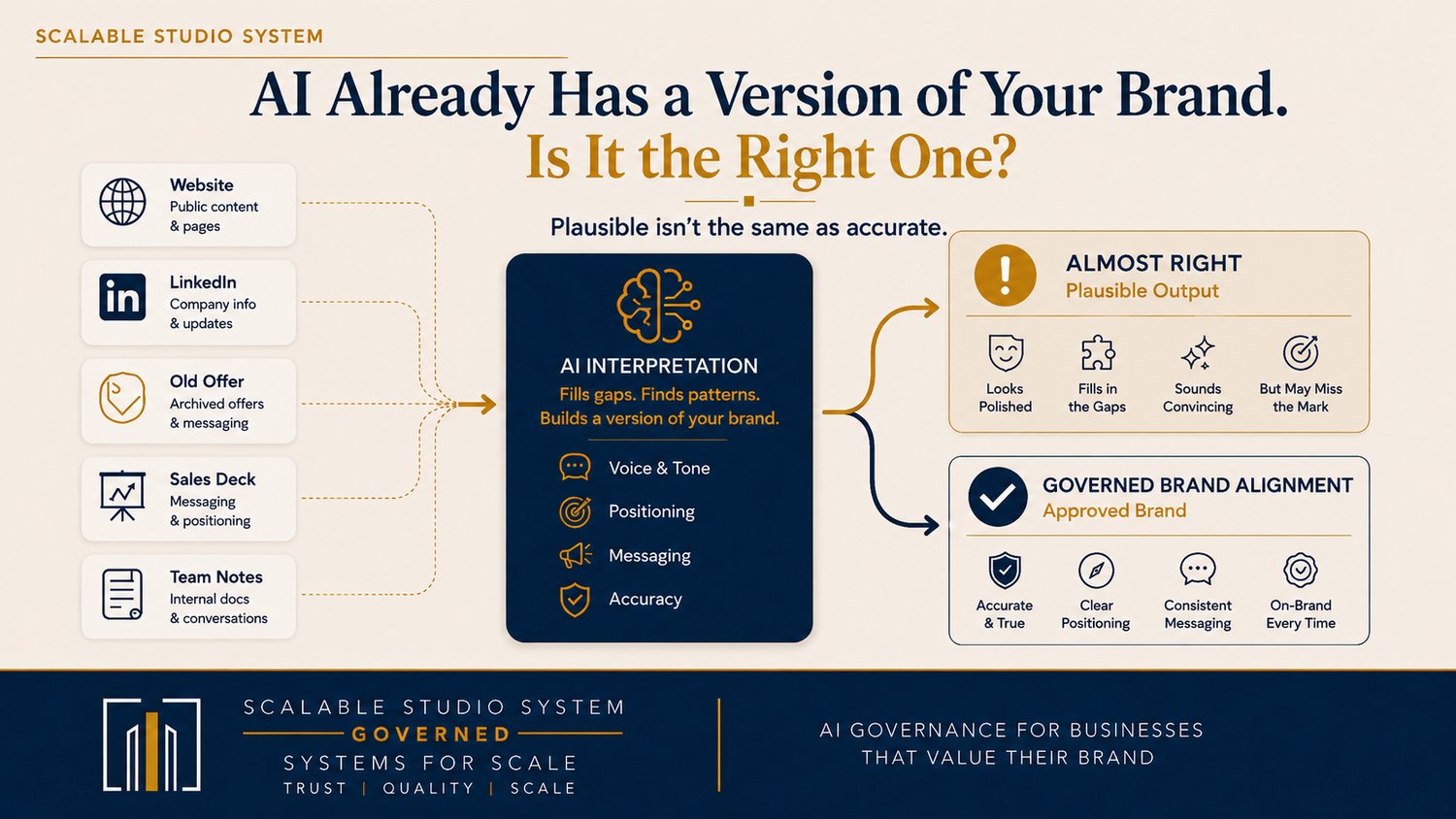
Every time AI describes your business, it makes decisions about your positioning, voice, audience, and offers — whether you formally taught it those things or not.
Ask an AI tool to describe your business.
At first glance, the answer may look impressive.
It may sound polished. Professional. Convincing.
It may even sound close enough to what you would say yourself.
But close enough is not the same as correct.
And that distinction matters more as businesses use AI across marketing, customer communication, research, content creation, proposals, internal documentation, and everyday operations.
AI does not simply repeat information.
It interprets it.
And every interpretation creates a version of your brand.
The question is whether that version is actually yours.
AI Fills in the Gaps
AI works with the information available to it.
Sometimes that information is clear.
Sometimes it is incomplete.
Sometimes it is outdated.
Sometimes different sources contradict each other.
And sometimes the information AI needs simply does not exist in a structured form.
When that happens, AI does what generative systems are designed to do:
It fills in the gaps.
That can create output that sounds entirely reasonable while still being wrong.
AI might:
- simplify your positioning too far
- emphasize the wrong service
- misunderstand who your ideal customer is
- use outdated terminology
- describe an old offer as if it still exists
- exaggerate a capability
- change your tone
- introduce language you would never normally use
- make assumptions about information that was never clearly defined
The problem is not always obvious.
In fact, some of the most dangerous AI errors are the ones that sound believable.
Plausible Is Not the Same as Accurate
Imagine AI generates this sentence about a business:
“We help growing companies automate their operations so they can scale without increasing headcount.”
It sounds strong.
But what if that business does not actually specialize in automation?
What if the real positioning is operational strategy?
What if the company serves founders, not “growing companies”?
What if reducing headcount has never been part of the brand promise?
Nothing about the sentence necessarily looks wrong.
Yet several pieces of the brand may have changed.
That is how AI brand drift often begins.
Not with something obviously ridiculous.
With something almost right.
Your Business May Have More Than One Public Story
Most companies assume they have one clear brand.
In reality, AI may be encountering several versions.
Your website may describe the company one way.
LinkedIn may describe it another.
An old product page may still appear online.
A directory listing may contain outdated information.
A team member may use different terminology.
A sales proposal may explain the offer differently than the website.
Your social media may emphasize a newer direction that has not yet been reflected elsewhere.
Individually, these inconsistencies may not seem significant.
But AI systems do not automatically know which version is authoritative.
They see information.
They interpret patterns.
They generate an answer.
And unless your business has clearly established which information should govern that answer, AI can construct its own version of the truth.
AI Can Understand Your Words and Still Miss Your Brand
Brand accuracy is about more than getting the company name and services correct.
Two descriptions can contain the same basic facts while representing very different brands.
Consider:
Version A
We provide AI consulting services that help businesses improve productivity.
Version B
We help businesses put structure around how AI is used so their teams can work more consistently, accurately, and at scale.
Both might technically describe the same company.
But they are not strategically equivalent.
The second communicates a different:
- position
- level of expertise
- customer problem
- value proposition
- tone
- competitive distinction
That is why AI brand alignment cannot be evaluated by asking only:
“Is this factually wrong?”
The better question is:
“Is this how we want the business represented?”
Brand Voice Creates Another Layer of Risk
AI can understand what your company does and still communicate it in the wrong voice.
A premium brand can suddenly sound casual.
A direct brand can become overly enthusiastic.
A sophisticated company can sound generic.
A trusted advisor can become promotional.
A restrained brand can start using exaggerated phrases such as:
revolutionary
game-changing
cutting-edge
transform your business
None of those phrases are inherently wrong.
They may simply be wrong for your brand.
And when different people use different prompts, tools, assistants, or AI workflows, those variations multiply.
One person generates an email.
Another creates social content.
Someone else rewrites website copy.
A contractor uses AI for a proposal.
Each output may be individually acceptable.
Together, they may no longer sound like the same company.
The Customer Only Sees One Brand
Customers do not divide your business into:
“human-written content”
“AI-generated content”
“contractor-created content”
“automated content”
“founder-written content”
They see your company.
That means every AI-generated interaction contributes to the same brand experience.
A prospect reading your website does not care which tool wrote the paragraph.
A customer receiving an email does not know which workflow generated it.
A potential client evaluating a proposal does not know whether the language came from a team member or an AI assistant.
They judge the outcome.
If the message is inconsistent, inaccurate, vague, or off-brand, the brand absorbs the consequences.
The Risk Grows as AI Becomes More Embedded
This matters even more as businesses move beyond occasional AI use.
AI is increasingly becoming part of:
- content workflows
- customer support
- sales communication
- internal knowledge systems
- research
- automated follow-up
- AI agents
- operational assistants
- documentation
- marketing production
The more responsibility AI receives, the more important its understanding of the business becomes.
If the foundation is aligned, AI can help scale consistency.
If the foundation is not aligned, AI can scale inconsistency.
That is why simply adopting more sophisticated AI tools does not automatically solve the problem.
A more powerful system working from unclear brand information can simply produce incorrect output faster.
You May Not Know Where the Drift Is Happening
This is where the issue becomes difficult for many businesses.
A founder usually recognizes a major error.
But subtle drift is harder to detect.
The business may be using AI every day without knowing:
- which information AI consistently misunderstands
- where messaging changes between outputs
- whether brand voice is stable
- where outdated information is still influencing responses
- which claims AI is making without adequate support
- whether different AI environments represent the company differently
- where stronger governance is needed
And once AI becomes distributed across a team, visibility becomes even harder.
The question is no longer simply:
“Are we using AI?”
It becomes:
“Do we know how AI is representing us?”
Those are very different questions.
Better Prompts Are Not Always the Answer
When AI output feels wrong, the instinct is often to rewrite the prompt.
Sometimes that works.
But repeated prompt correction can also be a symptom of a deeper problem.
If every new conversation requires someone to:
- explain the company again
- correct the terminology
- restate the audience
- fix the voice
- clarify the offer
- remove unsupported claims
- provide the same background information
then the issue may not be the individual prompt.
The system may not have a reliable understanding of the brand in the first place.
And that is an operational problem, not simply a writing problem.
Your Brand Should Not Depend on AI Guessing Correctly
AI should not have to infer the most important parts of your business.
It should not have to guess:
who you serve.
what you sell.
what you believe.
how you communicate.
which information is current.
what claims are approved.
where human judgment is required.
The more clearly those elements are governed, the more useful AI becomes.
And the less time your team spends correcting it.
The Real Question
The question is not whether AI can produce a convincing description of your business.
It probably can.
The question is:
Is the version AI is producing accurate, aligned, and consistent enough to represent your brand?
That requires more than reading one good response and deciding it “sounds right.”
It requires understanding where AI is aligned, where it is making assumptions, and where the brand is beginning to drift.
The Brand AI Audit
The Brand AI Audit from Scalable Studio System evaluates how AI currently understands and represents your business across key areas including:
Voice. Accuracy. Messaging. Brand alignment. Governance.
The purpose is not to make AI more complicated.
It is to identify where the system needs more control before those inconsistencies become embedded across your business.
Because AI already has a version of your brand.
You should know whether it is the right one.
Find the drift. Identify the gaps. Govern your brand.