

OpenAI, Anthropic, and AWS all made moves within days of each other. None of them change what actually determines whether AI works for your business.
In the last two weeks, three of the biggest names in AI all made moves that matter — and none of them were really about the technology getting smarter. They were about what happens once it does.
What happened
On August 31, AWS made its Agent Registry generally available: a private, governed catalog that lets organizations search and track every AI agent, tool, and skill running across their systems, instead of losing count of what they've already built. On September 1, Anthropic released Claude Fable 5.1, a faster, cheaper model built for coding, knowledge work, and long-running problem-solving. Three days later, on September 4, OpenAI rolled out GPT-6 Astra, which it's calling the best model yet for software engineering and computer-use tasks — letting ChatGPT operate a desktop and produce finished documents, spreadsheets, and presentations directly.
Two of those are model upgrades. The other is something else entirely: infrastructure built specifically to answer the question “what AI have we actually got running, and why?”
Why it matters
Model upgrades get the headlines. But the AWS announcement is the more telling one, because of who needed it and why. Amazon didn't build a registry because agents weren't capable enough — it built one because large organizations had gotten to the point where nobody could reliably say what agents and tools they had running, who owned them, or whether two teams had quietly built the same thing twice. In AWS's own words, it gives teams “complete visibility into their AI landscape” and lets them “discover existing capabilities instead of rebuilding from scratch.”
That's a big-company problem, solved with big-company infrastructure. But the underlying issue — using AI faster than you can keep track of how you're using it — isn't limited to companies with a cloud budget. It's just as real, and arguably more common, in a business with no IT department at all.
What it means for a small business
Every time a more capable model ships, it gets a little easier to bolt another AI tool onto your business without ever stepping back to look at the whole picture: a chatbot here, an automated email drafter there, an AI tool doing your bookkeeping categorization, another one writing product descriptions. Each one felt like a five-minute decision at the time. Six months later, almost nobody can answer basic questions about the setup: which tool is doing what, whether it's still the best option, what happens if it changes its pricing or shuts down, or why it was set up that way in the first place.
GPT-6 Astra and Claude Fable 5.1 both raise the ceiling on what a single AI tool can do unsupervised — multistep workflows, finished documents, long-running tasks completed with less oversight. That's genuinely useful. It's also exactly the kind of capability that turns a small, forgettable shortcut into a piece of infrastructure you're quietly depending on without ever having decided to.
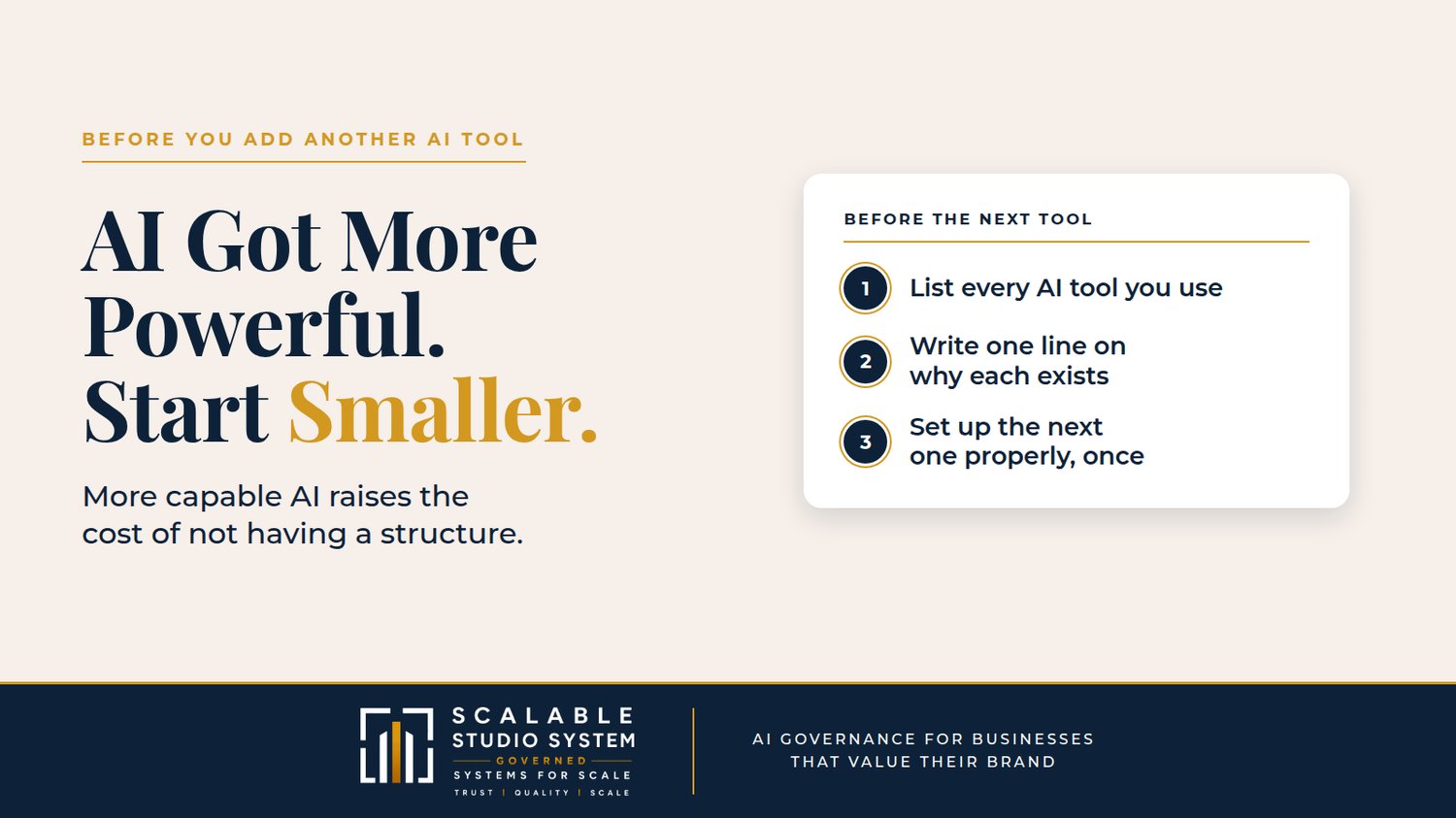
More capable AI doesn't remove the need for a starting structure. If anything, it raises the cost of not having one.
What to do next
You don't need an AWS-style registry to fix this — you need the small-business equivalent of stepping back once and actually looking at what you're running. Before you add the next AI tool because a new model made it more capable:
- List every AI tool currently touching your business, even the small ones. Most people are surprised by the count.
- For each one, write one line on what it does and why you chose it. If you can't answer that quickly, that's the one to look at first.
- Pick the next thing you want AI to help with, and set it up properly once — with a clear purpose and a way to check the output — rather than adding another one-off tool to the pile.
That third step is where most AI projects actually go sideways: not from picking the wrong tool, but from never having a structured starting point to begin with. That's exactly what Scalable Studio System's Build Your AI Project God Mode — Complete Kit ($97, on Payhip) is built for: a step-by-step framework — Ground, Organize, Define, Map, Operate, Direct, Evolve — for setting up an AI project inside a tool like ChatGPT or Claude Projects with real structure behind it, instead of bolting on another one-off tool and hoping.
The models will keep getting more capable. That was never really the hard part.