

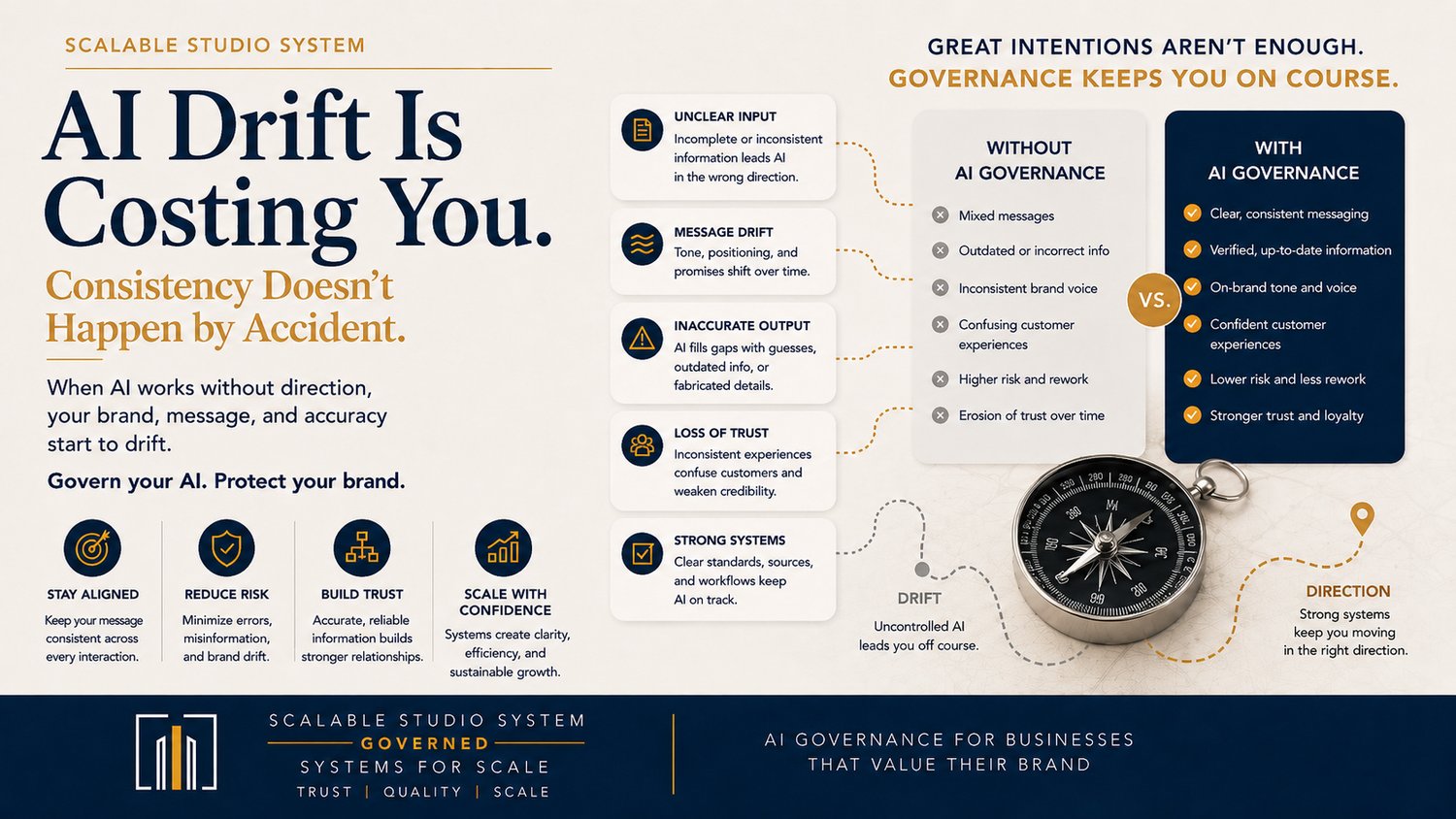
How AI quietly creates brand drift — and what businesses need to do before it becomes a bigger problem.
AI is becoming part of everyday business operations.
It writes emails.
Creates social posts.
Drafts website copy.
Answers customer questions.
Builds proposals.
Generates marketing ideas.
Summarizes documents.
Supports internal workflows.
And increasingly, it represents your business before you ever review the output.
That is where the problem begins.
The issue is not that businesses are using AI.
The issue is that many businesses are using AI without a system for determining whether what it produces is actually accurate, consistent, trustworthy, and aligned with the brand.
AI adoption is moving faster than AI governance.
And that gap can quietly create a very different version of your business than the one you intended to build.
Your Brand Can Drift Without Anyone Noticing
Brand drift rarely happens all at once.
It happens one AI-generated sentence at a time.
A slightly different explanation of your service.
A different tone in a customer email.
A headline that sounds more aggressive than your normal brand voice.
A product description that makes a promise you never approved.
A social post that uses terminology your company does not normally use.
A chatbot response that gives a customer inaccurate information.
Individually, these may look like minor inconsistencies.
Collectively, they create a governance problem.
Your customers do not know which content was written by you, your team, a contractor, or an AI system.
They simply experience your brand.
If every interaction sounds different, explains the business differently, or makes slightly different promises, trust begins to erode.
AI Makes Inconsistency Easier to Scale
Before generative AI, producing large amounts of business content required significant time.
That friction naturally limited output.
AI removed much of that friction.
A business can now generate dozens of marketing assets, emails, product descriptions, social posts, FAQs, proposals, and internal documents in a fraction of the time.
That is an enormous operational advantage.
It also means mistakes can scale just as quickly.
If your AI starts with incomplete instructions, outdated information, unclear brand standards, or inconsistent source material, it can reproduce those problems across hundreds of outputs.
Faster content production does not automatically create a stronger brand.
Sometimes it simply creates faster brand drift.
The Real Question Is Not “Are You Using AI?”
The better question is:
What is controlling the AI you are using?
If the answer is essentially:
- whatever prompt someone happens to type
- information copied from an old document
- whatever ChatGPT already knows
- instructions stored in one employee's account
- different prompts used by different team members
- brand guidelines that AI has never been given
- or “we review it before posting”
then your organization may already have an AI governance gap.
That does not mean AI needs to be removed.
It means the system around AI needs to mature.
Five Signs Your Business May Have an AI Brand Governance Problem
1. AI describes your business differently depending on who asks
Ask several AI tools — or even the same tool in different conversations — to explain what your company does.
Do you receive essentially the same answer?
Or does your positioning change?
Your target customer?
Your services?
Your terminology?
Your value proposition?
Your differentiators?
When AI does not have an authoritative source of truth, it fills gaps itself.
That is useful during brainstorming.
It is dangerous when AI is representing a business.
2. Your AI-generated content does not consistently sound like your brand
Most businesses have a recognizable communication style even if they have never formally documented it.
Maybe your brand is analytical and direct.
Maybe it is warm and conversational.
Maybe it is premium and restrained.
Maybe it is playful.
AI can imitate almost any voice.
But unless that voice is clearly defined, different prompts will produce different interpretations of what your brand should sound like.
Soon your website sounds one way.
Your LinkedIn posts sound another.
Your emails sound completely different.
And your customer service communication sounds like a fourth company.
That is voice drift.
3. AI occasionally invents or exaggerates information
Generative AI is designed to produce plausible responses.
Plausible is not the same as correct.
Without strong source controls, AI may:
- infer services you do not offer
- invent policies
- exaggerate capabilities
- use outdated pricing
- misstate product details
- create unsupported claims
- confuse internal terminology
- or confidently fill in information it does not actually know
A polished answer can still be a wrong answer.
For a business, that distinction matters.
4. Different people on your team are using AI differently
One person has a sophisticated prompt library.
Another uses basic one-line prompts.
Someone created a custom GPT six months ago.
Another employee has important instructions buried inside an old conversation.
A contractor is using their own AI account.
The founder has the most accurate prompts — but no one else has them.
This is common.
It is also difficult to scale.
If critical business knowledge exists primarily inside individual AI conversations, the organization does not truly control that knowledge.
The individual user does.
5. There is no clear answer to “What is AI allowed to say?”
Most brand guidelines were created for human designers and writers.
They cover things such as:
logos.
colors.
fonts.
taglines.
tone of voice.
Maybe messaging.
But AI introduces a new category of questions.
What information is authoritative?
What terminology must always be used?
What claims require human approval?
Which topics should AI never answer without escalation?
Which business policies may AI reference?
What information is outdated?
What can AI generate autonomously?
What must always be reviewed?
These are no longer theoretical governance questions.
They are operational questions.
Brand Guidelines Are No Longer Enough
Traditional brand guidelines are still important.
But AI needs something more structured.
A human designer can look at a style guide and understand nuance.
AI works through instructions, examples, constraints, reference information, and defined decision rules.
That means businesses increasingly need to translate their brand into an AI-usable operating system.
Not simply:
“Our voice is professional and friendly.”
But:
This is how our brand speaks.
This is how we describe the company.
These are the terms we use.
These are the terms we avoid.
These are our approved claims.
These are our authoritative sources.
These situations require escalation.
These outputs require human review.
That is the difference between casually using AI and intentionally governing it.
What Is a Brand AI Audit?
A Brand AI Audit evaluates how accurately and consistently AI currently understands and represents a business.
The goal is not to determine whether your company should use AI.
The goal is to determine whether the AI you are already using has enough structure to represent the business correctly.
A strong audit examines areas such as:
Brand Understanding
Does AI correctly understand who you are, what you offer, who you serve, and how you are positioned?
Voice & Tone
Does AI consistently communicate in a way that actually sounds like your business?
Messaging
Are your core messages, differentiators, offers, and terminology consistent?
Accuracy
Is AI producing unsupported assumptions, outdated information, or incorrect claims?
Visual Standards
Are AI-assisted creative outputs aligned with your established brand system?
Governance
Are there clear controls around what AI can generate, what information it should use, and what requires human review?
The result should tell you where your AI systems are aligned — and where drift has already started.
This Is Not About Making AI More Complicated
Good governance should make AI easier to use.
When the system is clear, your team spends less time:
rewriting AI output.
correcting terminology.
fixing tone.
checking basic facts.
re-explaining the business.
rebuilding prompts.
starting new AI conversations from scratch.
or trying to remember which prompt finally produced the right result.
Instead, AI becomes more repeatable.
And repeatability is what turns an interesting tool into useful infrastructure.
The Founder Should Not Be the Brand Control System
There is another warning sign many growing businesses overlook.
The founder becomes the final quality-control layer for everything AI produces.
Someone creates a post.
The founder fixes it.
Someone drafts an email.
The founder rewrites it.
AI produces website copy.
The founder corrects the positioning.
A contractor creates something.
The founder explains the brand again.
At that point, the business technically has brand standards.
But those standards primarily exist inside the founder's head.
That does not scale.
The objective of AI governance is not to remove the founder's judgment.
It is to turn that judgment into a system that other people — and AI — can reliably follow.
Before You Scale AI, Audit What It Already Knows
Businesses are rapidly adopting AI agents, automations, custom GPTs, AI assistants, AI customer support tools, and AI-powered workflows.
But adding more AI on top of inconsistent brand information does not solve the underlying problem.
It multiplies it.
Before you automate more content…
Before you give AI more customer-facing responsibility…
Before you build more agents…
Before you distribute AI across your team…
Make sure the foundation is accurate.
Because once AI becomes embedded across the organization, correcting the system becomes significantly harder than correcting a prompt.
The Brand AI Audit
The Brand AI Audit from Scalable Studio System is designed to identify where AI is accurately representing your business — and where brand drift, inconsistent messaging, accuracy risks, or governance gaps are beginning to appear.
The objective is straightforward:
Understand what your AI currently believes about your brand before you allow it to represent more of your brand.
Because the competitive advantage will not belong simply to businesses that use the most AI.
It will belong to businesses that can use AI without losing control of what makes their brand theirs.
AI Is Not the Problem.
Unmanaged AI Is.
Ready to see what AI is actually saying about your business?