

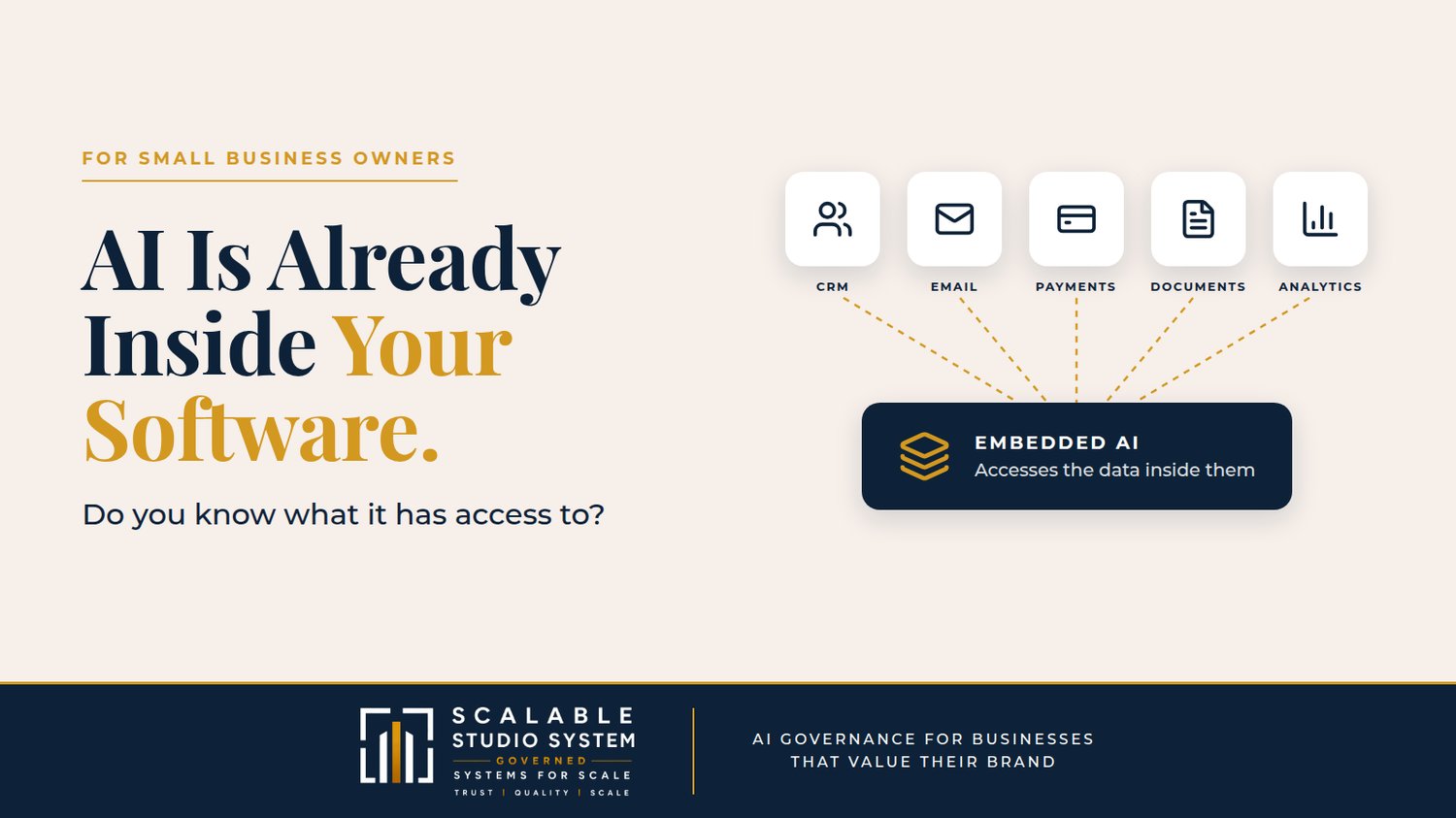
The next AI governance problem may not be the tool your business chooses. It may be the AI quietly arriving inside software you already use.
For many businesses, the first stage of AI adoption was obvious.
Someone opened ChatGPT.
A team subscribed to an AI writing platform.
A business intentionally added an automation.
A company tested an AI assistant.
Those tools were visible because someone deliberately chose to use them.
The next stage is different.
AI is increasingly becoming part of the software businesses already depend on.
Customer relationship platforms.
Email tools.
Meeting applications.
Project management systems.
Design platforms.
Accounting software.
Customer support tools.
Marketing platforms.
Website builders.
Analytics systems.
Browser extensions.
Scheduling software.
The business may not think of these products as part of its "AI stack."
But if those products now use AI to analyze information, generate content, summarize conversations, recommend actions, process customer data or automate work, they are part of the AI environment whether the business deliberately set out to build one or not.
That creates a new governance question:
Do you actually know where AI is operating inside your business?
The AI you selected is only part of the picture
AI governance conversations often begin with obvious tools.
Which employees are using ChatGPT?
Can customer information be entered into an AI model?
Which AI products have been approved?
Those are useful questions.
But they assume that AI enters the organization as a clearly identifiable AI product.
Increasingly, it does not.
AI can arrive as a feature inside an existing application.
A software provider can introduce:
AI summaries
AI search
AI-generated recommendations
AI writing assistance
AI meeting notes
AI analytics
AI customer responses
AI workflow automation
AI agents
The company may already trust the underlying software vendor.
That does not automatically mean every new AI capability should inherit the same level of trust.
An application storing information is one thing.
An AI system interpreting, transmitting, generating from or taking action on that information can be something very different.
This distinction is becoming important enough that the National Institute of Standards and Technology specifically addresses third-party AI risk in its AI Risk Management Framework.
NIST recommends that organizations identify and maintain documentation for third-party AI systems and components, monitor those resources, apply risk controls and establish contingency processes for important third-party systems.
The issue is not simply which AI companies you use.
It is understanding the AI supply chain behind the business systems you use.
Your software vendor may not be the AI provider
This is where the picture becomes more complicated.
Imagine that a business uses a customer service platform.
The platform launches an AI assistant.
To the business, it may look like one product from one vendor.
Behind the interface, however, that feature could involve several different components.
The customer service company may provide the application.
Another company may provide the underlying AI model.
Additional services may provide search, data storage, integrations or infrastructure.
The AI feature may interact with information stored elsewhere in the customer's technology stack.
That means the real question is not only:
Who is our software vendor?
It may also be:
What AI services exist behind our software vendor?
NIST's Generative AI Profile describes this problem as value chain and component integration.
Generative AI systems can depend on third-party datasets, pretrained models, software libraries and other components, creating additional complexity and reducing transparency for downstream users.
The International Association of Privacy Professionals has also highlighted the growing challenge of third-party AI APIs. A company can purchase one application while data moves through the application developer to a separate AI provider before an output returns to the business.
For a small business owner, understanding every technical layer may not be realistic.
Understanding that those layers exist is increasingly important.
Follow the data, not just the AI label
When evaluating embedded AI, one of the most useful questions is also one of the simplest:
Where does our information go?
Suppose an existing meeting platform introduces AI-generated summaries.
The useful governance questions are not limited to whether the summary is accurate.
They include:
What information does the feature process?
Are recordings or transcripts sent to another provider?
How long is that information retained?
Can the vendor use it for another purpose?
Is it used to improve or train models?
Can administrators disable the feature?
Can individual employees activate it?
Does enabling it change existing privacy or contractual terms?
What happens to previously processed information if the feature is turned off?
Now apply the same questions to a CRM containing customer histories.
Or an accounting platform containing financial information.
Or a support platform containing customer conversations.
Or a project system containing internal strategy.
The feature may simply say "AI Assistant."
The governance question is really about the data pathway behind the button.
The familiar vendor problem has changed
Businesses already understand vendor management.
Before adopting important software, they may consider:
cost
security
reliability
features
contracts
integrations
support
data protection
AI adds another layer.
A product that was reviewed last year may not be the same product today.
Its AI capabilities can change.
Its model provider can change.
Its integrations can change.
The types of information processed can change.
A feature that originally summarized information may later be able to create records, communicate with customers or initiate actions.
NIST's AI Risk Management Framework recommends monitoring third-party AI resources and specifically identifies issues such as sparse documentation, inconsistent release schedules and incomplete software change management as indicators organizations may need to evaluate.
That creates an important shift in vendor governance:
Approval cannot always be permanent.
A vendor may still be approved.
But a significant new AI capability may deserve its own review.
The emerging idea of an AI supply chain
Software security has spent years developing ways to understand the components hidden inside applications.
AI governance is beginning to confront a similar problem.
In May 2026, a presentation hosted by NIST's Cybersecurity Supply Chain Risk Management program specifically addressed navigating the AI supply chain and the concept of an AI Bill of Materials, or AIBOM.
The approach emphasizes inventory, responsibilities, risk understanding and demonstrating that controls actually work.
A small business does not need to build a sophisticated AIBOM program to benefit from the underlying idea.
The principle is simple:
You cannot meaningfully govern technology you cannot identify.
That means an AI inventory eventually needs to include more than obvious standalone AI tools.
It needs visibility into AI embedded within other systems.
Start with an embedded AI inventory
This does not require a fifty-page assessment.
Start with the software the business already relies on.
For each important platform, identify:
Software: What system are we using?
Business purpose: What does it do for us?
AI capability: Does the product currently contain AI functionality?
Status: Is that functionality enabled, optional, disabled or unknown?
Data: What company, employee or customer information can the feature access?
AI provider: Does the vendor identify the underlying model or AI service?
Action: Does the AI only generate information, or can it change records, communicate or trigger workflows?
Control: Can an administrator restrict or disable it?
Terms: Are there separate AI terms, privacy conditions or data-use provisions?
Owner: Who is responsible for reviewing meaningful changes to the product?
The point is not to create administrative work for its own sake.
It is to make invisible infrastructure visible.
Ask vendors better questions
Businesses do not need to become AI engineers.
They do need to become better AI customers.
When an important vendor introduces an AI feature, useful questions include:
What powers the AI feature?
Is the vendor using its own model?
A third-party model?
Multiple models?
Can the underlying provider change?
What business data reaches the AI?
Do not settle for "your data is secure."
Determine what categories of information the feature actually processes.
How is our information used?
Processing information to provide a feature is not necessarily the same as using information to improve a model.
Those differences matter.
What can administrators control?
Can AI functionality be disabled?
Can specific users access it?
Can individual features be restricted?
Can data sources be excluded?
What happens when the feature changes?
Does the vendor communicate material changes to AI functionality, providers or terms?
Is there a way to reassess the feature before broader use?
These questions turn AI vendor management from:
"Do we trust this company?"
into a more useful question:
"Do we understand this specific AI capability well enough to decide how it belongs in our business?"
Regulation is also beginning to look at the AI value chain
The movement toward greater visibility is not limited to voluntary frameworks.
The European Union's AI Act increasingly distinguishes among different participants in the AI value chain, including model providers, AI-system providers and deployers.
The European Commission's guidance for general-purpose AI models requires certain providers to make documentation available to downstream AI-system providers so those organizations can understand model capabilities and limitations and meet their own obligations.
Separately, transparency obligations under Article 50 began applying on August 2, 2026, with responsibilities applying to certain providers and deployers of AI systems.
Not every small U.S. business will fall under those particular provisions.
But the broader direction is significant:
Responsibility does not disappear merely because one company purchased AI capability from another company.
The AI value chain matters.
The problem with "we don't use AI"
This creates an interesting new problem for business owners.
A company might accurately say:
"We haven't purchased any AI tools."
And still be operating with AI.
Its website platform may have introduced it.
Its CRM may contain it.
Its email system may offer it.
Its meeting software may activate it.
Its contractor may use a tool containing it.
Its marketing platform may use AI to generate recommendations.
Its customer support application may use AI to categorize messages.
The question "Do we use AI?" is rapidly becoming too simple.
A better question is:
"Where does AI touch our business?"
That produces a very different conversation.
There is also a difference between having a feature and needing it
AI is becoming a competitive feature for software companies.
That does not mean every AI feature creates meaningful value for every customer.
Businesses should be willing to ask:
What problem does this feature solve for us?
If the answer is unclear, adding another AI-enabled process may create more exposure, complexity and management overhead without producing meaningful business value.
This is where disciplined AI adoption becomes important.
A feature should not become part of the company's operating environment simply because a software update placed a colorful AI button on the screen.
There should still be a business reason to use it.
Build an AI map before you build a bigger AI stack
The businesses most prepared for the next phase of AI may not be the ones with the longest list of AI tools.
They may be the ones with the clearest visibility.
They know:
which systems contain AI
which features are active
which information those features can access
which vendors sit behind them
which capabilities matter to the business
and when something important has changed
That visibility creates options.
The business can enable useful capabilities intentionally.
Restrict unnecessary ones.
Ask better vendor questions.
Recognize new risks earlier.
And adopt new AI functionality without losing track of how information and authority are moving through the company.
The next AI governance challenge is therefore not simply controlling the AI tools employees choose.
It is discovering the AI that has become part of the business without looking like a separate AI tool at all.
Where to Start
Open the list of software your business depends on most.
Do not start with ChatGPT.
Start with everything else.
Your CRM.
Email.
Accounting.
Project management.
Website.
Customer support.
Scheduling.
Marketing.
Meetings.
Design.
Analytics.
For each one, ask:
Does this product contain AI now?
Is it enabled?
What information can it access?
Does another company provide the underlying AI?
What can the feature actually do?
Can we control it?
Would we know if something important changed?
You may discover that your AI environment is considerably larger than your list of AI subscriptions.
And that is exactly why embedded AI deserves governance of its own.
Scalable Studio System
Structured AI workflows. Governed business systems. Practical AI implementation for businesses that want the benefits of AI without losing control of how it operates.