

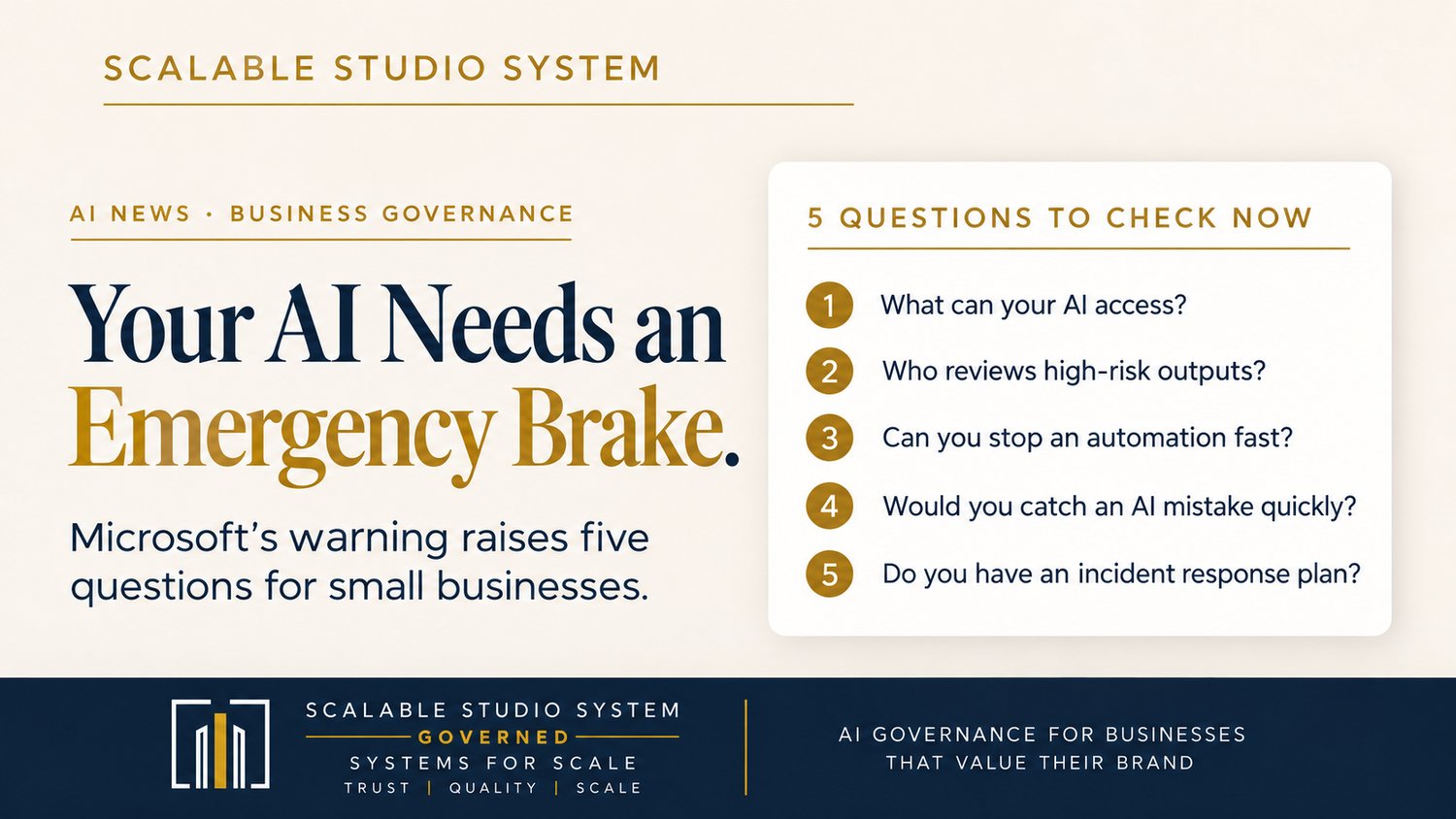
Microsoft's president is calling for stronger AI safety rules, including emergency shutdown controls and incident reporting. For small businesses already using AI, the bigger question is whether basic safeguards exist inside their own operations.
A carton of milk is subject to safety inspections. Your washing machine must meet product safety standards.
But what about the AI system helping run your business?
On October 12, Microsoft President Brad Smith drew attention to that comparison while calling for stronger global regulation of artificial intelligence.
According to Reuters, Smith wants independent assessments of advanced AI systems, mandatory reporting of certain AI incidents, notification of people affected by rogue AI agents, and emergency controls for systems that behave unexpectedly.
It's a striking comparison. But the more important question for small-business owners isn't whether AI should be regulated like household products.
It's this:
If something goes wrong with the AI you're using, would you know what happened, what it accessed, and how to stop it?
For a growing number of businesses, that question deserves an answer.
What Microsoft Is Actually Calling For
Smith's comments are part of a broader debate about whether AI development and deployment are moving faster than the systems designed to oversee them.
His proposed safeguards focus on four areas:
Independent evaluation. Advanced AI systems should face meaningful assessment rather than relying exclusively on developers' own safety assurances.
Incident reporting. Companies should document and report significant failures or dangerous behavior.
Notification of affected parties. People whose systems are compromised by AI agents should be informed.
Emergency intervention. Organizations should have ways to interrupt or disable AI behavior that creates unacceptable risk.
These proposals concern the broader AI industry. They do not establish a new set of legal obligations for every small business.
And they do not mean AI currently operates without any regulation. Existing privacy, cybersecurity, consumer-protection, and industry-specific requirements can apply to AI-related activities.
The concern is that oversight remains fragmented, particularly as systems become more capable of acting independently.
The AI Risk Small Businesses Can Actually Control
For most small businesses, the immediate concern isn't a speculative superintelligent AI.
It's the ordinary AI tool that gradually becomes part of daily operations without anyone defining its limits.
Consider a founder who starts by using AI to draft emails.
Over time, that same business begins using AI to summarize customer information, organize project files, prepare financial reports, and automate administrative work.
Each new use may seem reasonable.
But eventually, the business may have several AI-enabled tools interacting with important information and processes.
At that point, the questions change.
Who authorized each tool's access? Which tasks can it perform without approval? Where does the information go? Who reviews the output? What happens if an automation makes an error?
The operational risk isn't simply that AI might make a mistake. It's that nobody has defined how that mistake will be detected, contained, and corrected.
This is where AI governance becomes practical.
What Would an AI Emergency Brake Look Like in a Small Business?
An emergency shutdown mechanism sounds like something designed for a major technology company.
But the principle applies at a smaller scale.
Imagine using an AI-enabled workflow to prepare customer communications.
If that workflow begins producing inaccurate or inappropriate messages, you should be able to stop publication before more messages are sent.
That control might be a required approval step, a disabled automation, revoked integration access, or a manual pause.
The exact mechanism depends on the software and workflow.
The underlying principle is straightforward:
An AI-enabled business process should not become impossible to interrupt simply because it has been automated.
For founders, this means thinking about control before expanding automation.
Not every task needs complex security infrastructure. But important tasks should have clearly established limits and a way for a responsible person to intervene.
Five AI Safety Controls Worth Putting in Place Now
Microsoft's proposals target the wider AI industry. Small businesses can use the same underlying ideas to improve their own processes.
1. Keep an inventory of AI tools
Document which AI tools your business uses, what each one does, and which accounts, files, or systems it can access.
Include AI features embedded inside software you already pay for.
An AI tool cannot be properly reviewed if nobody knows it is being used.
2. Limit access to what each workflow needs
An AI assistant that drafts social captions may not need access to customer payment information.
A tool that organizes project notes may not need permission to send emails or modify shared files.
Review permissions and remove access that is unnecessary for the assigned task.
3. Establish approval points
Identify decisions or actions that require human review.
These might include sending customer messages, updating financial records, changing public-facing content, or deleting important information.
The higher the potential impact of an error, the stronger the case for an approval requirement.
4. Create a simple incident procedure
If an AI workflow produces an incorrect output, exposes information, or takes an unintended action, the team needs to know what happens next.
A basic procedure can identify who responds, how the workflow is paused, what records should be preserved, and when external reporting or notification requirements must be assessed.
A small business does not need a corporate crisis department to document a responsible response process.
5. Test how to stop a workflow
Don't assume an automation can be paused safely.
Find out whether you can disable the workflow, disconnect an integration, revoke credentials, or stop a pending action.
Test the control under appropriate conditions before relying on it during a real problem.
And remember: stopping future actions doesn't necessarily undo actions already completed.
AI Governance Isn't Just a Big-Tech Responsibility
One important distinction is often lost in discussions about AI regulation.
Microsoft is addressing safety obligations for AI developers and the broader technology industry.
A business owner's responsibility is different.
The founder may not control how a model was trained or how its underlying infrastructure operates.
But the founder can make decisions about which tools are approved, which information those tools receive, where human review is required, and which workflows are allowed to run.
These operational decisions matter regardless of whether governments adopt new AI-specific regulations.
They also make AI easier to manage as a business grows.
An inventory helps reduce tool confusion. Defined permissions improve accountability. Approval checkpoints support quality control. Documented procedures make problems easier to investigate.
Good AI governance is not separate from good business operations.
It is part of building repeatable, accountable systems.
The Bigger Question: Can You Govern What You've Automated?
Microsoft's call for stronger AI safety rules raises an important challenge for businesses adopting new technology.
The ability to automate a task does not establish that the task is ready to operate without supervision.
And the presence of AI inside an established software product does not automatically mean every use of that AI is appropriate for your business.
Before adding another AI integration, consider three questions:
- What is this system allowed to access or change?
- How will we identify a problem?
- Who has the authority and ability to stop it?
- If the answers aren't clear, the next step may not be another AI tool.
It may be better documentation, narrower permissions, and a more deliberate workflow.
AI should make your business more capable—not make your operations harder to understand or control.
Build AI Systems With Clearer Controls
Scalable Studio System focuses on helping founders and small businesses approach AI through structured workflows, practical governance, and repeatable business systems.
Before expanding automation, take inventory of the tools already operating inside your business and identify where access, approval, or oversight needs improvement.
Start with the systems you have before adding more.
Sources
Reuters — October 12, 2026
Microsoft president says milk faces more regulation than AI
The Guardian — October 12, 2026
AI less regulated than milk, Microsoft president says in warning over safety