

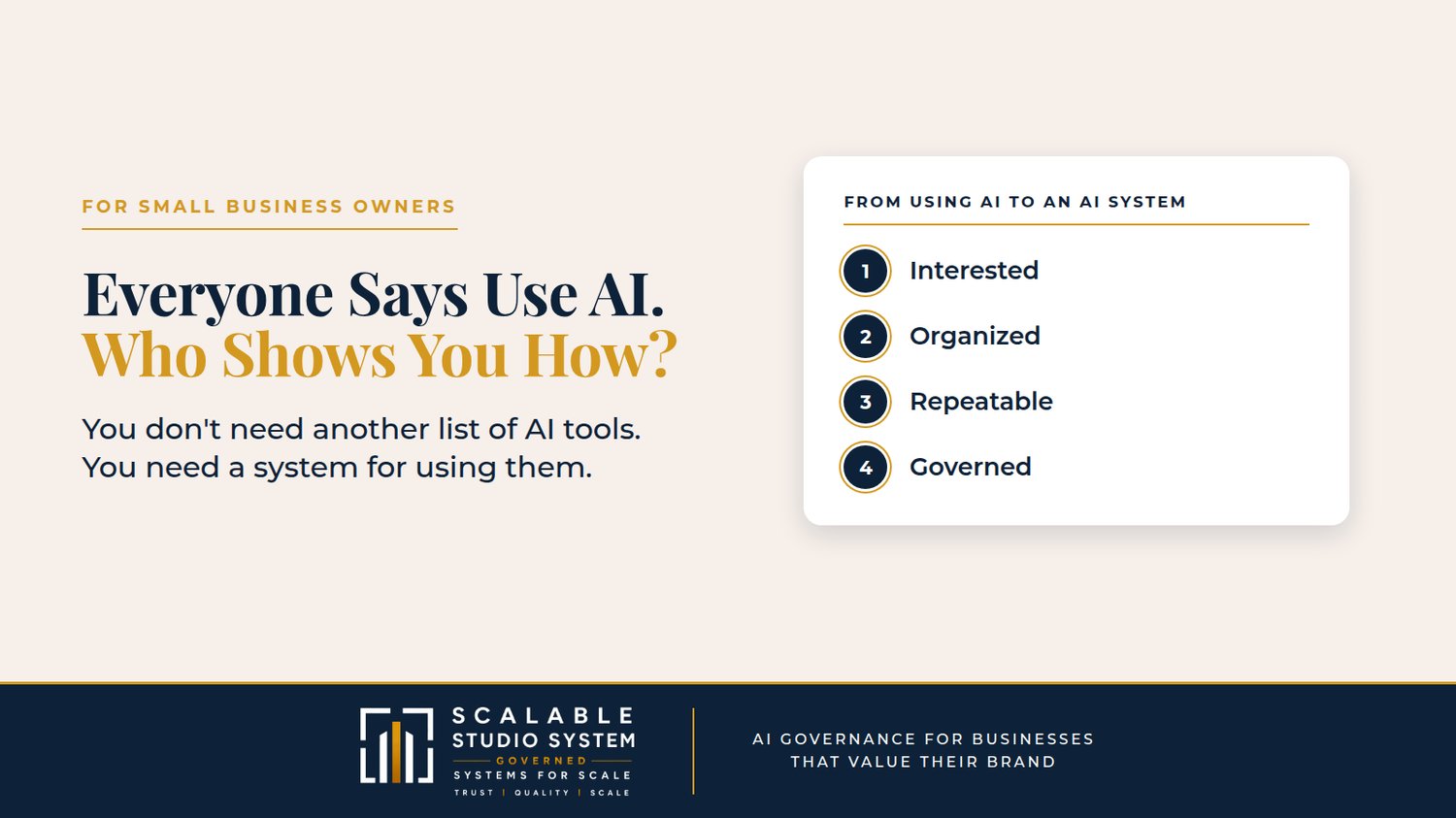
Small businesses don't need another list of AI tools. They need a system for actually using them.
Open almost any business feed right now and you will see the same message:
Small businesses need AI.
Use AI to save time.
Use AI to create content.
Use AI for customer service.
Automate repetitive work.
Build AI agents.
Create workflows.
Increase productivity.
Scale without adding overhead.
The graphics are everywhere.
The statistics are everywhere.
The recommendations are everywhere.
And increasingly, small-business owners seem to agree.
Recent research from QuickBooks found that more than three-quarters of U.S. small and midsize businesses now use AI regularly. SBE Council reported that 82% of small-business employers have adopted at least one AI tool, with the typical business using several different tools.
So the question is changing.
It is no longer:
“Should my business use AI?”
For many owners, the real question is:
“How am I actually supposed to set all of this up?”
And that is where a surprising amount of AI advice stops.
KNOWING WHAT AI CAN DO IS NOT THE SAME AS KNOWING HOW TO IMPLEMENT IT
A business owner can understand perfectly well that AI could help with:
• marketing
• content
• customer communication
• research
• documentation
• administrative work
• project management
• repeatable workflows
But recognizing an opportunity is not the same thing as building a working system around it.
There is a large gap between:
“Use AI to streamline your business.”
and:
“Here is how this process should actually work inside your business.”
That second question is harder.
What information does the AI need?
Where should that information live?
What should the workflow look like?
What happens first?
What happens next?
What should be automated?
What should remain human-controlled?
Which instructions should always stay consistent?
How do you stop rebuilding the same prompt every time?
How do you know whether the system is actually working?
Those are implementation questions.
And they matter much more than another list of the “10 Best AI Tools for Small Business.”
THE RESEARCH IS STARTING TO SHOW THE SAME GAP
Recent AI-adoption data makes this distinction increasingly important.
Clutch's August 2026 research found that small businesses already using AI are becoming significantly more sophisticated.
But the foundations are uneven.
Only 54% reported having a formal AI strategy.
Only 54% said their data was clean and organized.
And while many businesses have introduced guidelines and training, 38% still lack formal guidelines governing employee AI use.
At the same time, businesses are preparing for considerably more advanced AI use.
Clutch found 62% plan to use AI agents, while 46% plan greater integration between AI and existing business software.
That creates an important question:
Are businesses building more powerful AI on top of systems that were never properly organized in the first place?
Because an AI agent does not eliminate the need for structure.
It increases it.
MORE AI TOOLS DO NOT AUTOMATICALLY CREATE AN AI SYSTEM
This is one of the biggest misconceptions in small-business AI adoption.
Having ChatGPT, Claude, Canva AI, an automation platform, and several AI-enabled business applications does not necessarily mean you have an AI system.
You may simply have five separate tools.
SBE Council's research found the typical AI-using small business now uses about five AI tools.
But the more tools you add, the more questions you create.
Which tool does what?
Where does the approved information come from?
Which process belongs where?
What naming system should everyone use?
Which instructions should remain consistent?
Where are outputs stored?
What requires review?
How do you repeat a successful process next week?
How do you hand that process to someone else?
That is where AI moves from tool use to operational design.
THE MISSING LAYER IS STRUCTURE
The businesses that get sustained value from AI are not simply collecting prompts.
They are beginning to create structure around how AI is used.
For a small business, that structure does not need to look like an enterprise technology department.
But it does need to answer some basic operational questions.
What are we trying to improve?
Not “we need AI.”
What process actually needs to work better?
What does the AI need to know?
Your business information cannot remain scattered across old chats, documents, websites, and someone's memory.
What should happen every time?
A repeatable workflow requires more than a good result once.
What rules stay consistent?
Your standards should not disappear every time someone starts a new AI conversation.
How will we maintain it?
Businesses change.
Offers change.
Processes change.
AI systems need to evolve with them.
THIS IS WHY WE BUILT THE SCALABLE STUDIO SYSTEM EBOOK KITS DIFFERENTLY
A Scalable Studio System Ebook Kit is not designed to be something you read, close, and forget.
And it is not simply a polished PDF explaining what AI can do.
The kit is the tool.
The ebook provides the instruction.
The supporting materials help you build the system while you learn it.
Depending on the kit, that can include practical resources such as:
• guided workbooks
• implementation templates
• copy-and-use files
• checklists
• workflow builders
• reference guides
• examples
• trackers
• system documentation
• maintenance tools
The objective is not:
“Now you understand AI better.”
The objective is:
“Now you have something in your business that did not exist before.”
That distinction matters.
START WITH ORGANIZATION, NOT AUTOMATION
One of the fastest ways to make AI feel chaotic is to start automating before deciding how the work should operate.
That is why Organize Your AI Workflow begins with the foundation.
Before building more prompts, tools, or automations, you need to understand:
What are you using AI for?
Where does the work belong?
What should be repeatable?
What information supports it?
How will you keep it organized?
The goal is not more AI activity.
It is a cleaner AI operating environment.
THEN TURN REPEATABLE WORK INTO WORKFLOWS
Once the foundation is organized, the next question becomes:
Which parts of the business should become repeatable AI-assisted processes?
That is the purpose behind Build Your First 5 AI Workflows.
Instead of opening an AI tool and deciding what to type each time, the business begins defining repeatable processes around work it performs regularly.
The difference is substantial.
A prompt helps you complete a task.
A workflow helps you complete the same category of task consistently again and again.
That is where AI starts becoming operational.
AND THEN GOVERN HOW AI REPRESENTS THE BUSINESS
As AI takes on more responsibility, consistency becomes increasingly important.
Who decides how the brand sounds?
What terminology should AI use?
What should it avoid?
What information is authoritative?
What happens when AI is uncertain?
What should always receive human review?
Those questions are behind Govern Your AI Voice.
Because AI should not become more powerful inside the business while becoming less controlled.
YOU DO NOT NEED AN ENTERPRISE AI DEPARTMENT
This is another place where small-business AI advice often becomes unnecessarily intimidating.
You do not need:
a huge technology budget.
a data-science department.
a 40-person implementation team.
or an elaborate corporate transformation initiative just to begin creating structure.
Small businesses can implement AI well.
But small does not mean structureless.
In fact, structure can matter even more when there are fewer people and less time available to correct inefficient systems.
STOP ASKING ONLY “WHICH AI TOOL SHOULD I USE?”
A better sequence is:
What are we trying to accomplish?
How should the work operate?
What does AI need in order to do its part correctly?
What needs to stay consistent?
Then — which tool fits that system?
That reverses the way many businesses currently adopt AI.
Instead of buying technology and then searching for something to do with it, you build the operating logic first.
The tool becomes part of the system.
Not the system itself.
SMALL BUSINESSES DON'T NEED MORE AI HYPE
The evidence that AI can help small businesses is becoming difficult to dispute.
Owners are reporting time savings, productivity improvements, better communications, and revenue impact.
But adoption statistics do not tell an individual business owner how to make AI actually work inside their company.
That requires a different kind of resource.
Not another graphic saying:
USE AI.
Not another list of tools.
Not another collection of random prompts.
Small businesses need practical systems that help them move from:
Interested → Organized → Repeatable → Governed.
THAT IS WHAT SCALABLE STUDIO SYSTEM IS BUILT FOR
Our Ebook Kits are designed for business owners who are ready to move beyond simply experimenting with AI.
You do not just receive information about what you could do.
You receive the structure and supporting tools to help you build it.
Because the next stage of small-business AI adoption will not be defined by who has access to AI.
Nearly everyone does.
It will be defined by who learns how to turn that access into a system.
Don't just use AI. Build the way your business uses it.
Explore the Scalable Studio System Ebook Kits.
Trust | Quality | Scale