

AI can make work faster.
But using AI more often doesn’t automatically make your business more organized.
In fact, without a system, the opposite can happen.
You find a prompt that works well, but two weeks later you can’t remember which version you used.
You create a useful ChatGPT conversation, but the process stays buried inside that chat.
You improve a task with AI, but there’s no documented workflow explaining how to repeat it.
You have prompts in documents, notes, browser tabs, project folders, and old conversations — and eventually you’re spending nearly as much time looking for your AI work as you are using it.
The problem isn’t necessarily the AI.
The problem is that the work around the AI was never organized into a repeatable system.
Using AI Is Not the Same as Having an AI Workflow
There is a significant difference between asking AI to help with a task and building a workflow that can be used again.
A one-time prompt can produce a useful answer.
A workflow gives that work structure.
It creates a clearer way to understand:
- what the task is supposed to accomplish
- where the information required for the task comes from
- how AI fits into the process
- what needs to be reviewed before the work is considered complete
- where the finished process and supporting materials belong
That distinction becomes increasingly important as AI starts touching more areas of a business.
Marketing.
Research.
Customer communication.
Planning.
Content creation.
Operations.
Documentation.
Administrative work.
The more AI you use, the more important organization becomes.
The Hidden Cost of “I Know Where Everything Is”
At first, an informal AI setup may work perfectly well.
You remember the important prompts.
You know which chat contains the good version.
You recognize which instructions need to be added before running a task.
And because you created the process, much of the missing information exists in your head.
That works — until it doesn’t.
The problem usually becomes visible when you need to:
Repeat the work.
You know you completed the task successfully before, but rebuilding the exact process takes longer than expected.
Improve the work.
You change prompts and instructions over time, but there is no clear record of what changed or which version should now be used.
Hand the work off.
Another person can see the prompt, but they cannot necessarily see all of the decisions, context, standards, and knowledge you automatically bring to the task.
Scale the work.
What felt manageable with three AI-assisted tasks becomes significantly harder when there are twenty.
This is where AI organization stops being administrative housekeeping.
It becomes part of how the business operates.
A Better Question to Ask
Instead of asking:
“What prompts should I save?”
Start asking:
“What AI-assisted work in my business needs to become repeatable?”
That is a very different question.
It moves the focus away from collecting prompts and toward building usable workflows.
A prompt may be part of the workflow.
But it is not the entire workflow.
The workflow also needs enough structure that you can return to it later and understand what happens, why it happens, and what “done correctly” actually means.
That is what turns scattered AI activity into an operating asset.
Your AI Work Should Become Easier to Find — and Easier to Trust
A well-organized AI workflow should reduce uncertainty.
You should not have to wonder:
Where is the prompt?
Is this the current version?
What information did I give the AI last time?
Did I already create a process for this?
Which result am I supposed to use?
What am I supposed to check before this goes out?
Those questions are signs that the workflow still depends too heavily on memory.
And memory is difficult to scale.
The goal is not to document every click, every conversation, or every interaction with AI.
The goal is to create enough structure that the work can be found, understood, repeated, and improved.
Start With the Work You Already Do
You do not need to reorganize your entire business at once.
Look at the AI-assisted tasks you are already repeating.
Which ones happen every week?
Which prompts do you keep searching for?
Which processes would be difficult to explain to someone else?
Which tasks have multiple versions scattered across different places?
Which AI conversations contain work you would not want to lose?
Those are usually the best places to start.
Because the strongest AI systems often aren’t created by adding more technology.
They are created by organizing the valuable work that already exists.
Organize Your AI Workflow
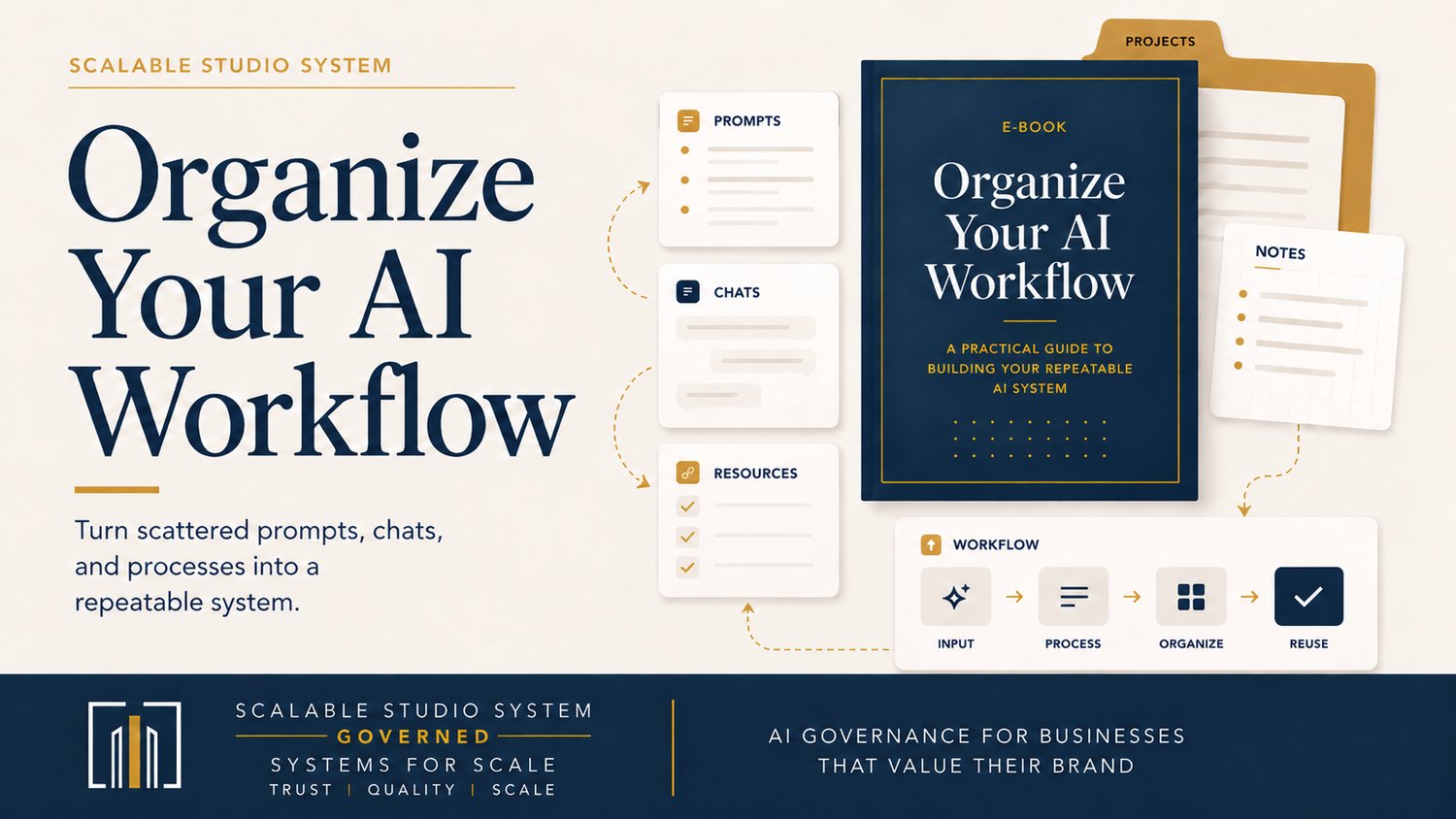
Organize Your AI Workflow — Complete Kit was created for business owners who are using AI but need a more structured way to manage the work around it.
Instead of adding another collection of disconnected prompts to your business, the kit helps you begin turning AI-assisted tasks into organized, repeatable workflows.
It is designed to help you move away from:
scattered prompts → undocumented processes → knowledge trapped in conversations
and toward:
organized workflows → clearer operating structure → AI work you can actually reuse
The Complete Kit includes the ebook plus practical implementation resources so you can work through the system instead of simply reading about it.
Because the goal isn’t to become better at collecting AI advice.
The goal is to build AI workflows your business can actually use.
Ready to Organize the AI Work You’ve Already Created?
If your prompts, chats, instructions, and AI-assisted processes are starting to feel scattered, Organize Your AI Workflow — Complete Kit gives you a structured place to begin.
Explore Organize Your AI Workflow