

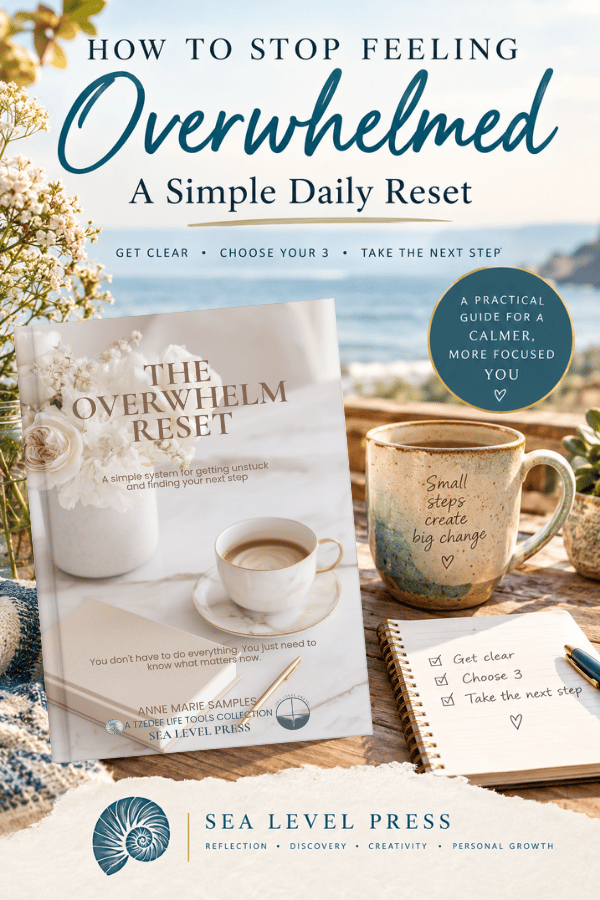
How to Stop Feeling Overwhelmed:
A Simple Reset for When Everything Feels Like Too Much
Have you ever reached the end of a long day feeling exhausted, yet somehow feeling as though you accomplished nothing?
The laundry is still waiting. Your inbox is overflowing. There are errands to run, people who need you, decisions to make, and a dozen little things you promised yourself you would get done today. You move from one task to another, trying to keep everything together. You make lists, reorganize your plans, and tell yourself that tomorrow you'll be more productive. But tomorrow arrives, and the list is even longer.
If this sounds familiar, I want you to consider something:
What if you don't need to do more? What if you need a better way to decide what deserves your attention right now?
Sometimes, the answer to feeling overwhelmed isn't a better planner, a stricter routine, or another productivity hack. Sometimes, it's learning to pause, clear your head, and begin again with a little more intention.
Let's talk about how to do that.
Why Do I Feel Overwhelmed Even When I'm Trying My Best?
Feeling overwhelmed often happens when the number of things competing for our attention exceeds the time, energy, or mental space we have available. And it's not always the big things that wear us down.
It's the appointment we need to schedule, the message we haven't answered, the project we started but haven't finished, the groceries we need to buy, and the small promise we made to someone three days ago.
Each unfinished task takes up a little space in our minds.
When we try to remember everything, prioritize everything, and respond to everything at once, it becomes difficult to identify what actually matters most. We can spend an entire day being busy without making meaningful progress on the things that matter to us. This is one reason an overwhelming to-do list can become counterproductive. Instead of helping us move forward, it can leave us feeling discouraged before we've even started.
And here's the part I think we need to hear more often:
Being overwhelmed doesn't necessarily mean you're bad at managing your time. It may mean you're trying to carry too much in your head at once.
You don't need to solve your entire life today. You need a place to start.
How to Stop Feeling Overwhelmed When You Have Too Much to Do
When everything feels urgent, it's tempting to work faster, push harder, and try to catch up on everything.
But before you add another task to your schedule, try a different approach.
Step 1: Stop Trying to Remember Everything
One of the simplest ways to begin managing overwhelm is to get your thoughts out of your head and onto paper. This is often called a brain dump: writing down the tasks, worries, ideas, responsibilities, and unfinished business occupying your attention.
Don't worry about organizing your thoughts yet. Don't decide whether something is important. Don't try to make your list look pretty.
Just write.
Include the practical things, such as paying a bill or making a phone call. Include the personal things, such as wanting to spend more time with your family or finally starting that project you've been thinking about for months.
Write down the things you keep reminding yourself not to forget. The goal isn't to create a longer to-do list. It's to give yourself a chance to see what's actually on your mind instead of repeatedly trying to hold it all in your memory. Once your thoughts are on paper, you have something you can work with.
Step 2: Decide What Actually Matters Today
Here's where we often get stuck.
We look at our list and assume everything on it needs our attention immediately.
But does it?
Some tasks have real deadlines. Some matter deeply but can wait until another day. Others have been sitting on our lists for weeks simply because we haven't decided what to do with them.
When you're figuring out how to prioritize tasks when everything feels urgent, ask yourself three questions:
- What genuinely needs to be done today?
- What would make a meaningful difference if I completed it?
- What can wait without creating a real problem?
Be honest with yourself.
Not every task deserves the same level of attention. Not every request requires an immediate response. And not every good idea needs to become today's project.
You are allowed to make choices about where your time and energy go.
Prioritizing isn't about proving you can do everything. It's about deciding what deserves to be done first.
Step 3: Choose Three Priorities
Now, look at your list and choose three things that would make today feel productive or meaningful.
Three. Not fifteen disguised as three categories. Not three enormous projects that would take a week each. Three realistic priorities for the day you're actually having. Maybe your three are paying an overdue bill, preparing dinner, and spending twenty uninterrupted minutes with your child. Maybe they're finishing a work assignment, taking a walk, and making the appointment you've been putting off.
Your priorities will change depending on your circumstances. That's the point.
A good daily plan should support your real life, not an imaginary version of your life in which you have unlimited energy, no interruptions, and an extra six hours every day. Choose three things that matter. Let the rest of the list exist without demanding that you finish it all today.
You can make new choices tomorrow.
Step 4: Start With One Small Win
Once you've identified your priorities, resist the urge to tackle everything at once. Choose one task and take the next practical step.
If the kitchen feels impossible, clear one section of the counter.
If the paperwork is overwhelming, open the first envelope.
If you've been avoiding a difficult project, spend ten minutes getting started.
You don't have to feel completely motivated before you begin. Sometimes, beginning is what helps you find your momentum.
And remember: a small win is still a win.
We tend to measure productivity by how much we finish. But progress also includes the decisions we make, the things we simplify, and the moments when we choose to stop scattering our attention and focus on one thing. Give yourself credit for moving forward, even when the movement is small.
Step 5: Make Room for Being Human
Here's something that deserves a place in every conversation about productivity: your energy is not unlimited. You are not a machine designed to complete an endless list of assignments. You have relationships to nurture, a body that needs rest, emotions that deserve attention, and a life that is happening while you're busy trying to manage it.
Some days, you will accomplish all three priorities. Other days, an unexpected phone call, a sick child, a difficult conversation, or simple exhaustion will change your plans. That doesn't mean your reset failed. It means life happened. Adjust your expectations. Choose the next right step. Give yourself permission to begin again. The goal isn't to create a perfect day. It's to create a more intentional one.
What If You Still Feel Behind?
You might be thinking, "This sounds wonderful, but I have so much to do that three priorities barely make a dent."
I understand the temptation to dismiss a small reset when the bigger picture feels enormous. But consider this: if you could finish everything on your list simply by working harder, wouldn't you have done it already?
Sometimes, the problem isn't a lack of effort. It's that our expectations have grown beyond our available capacity.
There will always be another email, another errand, another home project, and another opportunity to improve something. If you measure a successful day by whether you've finally reached the end of your responsibilities, you may spend your life waiting for a finish line that keeps moving.
Instead, begin measuring progress by the choices you make.
Did you focus on something important? Did you take a step toward a goal? Did you give your attention to someone you love? Did you make room to rest instead of pushing yourself past your limits?
Those things count, too.
You can be a responsible person without responding to everything immediately. You can have meaningful goals without pursuing all of them at once. You can want more for your life while appreciating the life you have today.
You don't have to finish everything to make today count.
The Overwhelm Reset: A Simple Way to Begin Again
I created The Overwhelm Reset around a simple idea: when life feels like too much, you don't always need another complicated system. You need a practical way to pause, sort through the noise, and decide what comes next.
It's a guided digital workbook designed to help you slow down and get your thoughts onto paper, identify your priorities, and take action without feeling as though you must tackle your entire life at once.
The process is simple:
- Clear your head. Put your thoughts, responsibilities, and unfinished tasks on paper.
- Choose your three. Identify the three priorities that deserve your attention today.
- Take your next step. Begin with something manageable instead of waiting for the perfect moment.
- Recognize your progress. Give yourself a visible reminder of what you've accomplished.
I also wanted the experience to feel encouraging rather than demanding. That's why the workbook includes colorful DONE boxes, giving you a satisfying way to recognize completed tasks instead of focusing only on what remains unfinished. Because sometimes, we need a reminder that we are making progress. And sometimes, seeing that progress helps us keep going.
The Overwhelm Reset is a digital PDF workbook you can use at your own pace. You don't need an elaborate morning routine, an empty calendar, or an entire free afternoon. You simply need a few moments to pause and begin.
If you're looking for a simple way to organize your thoughts, prioritize your day, and feel less overwhelmed by your to-do list, I'd love for you to take a look.
Explore The Overwhelm Reset at Sea Level Press:
Visit the Sea Level Press shop or visit SeaLevelPress.net
You Can Begin Again Without Starting Over
I want to leave you with one thought.
You don't have to wait until Monday to get organized. You don't have to wait for the house to be clean, the schedule to settle down, or every unfinished project to be resolved.
You can begin again in the middle of an ordinary Wednesday.
You can begin again after a difficult week.
You can begin again when you realize the way you've been doing things isn't working anymore.
A reset doesn't erase your responsibilities. It helps you approach them with a little more clarity.
So, if your mind feels crowded and your to-do list feels endless, take a breath.
Get a piece of paper.
Write down what's on your mind.
Choose three things that matter today.
Then take one small step.
You don't have to do it all. You just have to decide what comes next.
And tomorrow? You can begin again.
Sea Level Press is a place for reflection, discovery, creativity, and personal growth. Our goal is to help you slow down, look beneath the surface, and make room for what matters most.
Join our FREE weekly email list and receive a FREE digital book at SeaLevelPress.net
Comments ()