
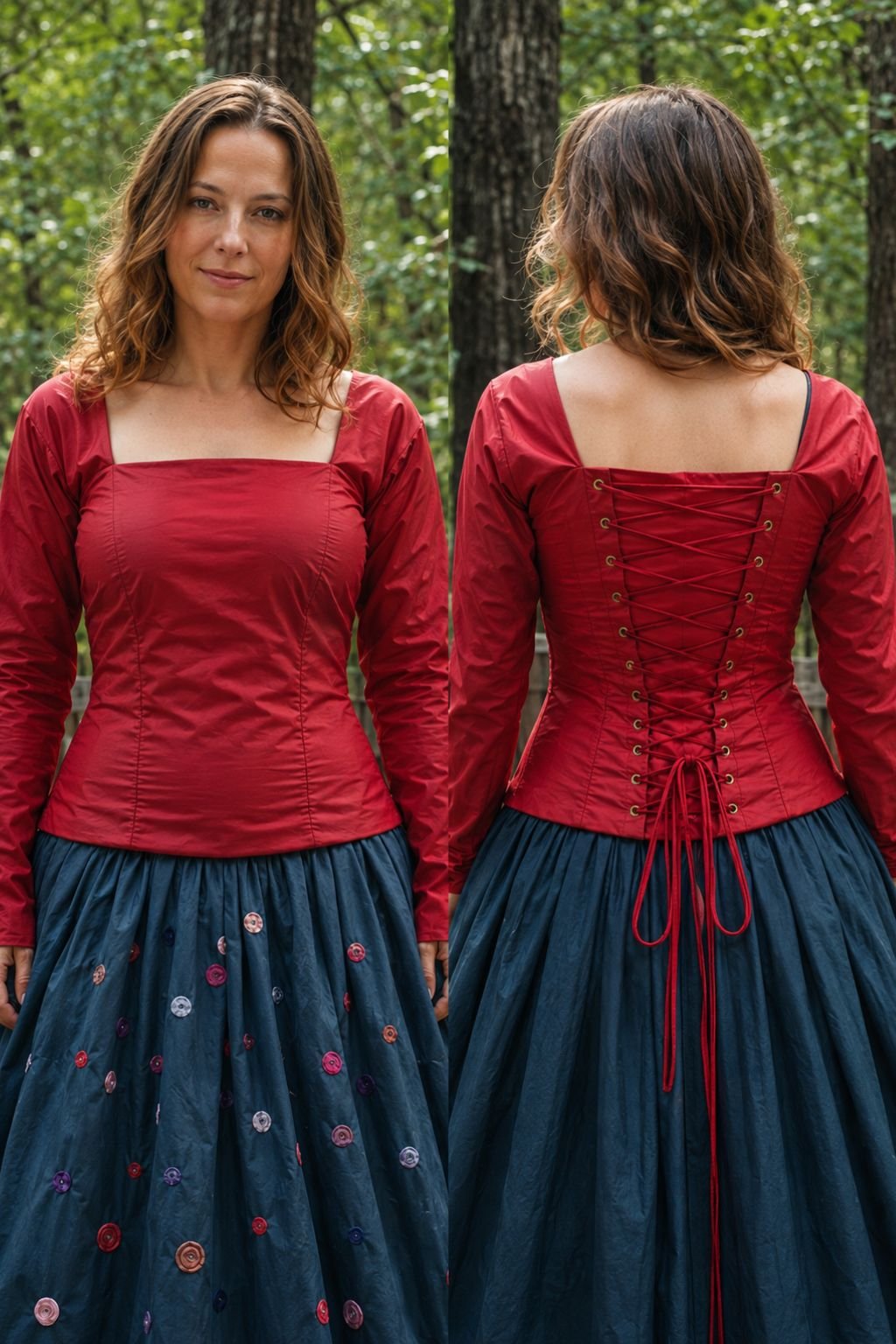
Let’s talk about the part of a dress that doesn’t get nearly enough credit.
The bodice.
It may not have the dramatic swish of a full skirt or the romance of flowing sleeves, but the bodice is doing some serious work behind the scenes. It shapes the garment, supports everything attached to it, helps determine the fit, and gives the dress its personality.
Think of it as the skeleton of the outfit.
Except this skeleton can be covered in velvet, laced with ribbons, decorated with embroidery, and, if we're being honest, occasionally make you question every life decision that led you to start sewing it.
Welcome to the anatomy of a bodice.
So… What Exactly Is a Bodice?
A bodice is the portion of a garment that covers the torso, generally from the shoulders down to the waist or hips.
Historically, bodices could be incredibly simple or surprisingly complicated depending on the period, social class, materials, and intended purpose of the garment.
Modern sewing patterns often break the bodice into several pieces, and each piece has a job.
It's a little like assembling a tiny fabric puzzle.
And unlike a normal puzzle, this one eventually gets worn.
The Seams: Where Everything Comes Together
Let's start with the most obvious part: seams.
Seams are where individual pieces of fabric are joined together.
Sounds boring, right?
Not at all.
Where you place those seams can completely change the appearance of a garment.
You can have:
- Center-front seams
- Center-back seams
- Side seams
- Princess seams
- Shoulder seams
- Waist seams
Each creates a different shape and visual line.
Princess seams, for example, can travel from the shoulder or armhole down toward the waist and create a beautifully shaped silhouette without relying on traditional darts.
And here's something I love about sewing:
The seams that make the garment fit your body can also become part of the design.
They're not just construction.
They're architecture.
Darts: Tiny Folds With a Big Job
If you've ever looked at a pattern and wondered why someone decided to put a random triangle-shaped marking on your bodice, congratulations.
You've met the dart.
A dart removes a small amount of fabric from one area so the garment can curve around the body instead of hanging like a cardboard box.
And that little fold can make an enormous difference.
Bust darts, waist darts, shoulder darts, and other variations can all shape fabric in different ways.
Essentially, a dart says:
«“This flat piece of fabric needs to become three-dimensional.”»
And that's one of the coolest things about sewing.
You're taking something flat and convincing it to become a shape.
Closures: How Are We Getting Into This Thing?
Eventually, we have to address the important question:
How do you get the bodice on?
This is where closures enter the picture.
Depending on the garment, you might find:
- Buttons
- Hooks and eyes
- Zippers
- Snaps
- Ties
- Grommets and lacing
- Hidden closures
Historical garments often relied heavily on lacing, hooks, ties, and other closures rather than modern zippers.
And there's something undeniably beautiful about a row of carefully placed eyelets with ribbon or cord woven through them.
Of course, closures aren't just decorative.
They need to hold the garment securely while still allowing you to put it on and take it off without requiring assistance from three people and a crowbar.
Facings: The Unsung Heroes
Facings aren't usually the part people notice first.
And that's exactly how they like it.
A facing is a piece of fabric used to finish an edge, such as a neckline, armhole, or opening.
It gives the edge a clean, finished appearance and helps prevent the garment from looking like you simply cut a hole in it and called it a day.
Facings can be simple.
They can also become beautiful design elements.
And if you've ever turned a garment inside out and thought, “Oh, this is actually pretty in here,” there's a good chance the finishing work deserves some credit.
Lining: The Pretty Secret on the Inside
Now let's talk about lining.
A lining is an additional layer of fabric placed inside the garment.
It can make a garment more comfortable, help protect the outer fabric, provide structure, hide construction details, and simply make the finished piece feel more polished.
A well-lined bodice can feel completely different from an unlined one.
There's something satisfying about opening a beautifully made garment and seeing that the inside has received just as much attention as the outside.
Because let's be honest:
A garment shouldn't have to be beautiful only from the outside.
Structure: When Fabric Needs a Little Backbone
Some bodices need more structure than fabric alone can provide.
That's where things like interfacing, buckram, canvas, boning, or other stabilizing materials can come into play.
And before anyone panics at the word boning, no, we're not talking about turning yourself into a human corset.
Structure simply helps the garment hold the shape you intended.
For historical-inspired garments, this can be particularly important.
A structured bodice can create a completely different silhouette from a soft, unstructured one.
The materials you choose underneath can be just as important as the beautiful fabric everyone sees.
The Bodice Is Where Fit Happens
Here's where things get serious.
You can have the most gorgeous fabric in the world.
You can have beautiful embroidery.
You can spend hours on the perfect trim.
But if the bodice doesn't fit?
We're going to have words.
The bodice is where many of the most important fitting decisions happen.
Bust.
Waist.
Shoulders.
Armholes.
Back.
Neckline.
All of those measurements work together.
That's why making a bodice isn't simply a matter of cutting fabric according to a pattern and hoping for the best.
Your body isn't a standardized mannequin.
And that's okay.
Patterns are starting points.
Adjustments are part of sewing.
And Then There Are Sleeves…
Technically, sleeves aren't part of the bodice itself.
But they certainly like to make themselves everyone's problem.
A sleeve has to connect properly to the armhole, allow movement, and work with the overall shape of the bodice.
A beautifully fitted bodice with an uncomfortable sleeve can quickly become a garment you admire from the closet rather than actually wear.
And we didn't spend all that time sewing it just to let it sit there looking pretty.
Why I Love Bodices
This is one of the reasons I love making historical and Renaissance-inspired clothing.
A bodice isn't simply a piece of a dress.
It's where so many elements of sewing come together.
Pattern drafting.
Measurements.
Fabric selection.
Construction.
Structure.
Fit.
Finishing.
Decoration.
And creativity.
You can take essentially the same basic bodice concept and create something completely different simply by changing the neckline, fabric, closures, sleeves, trim, structure, or silhouette.
That's a lot of personality packed into a relatively small piece of fabric.
The Best Part Is What's Underneath
When someone sees a finished Renaissance-inspired gown, they see the beautiful fabric, the sleeves, the skirt, the embroidery, the trim.
They don't necessarily see the hours spent measuring.
They don't see the pattern adjustments.
They don't see the carefully stitched seams.
They don't see the lining.
They don't see the little corrections.
They don't see the moment when you realize you've sewn something backward and stare at it in complete silence.
But all of those things are part of the garment.
That's the beauty of sewing.
The magic isn't just in what you see. It's in everything holding it together.
And that, my friends, is the anatomy of a bodice.
— Shannon Ridge Designs
Creating old-world-inspired clothing, one stitch at a time.
Comments ()