
Learning shapes is one of the first big steps in early maths. When children can spot circles, squares and triangles, they're building skills for counting, drawing, reading and problem-solving. You don't need fancy toys to teach shapes, because your home, your car and your neighbourhood are already full of them.
Here are six simple games you can play today.
1. Shape Hunt at Home
Pick a shape and challenge your child to find it around the house. A clock is a circle, a window is a square, and a slice of toast cut corner to corner makes two triangles. Add a timer for extra fun: "How many circles can you find in two minutes?"
2. I Spy Shapes on the Road
On your next car ride, play "I spy a shape." Wheels are circles, car windows are rectangles, and some road signs are triangles. Take turns spotting and naming shapes. It turns a boring drive into a learning game.
3. Snack-Time Shapes
Cut sandwiches, cheese or fruit into circles, squares and triangles. Before each bite, your child names the shape. Learning you can eat always goes down well!
4. Draw It in the Air
Call out a shape and have your child "draw" it in the air with their finger, then on your back. This builds movement memory and is great when you're out and about with no paper.
5. Shape Sorting
Gather a mix of household items such as lids, books, coasters and blocks. Ask your child to sort them into groups by shape. Then talk about it: "How do you know this one is a square?" Counting sides and corners is a big step forward.
6. Make a Shape Picture
Cut shapes from coloured paper and let your child build a picture. A house needs a square and a triangle, and a car needs a rectangle and two circles. They could also make a rocket or a funny animal. It's creative play and shape practice in one.
Little and often works best
Five or ten minutes of shape play a few times a week is plenty. Keep it light and fun, and praise effort rather than right answers.
From play to the table
Once your child has practiced spotting, naming and building shapes through play, they're ready to bring those skills to the table. Sitting down with a pencil and crayons to colour, count, match, trace and draw shapes helps them practice what they've learned on paper. It also builds focus and fine motor skills for school.
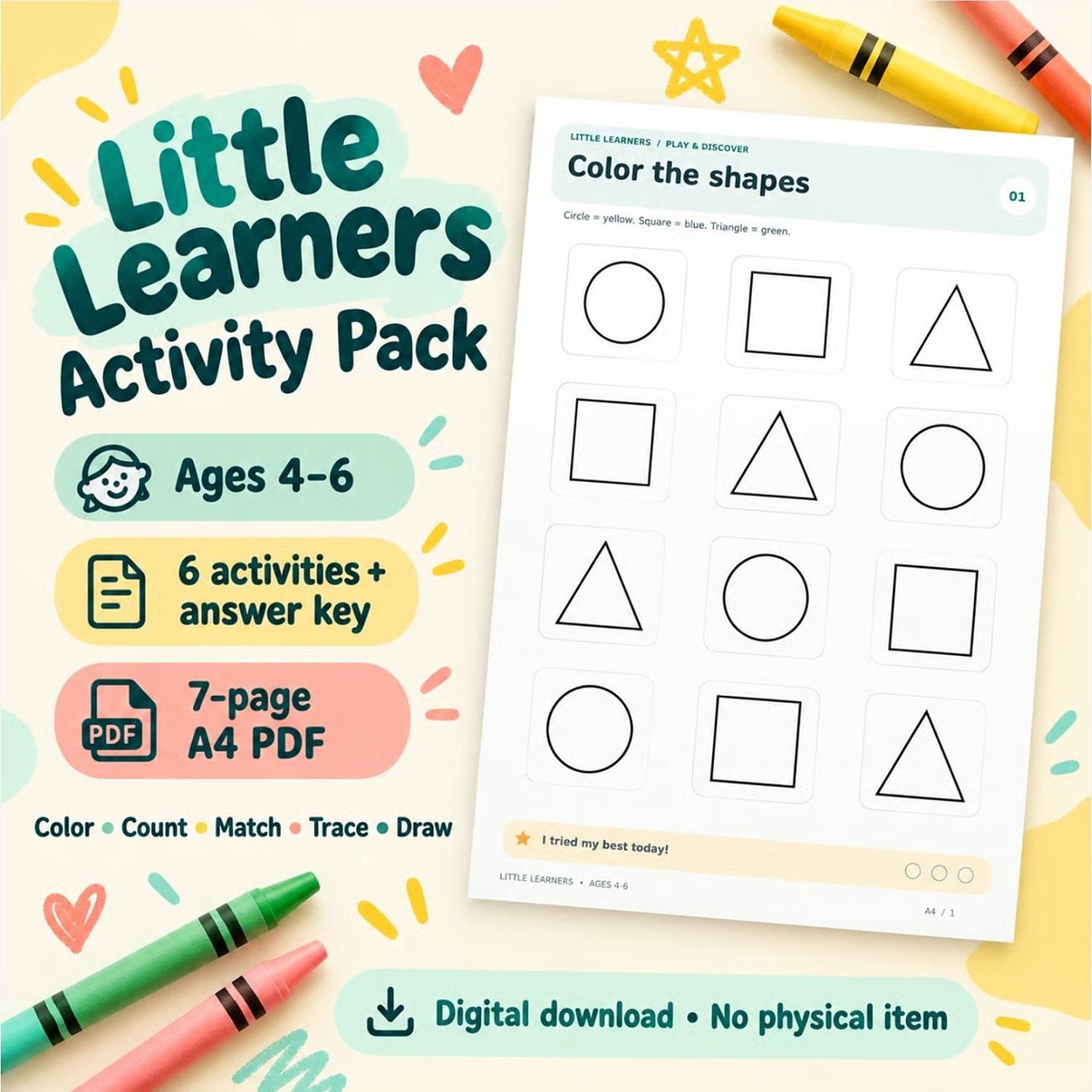
Our Little Learner Activity Pack is made for exactly this step. It has 6 printable activities for ages 4–6, plus an answer key, so your child can show off everything they've learned.
Just download, print and enjoy some proud "I did it!" moments together.
Comments ()