

Have you ever given clear directions, watched your students nod, and then found yourself repeating the same instructions a few minutes later?
You are not alone.
For many K–12 teachers, repeating directions can become one of those small daily frustrations that quietly consumes valuable instructional time. The more often students depend on the teacher to repeat what to do, the harder it becomes to build independence in the classroom.
The solution is not to simply speak louder, repeat yourself more often, or give students longer explanations.
Instead, students need a clear system that helps them understand what to do, remember the key steps, and begin with confidence.
In this article, you’ll learn a simple five-step approach—STOP → SAY → SHOW → CHECK → START—that can help you give clearer directions, reduce unnecessary repetition, and help K–12 students become more independent learners.
Why Students Don’t Always Follow Directions
When students do not follow directions, it is easy to assume they were not listening.
Sometimes that is true. But often, the problem is more complicated.
Students may miss an instruction because they are still transitioning from one activity to another, the directions contain too many steps, the important information is buried in a long explanation, or they are unsure about what they should do first.
Age and developmental level also matter. A direction that feels obvious to a high school student may need more structure for a younger learner. Even older students can struggle when a task has several steps or when expectations are unclear.
This is why effective directions are not simply about telling students what to do. They are about making the next action clear.
A useful question for teachers is:
“Could a student who missed part of my explanation still figure out what to do next?”
If the answer is no, the directions may need a little more structure.
The STOP → SAY → SHOW → CHECK → START System
Instead of repeating the same directions throughout the lesson, use a simple five-step routine.
1. STOP: Get Attention Before Giving Directions
Before giving important instructions, make sure students know that it is time to listen.
Pause the activity. Use your established attention signal. Wait until most students are focused before you begin.
You do not need to compete with classroom noise.
A calm, consistent attention routine helps students understand that important information is about to be given.
2. SAY: Give Short, Specific Directions
Keep directions focused on what students need to do—not everything they might need to know.
For example, instead of saying:
“Okay, everyone, I want you to take out your notebooks, turn to a new page, write today's date, and then look at the question on the board and think about how you might answer it before we discuss it together.”
Try:
“Take out your notebook. Write today's date. Then read the question on the board.”
Short directions are easier to process, remember, and act on.
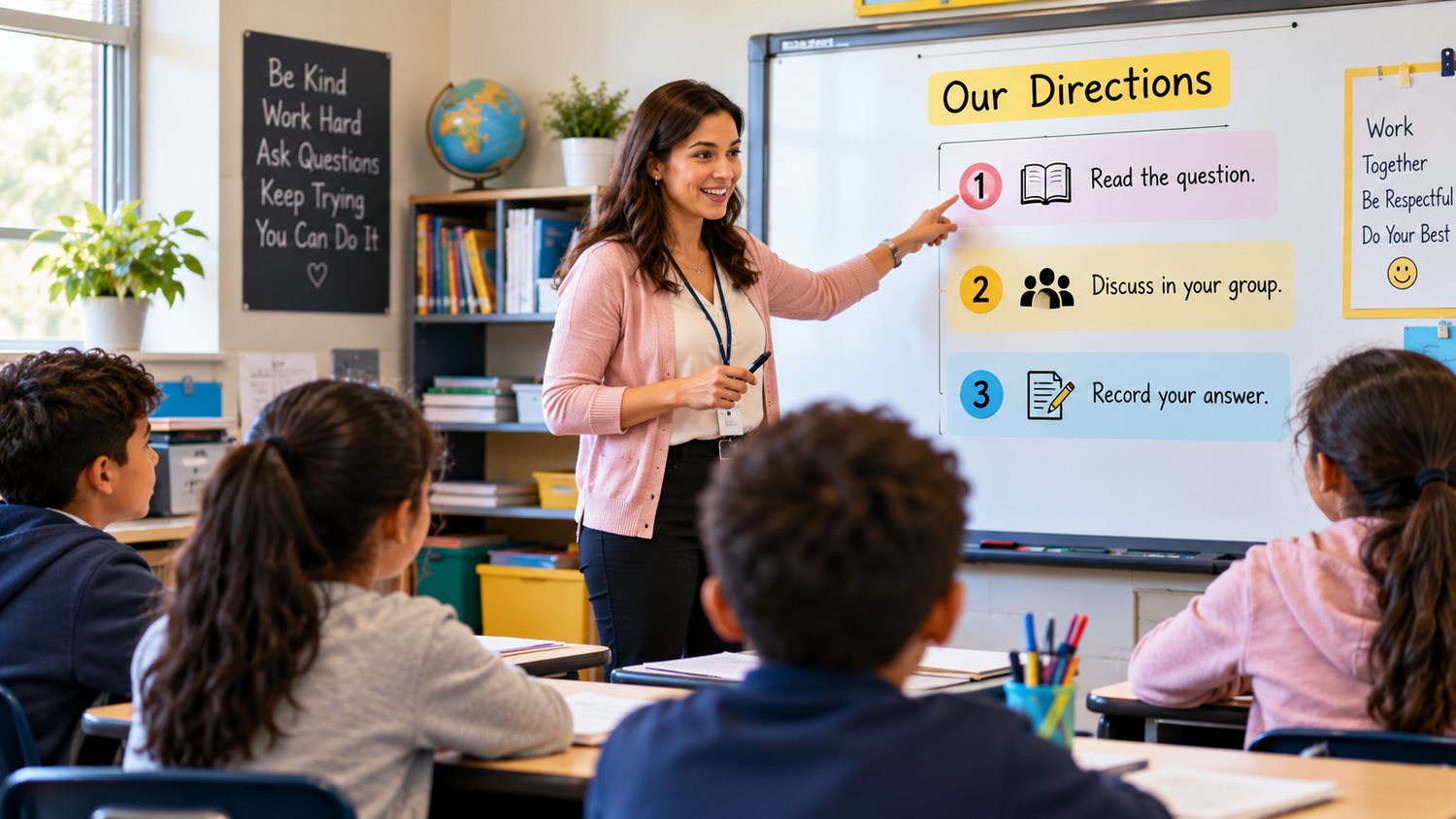
3. SHOW: Make the Directions Visible
Whenever possible, put the key steps somewhere students can see them.
You might use the board, a slide, a classroom display, or a printed task card.
For example:
1. Open your notebook.
2. Write the date.
3. Read the question.
4. Write your response.
A visible set of directions gives students something to refer back to without immediately asking, “What are we supposed to do?”
4. CHECK: Confirm Understanding
Do not assume that silence means everyone understands.
Ask a quick question such as:
“What is the first thing you are going to do?”
Or:
“Turn to a partner and tell them the first two steps.”
This takes only a few seconds but can reveal confusion before students begin the task.
5. START: Give a Clear Beginning Signal
Once students know what to do, clearly signal that it is time to begin.
Try:
“Go ahead and start.”
Or:
“You have five minutes. Begin now.”
A clear starting point removes uncertainty and helps students move from listening to action.
The goal is not to make every direction complicated. The goal is to make the next step so clear that students can begin without waiting for you to repeat yourself.
How to Adapt the System for Different K–12 Classrooms
The same five-step system can work across grade levels, but the way you use it should change with your students.
Elementary School
Younger students often benefit from shorter directions, visual cues, modeling, and repetition of the routine—not necessarily repetition of the entire instruction.
For example:
“First, write your name. Then color the picture. When you finish, bring it to the reading table.”
Use simple language and show the steps whenever possible.
Middle School
Middle school students can usually handle more independence, but they still benefit from clear expectations and visible steps.
Instead of repeatedly answering, “What do I do next?” point students back to the posted directions.
This gradually shifts responsibility from the teacher to the student.
High School
High school students should increasingly be expected to manage multi-step directions independently.
Give them the task, make the important expectations visible, and encourage them to check the directions before asking for clarification.
You can even build a classroom habit such as:
“Check the directions first. If you still have a question, then ask.”
Across all grade levels, the goal remains the same: **make the next action clear and gradually help students take more responsibility for knowing what to do.**
What to Do When a Student Says, “I Don’t Know What to Do”
Even with clear directions, some students will still ask for help.
Instead of immediately repeating all the instructions, use the moment as an opportunity to build independence.
Try asking:
What step are you on?
Which part is unclear?
What do the directions say?
What do you think you should do first?
These questions encourage students to return to the information already available to them.
If several students are asking the same question, that is useful information for you, too. It may mean that one part of the directions needs to be clarified, modeled, or made more visible.
The goal is not to avoid helping students.
The goal is to help them learn how to find and use information before depending on the teacher for every next step.
Over time, this simple shift can make a noticeable difference in classroom independence.
A 2-Minute Routine You Can Use Tomorrow
You do not need to redesign your entire classroom to reduce repeated directions.
Start with one routine.
Before a task begins, use these five questions:
1. Did I get their attention?
Make sure students are ready to listen.
2. Did I say exactly what they need to do?
Keep the directions short and specific.
3. Can students see the directions?
Write the key steps on the board or display them on a slide.
4. Did I check that they understand the first step?
Ask one quick question before they begin.
5. Did I clearly signal the start?
Tell students when to begin.
Once students experience this routine consistently, it becomes predictable. They begin to know where to look, what to listen for, and what to do when they are unsure.
That predictability is what makes the routine powerful.
You are not simply giving better directions.
You are teaching students how to follow directions independently.
4.Common Mistakes That Make Teachers Repeat Directions
Even well-intentioned directions can create confusion. Watch for these common patterns.
1. Giving Too Many Directions at Once
When students receive a long list of instructions, they may remember only the first or last step.
Try instead: Break multi-step tasks into manageable chunks and make the steps visible.
2. Giving Directions While Students Are Still Talking
Students cannot consistently follow information they never heard.
Try instead: Establish attention first, then give the directions.
3. Repeating the Entire Explanation for Everyone
When one student asks a question, it can be tempting to repeat every instruction to the whole class.
Try instead: Ask the student which part is unclear and direct them back to the posted steps when appropriate.
4. Changing the Routine Too Often
If students never know where directions will appear or how you expect them to begin, they may become dependent on verbal reminders.
Try instead: Keep your direction routine predictable.
A consistent structure does not make teaching rigid. It gives students a reliable path toward independence.
See the System in Action
Imagine you are about to begin a small-group activity in a fifth-grade classroom.
Instead of saying:
“Okay, everyone, get into your groups, take out your materials, read the instructions, decide who is going to do each part, and then get started.”
Use the five-step system.
STOP:
“Eyes this way for a moment.”
SAY:
“Get into your assigned group and take out your science notebook.”
SHOW:
Display the three task steps:
1. Read the question.
2. Discuss your answer.
3. Record one group response.
CHECK:
“Before we begin, what is the first thing your group will do?”
START:
“Great. You may begin.”
Now students have heard the directions, seen them, confirmed the first step, and received a clear signal to begin.
If a student later asks, “What are we supposed to do?” you can calmly point to the displayed steps instead of starting the entire explanation again.
This is how a simple routine can turn directions into a classroom support system rather than a repeated teacher task.
The Goal Is Independence, Not Silence
Getting students to follow directions is not about making your classroom perfectly quiet or expecting every student to respond immediately.
The real goal is to create a classroom where students know how to listen, find information, check what they understand, and take the next step without always waiting for the teacher.
Start small.
Use the same direction routine consistently:
STOP → SAY → SHOW → CHECK → START
Then give students time to learn the routine.
You may still need to clarify directions. You may still have students who need extra support. That is part of teaching.
But when your directions are clear, visible, and predictable, you can gradually reduce unnecessary repetition and give students more responsibility for their own learning.
The result is not just fewer repeated instructions.
It is a classroom where students become more confident, capable, and independent.
Build a More Independent Classroom
Clear directions are one part of helping students work more independently. Another important step is creating simple classroom routines that reduce unnecessary teacher workload.
If you are also looking for practical ways to help students get started on their work more confidently, read:
How to Help Students Start Their Work: A Simple 3-Step Teacher System
Small improvements in everyday classroom routines can add up to more instructional time, less repetition, and greater student independence.
Need Practical Solutions for Everyday Teaching Problems?
Teaching does not come with a one-size-fits-all manual.
At Smart Teacher Toolkit, we focus on practical tools, ideas, and resources designed to help K–12 teachers solve everyday classroom and productivity challenges with greater clarity and confidence.
Whether you are trying to save time, improve classroom routines, use AI more effectively, or organize your teaching workflow, our goal is simple:
Make teaching more manageable, practical, and productive.
Explore the Smart Teacher Toolkit and discover resources created with real teacher needs in mind.
What is the one classroom direction you find yourself repeating most often?
Share your experience with us.
Please share your problem with us. We’ll help you find a practical, professional solution.
Continue Your Teaching Journey
Looking for practical ways to save time, simplify your workload, and solve everyday teaching challenges?
Explore Smart Teacher Toolkit for practical resources designed to help teachers plan, create, and work more efficiently.
Visit the Smart Teacher Toolkit Store