
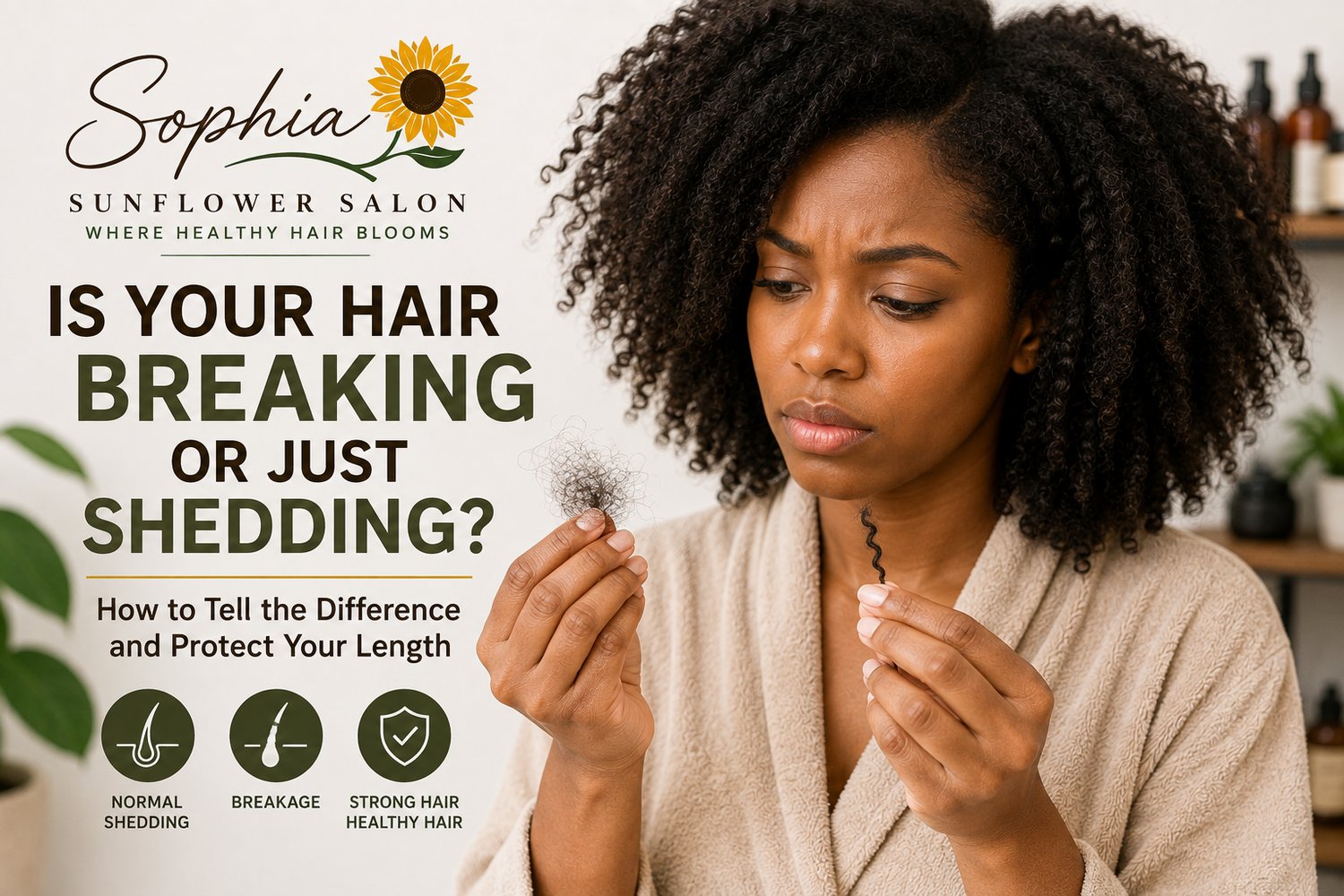
You’re doing your hair and suddenly notice strands in the sink, on your clothes, wrapped around your fingers, or caught in your comb.
Your first thought may be:
“My hair is breaking off!”
But not every strand of hair you lose is breakage.
Some hair shedding is a normal part of the hair-growth cycle. Breakage, on the other hand, happens when the hair strand becomes weak and snaps somewhere along its length.
After more than 25 years of working with natural and textured hair, I’ve seen how quickly clients can become concerned when they notice hair coming out. One of the first things we need to determine is whether we're looking at normal shedding or excessive breakage.
At Sophia Sunflower Salon, healthy hair begins with understanding what your hair is telling you.
What Is Normal Hair Shedding?
Every individual hair goes through a natural growth cycle. Eventually, a strand reaches the end of that cycle and sheds from the follicle.
That means seeing some hair when you shampoo, detangle, or style isn't automatically a reason to panic.
If you wear your hair in braids, twists, or another style for several days or weeks, you may notice what looks like a large amount of hair when you finally take the style down.
Remember: the hairs that would normally have shed each day may have remained trapped within the style.
Once you detangle, you're seeing several days—or even weeks—of accumulated shed hair at once.
What Does Breakage Look Like?
Breakage is different.
Instead of the entire strand naturally releasing from the follicle, the hair snaps somewhere along the strand.
You may notice:
- Lots of short pieces of hair
- Uneven or thinning ends
- Hair that seems stuck at the same length
- Small pieces of hair on your clothing
- Excessive tangling
- Ends that feel rough or brittle
- Hair snapping during detangling
If you continue growing new hair but lose length through breakage, it can feel as though your hair simply refuses to grow.
In many cases, the issue isn't growth.
It's length retention.
Look at the Strand
One simple way to begin identifying the difference is to look at the hair you're losing.
A naturally shed hair is generally a full-length strand that has released from the scalp and may have a tiny club-shaped end at the root.
Broken hair is often shorter than the rest of your hair and doesn't represent the full length of the strand.
If you're consistently finding lots of little pieces rather than full strands, breakage may be occurring.
Why Does Natural Hair Break?
Natural hair can be incredibly resilient, but the bends and curves within curly and coily strands can also create points where the hair is more vulnerable to mechanical stress.
Several things can contribute to breakage.
1. Dryness
Hair that lacks adequate moisture may become less flexible and more likely to snap during manipulation.
This is why your moisturizing routine matters.
2. Rough Detangling
Trying to rush through knots and tangles can cause unnecessary breakage.
Work in sections, use adequate slip, and detangle gently—especially at the ends.
Your hair doesn't need to fight with your comb.
3. Too Much Heat
Frequent use of high-temperature styling tools can weaken the hair over time.
Heat isn't automatically the enemy, but how much, how often, and how it's used matters.
4. Tight Hairstyles
Braids, ponytails, extensions, wigs, and other styles that place excessive tension on the hair can contribute to breakage—especially around the hairline.
If your style hurts, feels extremely tight, or leaves your scalp sore, pay attention.
Beauty should not require sacrificing the health of your hair.
5. Holding Onto Damaged Ends
I understand—we work hard for our length!
But sometimes keeping severely split or damaged ends can actually make your hair more difficult to manage.
Damaged ends tangle more easily and can continue splitting farther up the strand.
A good trim doesn't take away from your healthy-hair journey.
Sometimes the trim is part of the journey.
What I Look for Behind the Chair
When a client tells me her hair isn't growing, I don't only look at the length.
I look at the condition of the hair.
Are the ends thinning?
Is the hair breaking around the crown?
Are the edges fragile?
Does the hair feel excessively dry?
Is there a noticeable difference between the density near the scalp and the density toward the ends?
How is the client detangling and styling at home?
Those details can tell us much more than length alone.
🌻 Sophia's Healthy Hair Tip
Stop measuring your healthy-hair progress only by inches.
Pay attention to:
Strength. Softness. Fullness. Elasticity. Manageability. And reduced breakage.
Long hair that constantly breaks isn't necessarily healthy hair.
Your first goal should be creating and maintaining healthy strands. Length can follow as you're better able to retain the hair you're growing.
How to Help Reduce Breakage
Keep your routine simple and consistent.
Cleanse your hair and scalp regularly. Condition thoroughly. Keep your hair adequately moisturized. Detangle gently. Protect your hair while sleeping. Limit unnecessary manipulation and excessive heat.
And don't be afraid of regular trims when your ends need them.
Most importantly, listen to your hair.
If something repeatedly leaves your hair dry, tangled, brittle, or broken, it may not belong in your routine—even if it works beautifully for someone else.
When Hair Loss Deserves More Attention
There is an important difference between ordinary shedding or cosmetic breakage and hair loss that may need medical attention.
If you notice sudden or significant hair loss, bald patches, scalp pain, sores, unusual inflammation, or a major change in your normal shedding pattern, consider speaking with a dermatologist or other qualified healthcare professional.
A hairstylist can help you recognize changes in your hair and scalp, but some concerns extend beyond the salon chair.
Final Thoughts
Seeing hair in your comb doesn't automatically mean something is wrong.
The important question is:
Is my hair naturally shedding—or is it breaking?
Learning the difference can help you make better decisions about your routine instead of immediately buying another product or trying another internet trend.
At Sophia Sunflower Salon, my philosophy has remained simple throughout my career:
Healthy hair comes first.
Learn your hair. Nourish it. Protect it. Give it patience. And when something changes, pay attention.
🌻 Sophia Sunflower Salon — Where Healthy Hair Blooms.
Ready to give your hair some professional attention? Book your appointment at Sophia Sunflower Salon and let's work toward healthier, stronger natural hair together.
Comments ()