
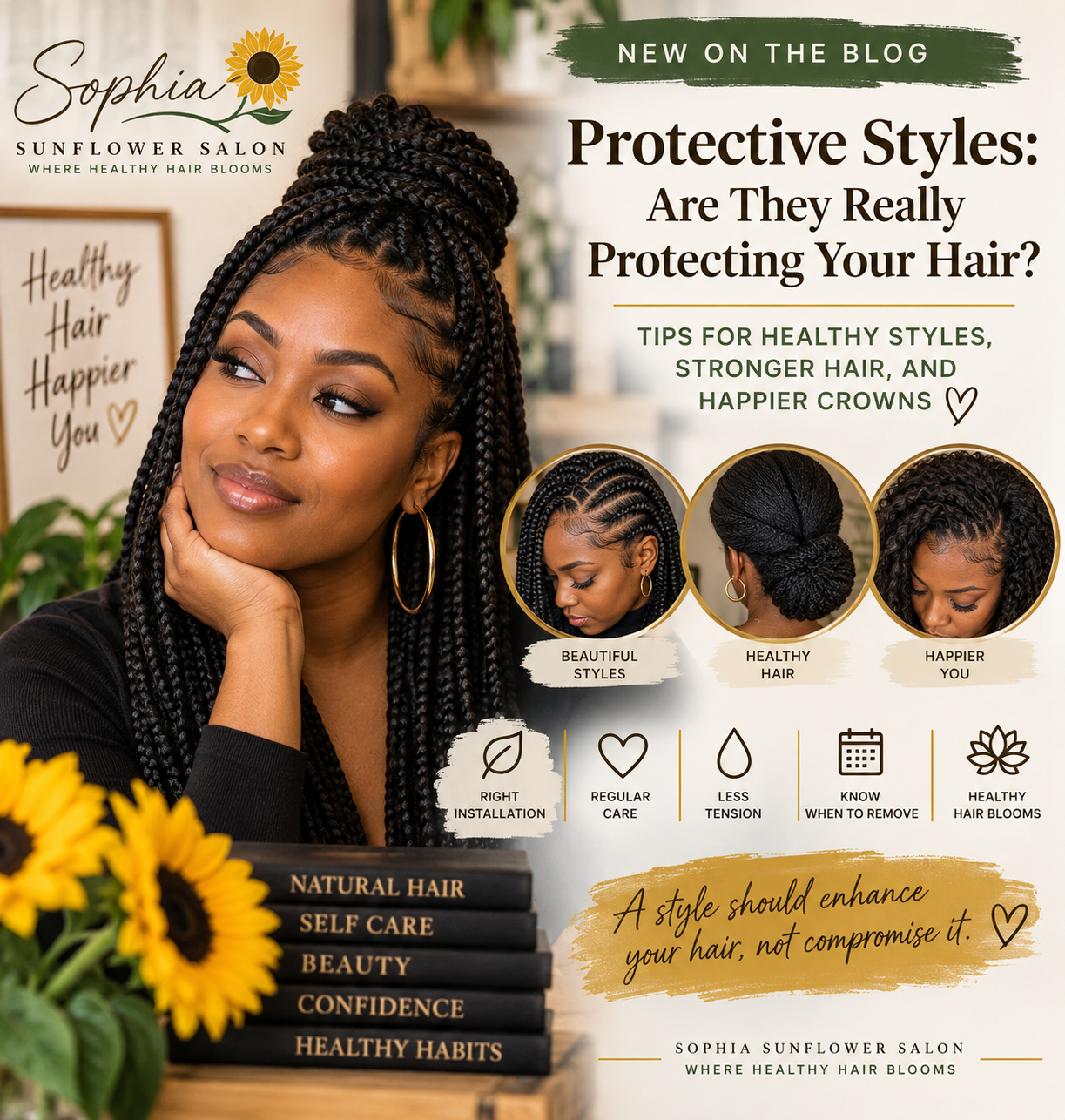
Braids. Twists. Wigs. Crochet styles. Loc extensions.
We call them protective styles, but here's a question I think more of us need to ask:
Is your protective style actually protecting your hair?
After more than 25 years of caring for natural hair, I've seen protective styles do wonderful things. They can reduce daily manipulation, give you a break from styling, and help you maintain your hair.
But I've also seen the other side—broken edges, thinning hairlines, dry strands, excessive shedding, and damaged hair after a style is removed.
At Sophia Sunflower Salon, my philosophy has always been simple:
A hairstyle isn't truly protective if your hair is less healthy when you take it down.
What Is a Protective Style?
A protective style is generally a hairstyle designed to reduce manipulation and protect vulnerable areas of the hair, particularly the ends.
That can include styles such as:
- Braids
- Two-strand twists
- Buns
- Wigs
- Crochet styles
- Flat twists
- Some extension styles
But the name of the hairstyle doesn't automatically make it protective.
How the style is installed, maintained, and removed matters.
1. Your Protective Style Shouldn't Hurt
This is one of my biggest rules.
We've somehow normalized the idea that braids or extensions are supposed to hurt for the first few days.
They aren't.
If your scalp is extremely sore, you're developing bumps around your hairline, or you can barely move your eyebrows after getting your hair braided, that isn't something you should simply accept.
Excessive tension can put unnecessary stress on the hair and scalp.
Your edges are especially vulnerable.
Tighter doesn't mean better.
2. Don't Forget About Your Hair Underneath
Putting your hair away doesn't mean your hair stops needing care.
This is particularly important when wearing wigs.
Your natural hair underneath still needs appropriate cleansing, conditioning, hydration, and attention.
Your scalp needs care too.
I want my clients to think of a protective style as low maintenance—not no maintenance.
3. Your Hair Still Needs Moisture
Your braids may look beautiful on the outside while the hair inside becomes increasingly dry.
This is why it's important to pay attention to your natural hair while it's in a long-term style.
You don't necessarily need to soak your hairstyle in heavy products every day.
But you shouldn't completely ignore your hair for weeks either.
Finding the right balance is important.
4. Be Careful With Your Edges
Your edges don't need to be included in every braid.
They don't need to be slicked down every day.
And they certainly don't need to be pulled until your hairstyle looks tighter.
The hairs around your hairline are often finer and more vulnerable than the rest of your hair.
Give them some grace.
Sometimes the healthiest thing you can do for your edges is simply leave them alone.
5. Don't Leave the Style in Forever
I know what happens.
The style still looks decent.
You paid good money for it.
And you want to get every possible week out of it.
But eventually, it's time to let it go.
As your hair grows and the style ages, you may experience tangling, matting, buildup, and increased stress at the roots.
How long you should keep a style depends on the hairstyle and the condition of your hair, but don't sacrifice your natural hair simply to extend the life of a style.
6. Take Your Time During Takedown
This is where a lot of unnecessary breakage happens.
After wearing a protective style for weeks, you're ready to get it OUT.
So you start pulling, ripping, combing, and rushing.
Slow down.
Your hair may contain shed strands, tangles, and product residue.
Work carefully.
Separate your hair into sections and detangle patiently.
Remember that seeing shed hair after a long-term style doesn't automatically mean your hair is falling out. Normally shed strands can remain trapped inside the hairstyle until you remove it.
🌻 Sophia's Healthy Hair Tip
Judge a protective style by the condition of your hair after you remove it—not just by how beautiful the style looked while you wore it.
Ask yourself:
Does my hair feel healthy?
Are my edges intact?
Did I experience unusual breakage?
Is my scalp comfortable?
Are my ends still in good condition?
If the answer is consistently no, that style—or the way it's being installed—may not be protective for your hair.
Give Your Hair a Little Attention Between Styles
You don't necessarily have to move immediately from one extension style into another.
Sometimes your natural hair benefits from a little attention between installations.
This is a good opportunity to:
Cleanse your scalp.
Condition your hair.
Detangle thoroughly.
Evaluate your ends.
Trim when needed.
Restore moisture.
And most importantly, actually look at your hair.
Protective styling shouldn't become a way of avoiding your natural hair.
What I Look for Behind the Chair
When a client removes a protective style, I'm interested in more than her new growth.
I'm looking at the overall condition of the hair.
Are the edges thinner?
Are there areas of breakage?
How do the ends look?
Is there excessive tangling or matting?
How does the scalp look?
Has the hair maintained its fullness?
Those clues help determine whether the style actually served its purpose.
Protective Styling Should Support Your Healthy-Hair Journey
I love versatility.
One of the beautiful things about natural hair is everything we can do with it.
But no hairstyle is worth compromising the health of your hair or scalp.
Wear your braids.
Enjoy your twists.
Rock your wigs.
Have fun with your hair.
Just remember that underneath every beautiful style is the hair we're supposed to be protecting.
Final Thoughts
The goal of protective styling isn't simply to keep your hands out of your hair.
It's to give your hair a break while maintaining its health.
A good protective style should minimize unnecessary manipulation, avoid excessive tension, and allow you to continue caring for your natural hair and scalp.
And when the style comes down?
Your hair should still be there—healthy, cared for, and ready for what's next.
At Sophia Sunflower Salon, beautiful styles matter.
But healthy hair will always come first.
🌻 Sophia Sunflower Salon — Where Healthy Hair Blooms.
Ready to give your natural hair some professional attention? Schedule your appointment with Sophia Sunflower Salon and let's make sure your styles are supporting—not sacrificing—your healthy-hair journey.
Comments ()