
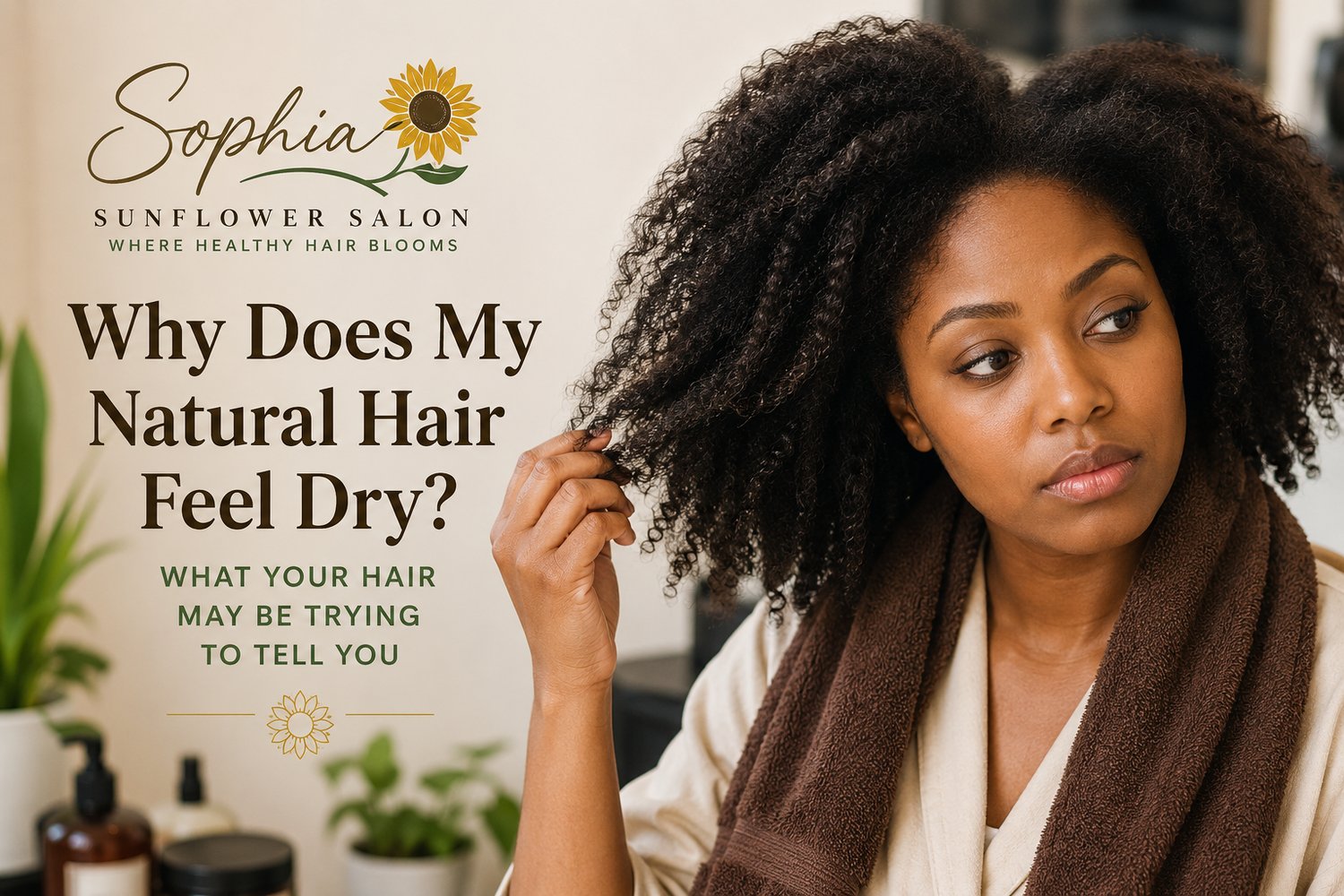
Dry hair is one of the most common concerns I hear from clients.
You wash your hair. You condition it. You apply your favorite moisturizer and maybe finish with an oil. Your hair feels wonderful at first—but a day or two later, it feels dry again.
So what’s going on?
After more than 25 years of working with natural and textured hair, I’ve learned that persistent dryness isn't always about needing more product. Sometimes your hair is telling you that something in your routine needs to change.
At Sophia Sunflower Salon, healthy hair has always been the goal. Understanding why your hair feels dry is the first step toward giving it what it actually needs.
Dry Hair and Dehydrated Hair Aren't Always the Same Thing
When we talk about moisture in natural hair care, water is an important part of the conversation.
Your hair needs adequate hydration to remain flexible and manageable. When it doesn't retain enough moisture, it can begin to feel rough, stiff, tangled, or brittle.
Adding more oils or heavy products doesn't necessarily solve that problem.
Oil can help reduce moisture loss and improve lubrication, softness, and shine, but oil isn't a substitute for water-based hydration.
That's why hair can feel greasy and dry at the same time.
1. Your Hair May Have Product Buildup
Natural hair routines often involve creams, oils, butters, gels, edge controls, and styling products.
Over time, these products can accumulate on the hair and scalp.
If your hair suddenly seems difficult to moisturize or products appear to sit on top of your strands, buildup could be part of the problem.
Regular cleansing is important.
The goal isn't to strip your hair. It's to remove enough buildup so your hair and scalp have a clean foundation for conditioning and styling.
2. You May Be Using Too Much Oil
This surprises many clients.
If your hair feels dry, your first instinct may be to add oil. Then a little more oil. Then perhaps some hair grease.
But if the hair needs hydration, continuously adding oil won't necessarily address the problem.
Try starting with slightly damp hair or an appropriate water-based moisturizing product before using an oil or other sealant.
Remember:
Hydrate first. Seal second.
3. Your Ends May Need Extra Attention
The ends are the oldest part of your hair.
They've experienced everything you've done to your hair—washing, detangling, styling, heat, protective styles, weather, and everyday manipulation.
That's why your ends may become dry or fragile before the rest of your hair.
Give them special attention when moisturizing and detangling.
And when ends become excessively split or damaged, holding onto them for the sake of length can sometimes work against your healthy-hair goals.
A professional trim can give your hair a healthier foundation.
4. Your Wash-Day Routine May Need Adjusting
Sometimes the problem begins before you ever apply your moisturizer.
Ask yourself:
Are you cleansing regularly?
Are you thoroughly conditioning?
Are you detangling gently?
Are you rinsing your hair properly?
Are you applying moisturizing products while your hair still has some hydration?
Wash day isn't simply about getting your hair clean. It's the foundation for how your hair behaves until the next wash.
5. Your Hair Routine May Not Match Your Hair
This is something I have seen throughout my career.
Two people can have hair that looks similar and still need completely different routines.
Texture isn't the only factor.
Density, strand thickness, porosity, styling habits, chemical treatments, heat use, environment, and the condition of the hair can all influence how it responds to products and techniques.
That's why copying someone else's routine doesn't always give you the same results.
Your hair needs a routine designed for your hair.
6. Protective Styles Don't Replace Hair Care
Braids, twists, wigs, and other low-manipulation styles can be helpful, but putting your hair away doesn't mean you can forget about it.
Your scalp still needs attention.
Your hair still needs appropriate cleansing and hydration.
And your edges need protection from excessive tension.
A protective style should actually protect your hair, not simply hide it.
What I Look for Behind the Chair
When a client tells me, "My hair is always dry," I don't immediately assume she needs another moisturizer.
I look at the bigger picture.
How does the hair feel?
Is there buildup?
Are the ends damaged?
Is there excessive breakage?
How is the scalp?
What products are being used at home?
How often is the hair being shampooed and conditioned?
What styling practices could be contributing to the problem?
Sometimes a few small changes can make a significant difference.
🌻 Sophia's Healthy Hair Tip
Don't judge your hair routine by how your hair feels immediately after you style it.
Pay attention to how your hair behaves over the following several days.
A routine that works for your hair should support softness, manageability, and moisture retention—not simply make your hair look shiny on wash day.
And remember: shine and moisture are not the same thing.
When It's Time to See a Professional
If you've tried changing products and your hair continues to feel unusually dry, brittle, tangled, or prone to breakage, a professional evaluation may help.
Sometimes you need another set of experienced eyes to determine what's happening.
At Sophia Sunflower Salon, my approach has always been about more than creating a beautiful style.
Healthy hair comes first.
We'll look at the condition of your hair and scalp, discuss your current routine, and determine what your hair needs—not what social media says everyone's hair needs.
Final Thoughts
Natural hair doesn't have to be complicated.
Cleanse it.
Condition it.
Hydrate it.
Protect it.
Trim it when necessary.
And most importantly, learn your hair.
You don't need every new product or every new technique. You need consistency and a routine that makes sense for your individual hair.
After more than 25 years behind the chair, that's one lesson I continue to stand by:
When you understand your hair, you can care for it better.
🌻 Sophia Sunflower Salon — Where Healthy Hair Blooms.
Ready to give your hair the individual attention it deserves? Book your next appointment with Sophia Sunflower Salon and let's build a healthy-hair routine that works for you.
Comments ()