
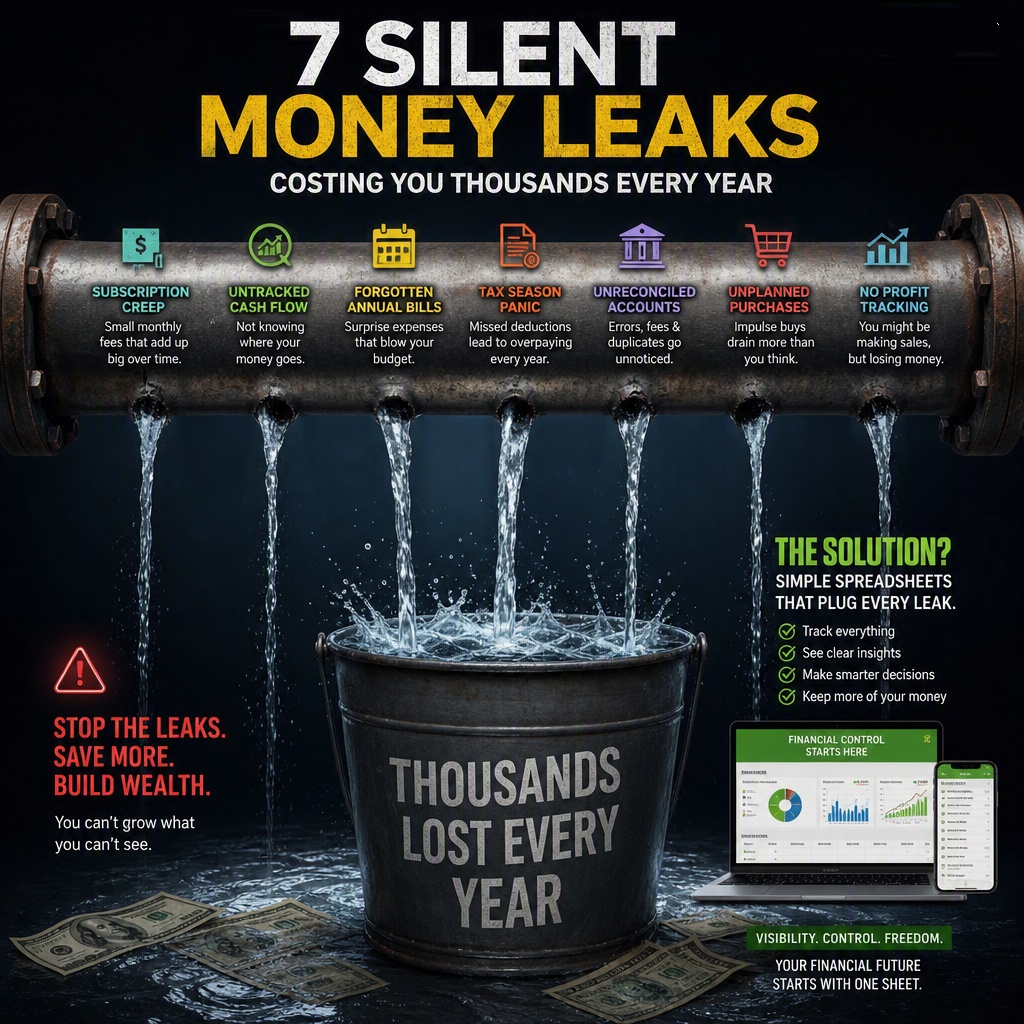
Small financial problems rarely announce themselves.
A forgotten subscription here, an annual bill there, a few purchases that never get categorized — none of them may seem serious on their own. But when you don't have a clear view of where your money is going, small gaps can become surprisingly expensive over time.
You don't necessarily need complicated financial software to get better visibility.
Sometimes a well-organized spreadsheet is enough to show you what has been hiding in plain sight.
Here are seven areas worth checking.
1. Recurring Expenses You No Longer Notice
Streaming services, software subscriptions, memberships, cloud storage, website services and other recurring charges are easy to accumulate because they are usually paid automatically.
The problem isn't necessarily the individual charge.
It's losing track of the total.
A recurring-expense spreadsheet can help you record:
- service name
- monthly or annual cost
- renewal date
- payment method
- whether you still use the service
- whether there is a cheaper alternative
Once everything is visible in one place, deciding what is still worth paying for becomes much easier.
2. Annual and Irregular Bills
Monthly bills are usually easy to remember.
Annual expenses are different.
Insurance renewals, vehicle registration, memberships, professional fees, domain renewals and other periodic expenses can feel unexpected simply because they haven't been visible for several months.
An annual-expense calendar or bill tracker gives those expenses a place on the calendar before they arrive.
That makes them easier to plan for rather than react to.
3. Spending That Has Drifted Upward
Sometimes there isn't one large expense causing the problem.
Instead, several categories gradually become more expensive.
Food, fuel, utilities, entertainment, supplies or miscellaneous purchases may increase slowly enough that you don't notice the change.
A monthly income-and-expense tracker lets you compare categories over time.
The goal isn't to criticize every purchase.
It's to answer a simple question:
Where is my money actually going now compared with a few months ago?
That information gives you something concrete to work with.
4. Transactions That Don't Match Your Records
For businesses and households alike, it's useful to periodically compare your records with your bank or credit-card statements.
You may discover:
- duplicated charges
- forgotten payments
- incorrect amounts
- missing transactions
- fees you weren't expecting
- entries recorded in the wrong category
A reconciliation worksheet gives you a structured way to compare the two sides.
It doesn't replace your financial institution's records, but it can make discrepancies easier to spot and investigate.
5. Business Expenses That Aren't Being Recorded Consistently
For a small business, incomplete records can create problems later when you're trying to understand expenses, prepare reports or organize information for tax preparation.
A simple expense log can help you consistently record:
- date
- vendor
- expense category
- description
- amount
- payment method
- receipt or reference information
Good record keeping does not make tax decisions for you, but it gives you much better information to work with.
6. Money Customers Still Owe You
A business can make sales and still have cash-flow problems if invoices remain unpaid.
That's why revenue and cash received are not always the same thing.
A receivables tracker can help you see:
- invoice number
- customer
- invoice date
- amount billed
- amount paid
- balance remaining
- due date
- payment status
That gives you a clearer picture of money that has been earned but has not yet reached your bank account.
7. Sales Without a Clear Picture of Profit
Revenue gets attention because it's easy to see.
Profit requires more context.
If you sell $10,000 worth of products or services but spend most of that amount delivering them and operating the business, the sales number alone doesn't tell you very much.
A profit-and-loss worksheet can help organize:
Revenue
minus
costs and operating expenses
to give you a clearer view of whether the business is actually generating a profit.
That doesn't replace professional accounting, but it can make your financial picture much easier to understand.
The Goal Isn't More Spreadsheets — It's Better Visibility
You don't need to track everything simply because you can.
Start with the area causing the most uncertainty.
Maybe that's recurring bills.
Maybe it's business expenses.
Maybe it's invoices that haven't been paid.
Maybe you simply don't know where your money went last month.
Choose one problem, start tracking it consistently, and expand only when another tool becomes useful.
A spreadsheet should reduce complexity — not create more of it.
Want a Structured Place to Start?
Bay Area Spreadsheets offers editable Excel tools for accounting, budgeting, banking and financial tracking.
If you need a broader set of accounting tools, the Accounting Command Center includes separate workbooks for journals, ledgers, profit-and-loss reporting, balance sheets, cash flow and other core accounting records.
You don't have to learn everything at once. Start with the workbook that solves the problem you have today and use the others when you need them.
Explore the Accounting Command Center
These spreadsheets are record-keeping and planning tools and are not a substitute for professional accounting, tax, investment or financial advice.