
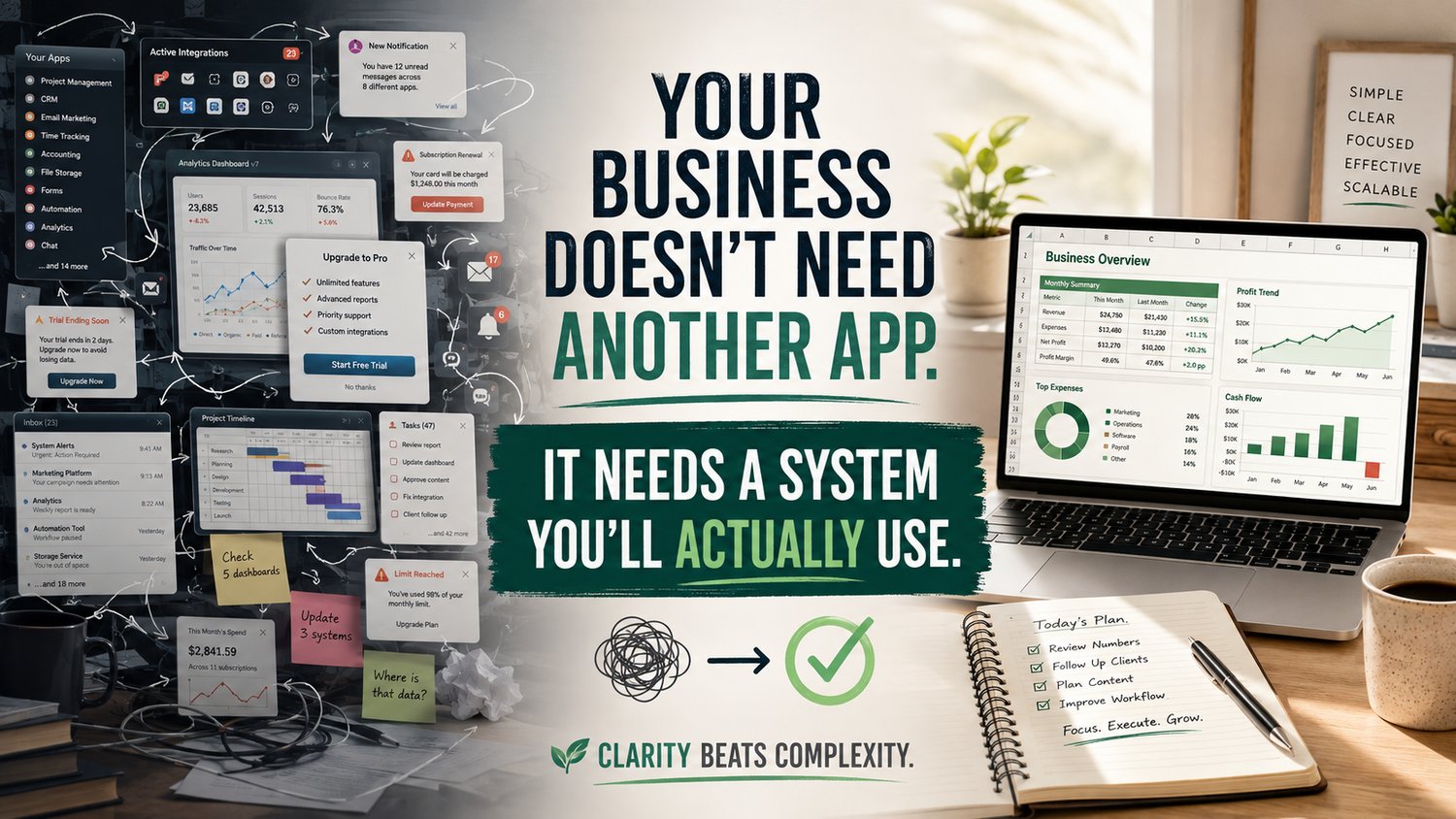
There is something I have watched happen over and over again during decades of working with computers, business systems and everyday workflows.
A problem starts out simple.
Someone needs to track customers.
Or expenses.
Or invoices.
Or inventory.
Or rental properties.
Or employee schedules.
Or sales.
Then somebody says:
“There has to be an app for that.”
And suddenly the simple problem isn't simple anymore.
Now there is an account to create.
A subscription to pay.
A dashboard to configure.
Permissions to assign.
Notifications to manage.
A mobile app to install.
An integration to connect.
Another integration because the first integration doesn't talk to the other system.
A help center.
A tutorial library.
A webinar.
An onboarding sequence.
And somewhere along the way, the original problem gets lost.
You didn't wake up wanting software.
You wanted to know which customers still owed you money.
You wanted to know whether the business made a profit last month.
You wanted to see which tenant hadn't paid rent.
You wanted to organize your inventory.
You wanted a schedule everyone could understand.
You wanted an answer.
Instead, you got a software ecosystem.
When the System Becomes the Job
Technology is supposed to reduce work.
But sometimes the system we choose to manage the work starts demanding so much attention that maintaining the system becomes another job.
That's backwards.
If you spend more time configuring a tool than using the information it gives you, something has gone wrong.
If you need three tutorials before you can record an expense, something has gone wrong.
If you're paying every month for 50 features but regularly use six of them, it is worth asking whether sophistication has actually improved anything.
And if your staff quietly keeps an unofficial spreadsheet on the side because the expensive software doesn't answer the question they need answered quickly?
That tells you something too.
Complexity Is Not the Same as Capability
This distinction matters.
A complicated product can be powerful.
But a powerful product does not have to be complicated.
Those two ideas have become confused.
We have been conditioned to associate:
More menus = more professional
More features = more value
More automation = better system
More integrations = better workflow
Not necessarily.
A tool is valuable when it helps you do the job you bought it to do.
That's the test.
Not how many buttons it has.
Not how impressive the feature list sounds.
Not how many logos appear under “Integrates With.”
The question is:
Does this make the work clearer, faster or easier to control?
If it doesn't, all that sophistication may simply be decoration.
There Is Nothing Wrong With Software
This isn't an argument against software.
There are jobs spreadsheets should never be expected to handle.
Large organizations may need multi-user databases, sophisticated permissions, real-time collaboration, regulatory controls, transaction processing, enterprise integrations and infrastructure that a spreadsheet simply cannot provide.
When the job requires that level of technology, use it.
The mistake is assuming every problem requires it.
Sometimes you don't need an enterprise platform.
Sometimes you need a good ledger.
A useful dashboard.
A customer tracker.
A payment register.
A project planner.
A scheduling worksheet.
A clear place to put information so you can see what's happening.
And for those jobs, a spreadsheet can still be remarkably effective.
The Best System Is Often the One You Will Actually Keep Using
This may be the least glamorous lesson I've learned about business systems:
Consistency usually beats sophistication.
The most advanced system in the world does you very little good if nobody wants to maintain it.
A simple system that gets updated every day can be substantially more useful than an elaborate system everyone avoids.
That is why usability matters.
You should be able to understand:
- what information goes in
- where it goes
- what the numbers mean
- what requires your attention
- what happened yesterday
- what needs to happen next
The tool should help expose the business.
It shouldn't hide the business behind the tool.
Start With the Question, Not the Software
Before choosing any system, I think there is a better question than:
“What software should I buy?”
Ask:
“What do I need to know that I cannot see clearly today?”
That's a very different starting point.
Maybe the answer is:
I don't know which invoices are overdue.
Then start with receivables.
Maybe:
I don't know where the money goes every month.
Start with expenses.
Maybe:
I can't tell which leads need follow-up.
Start with a pipeline tracker.
Maybe:
I don't know whether my rental properties are actually performing well.
Start with rent, expenses and cash flow.
Solve the problem you have.
Then expand when there is a reason to expand.
Not because somebody sold you a bundle of features you might need someday.
You Don't Have to Use Everything
This is particularly important when working with spreadsheet collections.
Seeing 10, 15 or 20 spreadsheets can initially feel like seeing 10, 15 or 20 new things you have to learn.
You don't.
A collection should be treated like a toolbox.
You don't empty the entire toolbox onto the floor every time you tighten one screw.
You choose the tool appropriate for the job.
The same principle applies here.
Need to track expenses?
Use the expense tracker.
Need an invoice?
Use the invoice workbook.
Need a dashboard?
Use the dashboard.
The other tools can sit there until the day they become useful.
More tools should mean more options — not more homework.
Your Data Should Help You Think
One of the things I have always liked about spreadsheets is visibility.
You can see the numbers.
You can see the formulas.
You can see the relationships.
You can change the layout.
You can add a category.
You can remove something you don't need.
You can make the system reflect the way you actually work.
There is something valuable about that.
The tool isn't trying to dictate the workflow.
The workflow can shape the tool.
That doesn't make spreadsheets perfect.
It makes them appropriate for certain jobs.
And choosing the appropriate tool is far more important than choosing the most fashionable one.
Before You Buy Another Subscription, Ask Five Questions
The next time a piece of software promises to transform some part of your business or personal life, ask yourself:
What specific problem am I trying to solve?
Which features will I actually use?
How much time will this take to maintain?
Could a simpler system give me the information I need?
Am I buying capability — or complexity?
Sometimes the answer will absolutely be:
Buy the software.
Other times you may discover that what you actually needed was far simpler.
And there is nothing unsophisticated about simplicity when simplicity works.
That's Why I Still Build Spreadsheets
After decades around computers and business systems, I am not impressed by technology simply because it is technology.
I am impressed when something works.
When it makes information easier to understand.
When it eliminates unnecessary effort.
When it helps someone answer a question they couldn't answer before.
When the person using it says:
“Okay. Now I can see what's going on.”
That is what a good system should accomplish.
The spreadsheets at Bay Area Spreadsheets are built around that philosophy.
Some are simple individual tools.
Others are larger management systems.
But the objective is the same:
Give people practical ways to organize information, understand what's happening and get work done without making the tool itself the center of attention.
Because at the end of the day, you don't run a business so you can operate software.
You use software — or a spreadsheet — so you can operate the business.
And sometimes the smartest technology decision you can make is refusing to make a simple problem more complicated than it needs to be.
One Final Thought
If your current system works well, keep using it.
If your software earns its monthly fee, keep paying for it.
If your business genuinely needs the capabilities of a sophisticated platform, use the sophisticated platform.
But if you've ever found yourself staring at a screen thinking:
“Why does this have to be this complicated?”
maybe it doesn't.
The best system isn't always the one with the most features.
Sometimes it's simply the one that helps you see clearly — and then gets out of your way.
Bay Area Spreadsheets creates practical, editable Excel tools for business, finance, planning, tracking and everyday management. Start with the tool you need today and add more only when they become useful.