

A bank balance can look reassuring while several bills are still waiting. Before making a purchase, sketch a short plan for the days until your next payday. Paper and a calculator are enough.
1. Start with cash available today. Write down the money you can actually use now. Exclude credit limits and savings you intend to leave untouched. Keep the date beside your figure.
2. Set your window. Note your next expected income date. Do not add that future paycheck to today’s cash. Include commitments due before it arrives, including anything due on payday before the income becomes available.
3. Reserve what still needs paying. List unpaid bills, including overdue ones, then estimate the essentials still needed: groceries, transport and other basics. Add savings you still plan to transfer and a buffer you want to keep.
Check each item against your starting cash. If a payment or savings transfer has already reduced that figure, do not subtract it again. Reserve only what remains to be paid or transferred.
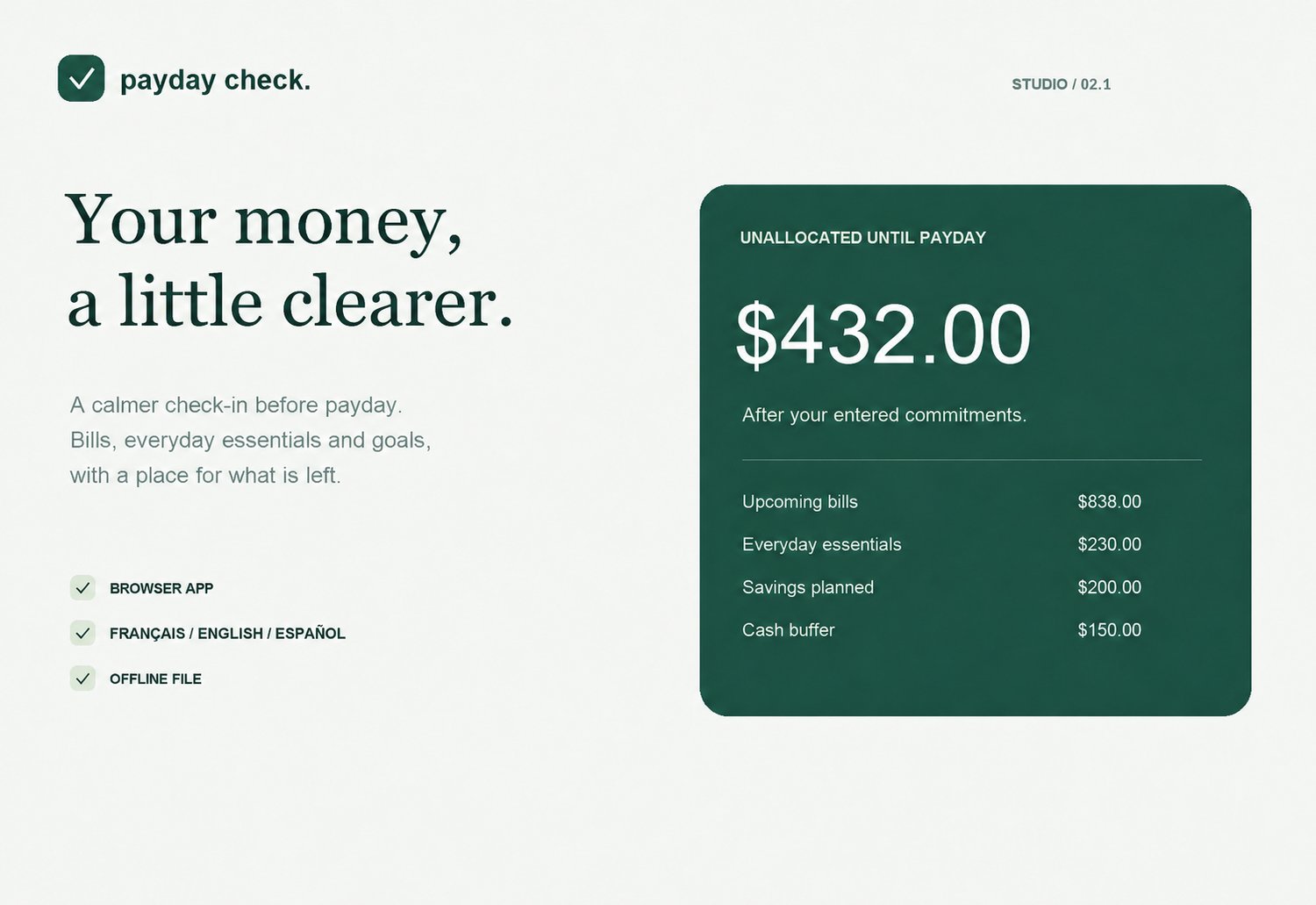
4. Calculate what the plan leaves. In Payday’s demo, the entered amounts are $1,850 cash, $838 bills, $230 essentials, $200 planned savings and a $150 buffer:
$1,850 − $838 − $230 − $200 − $150 = $432.
5. Try the purchase separately. A $100 purchase would change the amount left in that plan from $432 to $332. This simulation does not change the starting cash or record an actual purchase.
Treat the result as an estimate based on your entries. Recheck missing expenses and update your snapshot when money moves.
Try our interactive fixed-plan demo to explore a purchase amount. Payday Check Studio is a $20 USD one-time HTML download for a computer browser, with manual entries, no bank connection and no subscription.
Further reading: The CFPB’s Creating a cash flow budget explains why the timing of income and expenses matters.