

Some days you can take a difficult email, a delayed train and a hard conversation without much trouble. Other days a single unexpected question makes your chest go tight and your words come out wrong. Same person, same skills, different state. The idea that explains the difference is called the window of tolerance, and once you can see yours, a lot of confusing behaviour — yours and other people's — stops being confusing.
What the window actually is
The window of tolerance is a term introduced by psychiatrist Dan Siegel, and it describes something simple: there's a band of nervous-system activation inside which you function well. Inside the window you can think and feel at the same time. You can be annoyed and still be reasonable. You can hear criticism without either fighting it or going blank. Your attention works, your memory works, your sense of humour is available.
Below that band, and above it, those things quietly stop being available — not because you've decided to be difficult, but because the parts of your brain that handle nuance take a back seat when your body has decided something urgent is happening.
That's the whole model. It isn't a personality type or a score. It's a range, and it moves.
There are two ways out, not one
Most people only recognise one edge. Going above the window is the loud one — hyperarousal. Racing heart, tight chest, restlessness, irritability, a short fuse, a mind that won't stop generating threats. This is the fight-or-flight end, and it's easy to notice because it's uncomfortable and visible.
Going below the window is the quiet one — hypoarousal. Numbness, fog, heaviness, a flat voice, feeling far away from the conversation you're in, an odd absence of feeling about something that should matter. This is the shutdown end. People routinely mistake it for laziness, apathy, or "just being tired," including about themselves.
Both are protective. Up is your body preparing to deal with something. Down is your body conserving when dealing with it doesn't seem possible. Neither is a failure of character, and both make you worse at the thing in front of you.
Why your window might be narrower than it used to be
A window narrows when the system running it has been under sustained load. The usual contributors are unglamorous: not enough sleep, months of low-grade stress with no recovery in between, illness, grief, a job with no predictability, caring for someone, or a period of your life where being on alert was genuinely the right call.
It narrows most when there's no downtime between activations. A system that goes up and comes back down is doing exactly what it's designed to do; one that goes up on Monday and hasn't come down by Thursday meets the next stressor already near the edge. So a small thing produces a big response, and then you feel unreasonable on top of everything else. The useful reframe: an outsized reaction usually isn't about the trigger. It's about where you were standing when the trigger arrived.
How to recognise you've left it — before it's obvious
By the time you're shouting or staring at a wall, you already know. The skill worth building is catching the first 20%, because that's where you still have options. Everyone's early signals are specific, and they're usually physical before they're mental. Common ones:
• Going up: shallower breathing high in the chest, jaw or shoulders tightening, talking faster, interrupting, re-reading the same line, a sudden urge to fix everything right now, temperature rising.
• Going down: heaviness behind the eyes, a delay before you answer, words feeling far away, scrolling without taking anything in, the room seeming slightly unreal, a flat "I don't care" about something you do care about.
Spend a week noting what shows up first for you and you'll have something more useful than any general list: your own early-warning signature. Most people find two or three reliable tells, and are surprised how early they appear.
The mistake almost everyone makes
Using the wrong tool for the direction you've gone.
Slow breathing, stillness, dim light and a soft voice are calming tools, and they work when you're above the window. Applied when you're below it — already flat, foggy and slowed down — they often make things worse, because you're adding more slowing to a system that's already shut down. That's why "just sit quietly and breathe" sometimes leaves people heavier and more stuck, and then feeling like they failed at breathing, of all things.
Shutdown needs the opposite: gentle activation. Get up. Walk, ideally outside. Push your palms hard against a wall for ten seconds. Cold water on the wrists or face. Sound — music with a beat, or your own voice reading something out loud. Something with a bit of a jolt in it, to nudge the system up towards the window rather than deeper away from it.
Above the window, the calming tools are right: lengthen the exhale so it's longer than the inhale, let your feet feel the floor, name five things you can see to remind your brain where it actually is, weight and pressure, and a reduction in input — fewer screens, fewer voices, less light.
How the window actually widens
Not by forcing yourself through more stress. Exposure without recovery is just how it got narrow in the first place.
What widens it is repetition of a specific sequence: go a little towards the edge, then come back, deliberately. Somatic approaches call versions of this titration and pendulation — small doses, with a return. The return is the part that teaches the system something. Every time you go slightly activated and then genuinely settle, you're providing evidence that activation is survivable and temporary, which is precisely the belief a narrow window lacks.
Practically, that looks like:
• Practise when you're calm, not only in a crisis. A regulation skill you've only ever tried during a bad moment isn't available during a bad moment. Run it on an ordinary Tuesday until it's boring.
• Protect sleep first. Nothing on this page competes with sleep debt. A short-slept nervous system has a narrow window by default, and no breathing exercise will out-argue that.
• Build in recovery after hard things, on purpose. Ten minutes of nothing after a difficult call is not indulgence; it's the part that closes the loop.
• Stay at the edge, not past it. If a practice leaves you shaky, flooded or blank, it was too much. Smaller dose, more often, is better than one heroic attempt.
• Add predictability where you can. Regular meals, a fixed wind-down, a known start to the day. A body that can predict the next few hours spends less energy bracing for them.
Your window is not a fixed measurement
It's wider when you're rested, fed, and around people you feel safe with. It's narrower when you're ill, hungry, sleep-deprived, or three weeks into something hard. The same event can sit comfortably inside it on Saturday and knock you out of it on Wednesday — and that isn't inconsistency, it's just the state you were in.
Knowing that changes how you plan. The hard conversation goes better at 10am than at 9pm. The decision made while you're above the window is worth re-reading in the morning. And the day you notice you're already close to an edge is the day to lower the bar on purpose, rather than discover the limit the hard way.
If it's bigger than this
Understanding your window is a self-help skill, not treatment. If you're spending most of your days outside it, if shutdown or panic is a regular feature of your week, or if this connects to trauma you haven't had support with, that's worth taking to a licensed therapist — trauma-informed and somatic approaches exist precisely for this. If you're in crisis, in the US and Canada you can call or text 988; in the UK and Ireland, Samaritans is free on 116 123, any time.
Where the workbook fits
Everything above works on a blank page and a bit of attention. What the printable version adds is structure you don't have to remember when you're already outside the window: a window map you fill in with your own early signals, a body signal chart, a repeatable six-step sequence for coming back, and trackers that turn "I think afternoons are worse" into eight weeks of evidence you can actually read.
Get the workbook
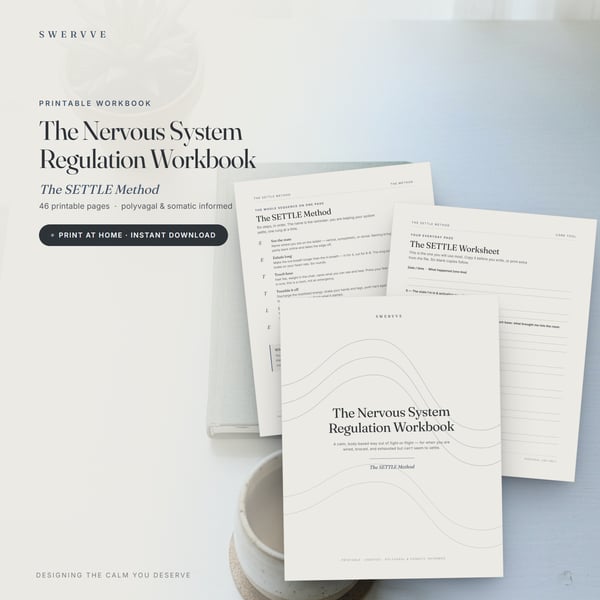
Nervous System Regulation Workbook →
The SETTLE Method — a body-based way out of fight-or-flight. Printable PDF, instant download.