
What would you do if a student suddenly collapsed in front of you? You might know that help is needed, but knowing the right steps is very different from being ready to take them. In a school, those first few minutes can feel confusing. Students may be watching, staff may be rushing in, and emergency responders may still be on the way.
This is why practical CPR training matters for teachers. CPR classes Plano can give educators a chance to practice chest compressions, AED use, and emergency response steps before they ever need to use them in a real classroom.
A Teacher May Be the First Person to Respond
Think about a typical school day in Plano. A teacher may be supervising students in a classroom, walking across a hallway, watching recess, or helping with an after-school activity. If a student suddenly becomes unresponsive, there may not be a nurse or emergency responder standing nearby.
The teacher may be the first adult at the scene.
That first response can include recognizing that an emergency is happening, calling 911, starting CPR when appropriate, and using an AED if one is available and the situation calls for it.
The American Heart Association recommends hands-on practice for CPR skills because physical practice helps learners become familiar with the actions they may need to perform during an emergency. This is where practical training becomes important.
Reading About CPR Is Not the Same as Performing It
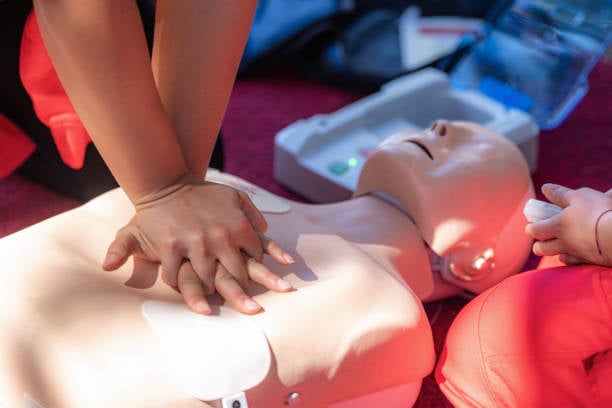
You can read instructions about CPR and understand every step. But try placing your hands on a CPR manikin and performing compressions. It feels different.
You have to find the correct hand position. You need to maintain an appropriate compression rate and depth. You also have to coordinate your actions while thinking about what needs to happen next.
That is difficult to fully understand from written instructions alone.
Hands-on training allows teachers to practice these actions in a controlled setting. An instructor can watch the technique, correct mistakes, and help participants become more comfortable with the process.
The American Heart Association uses practice-based learning in several CPR programs, including training where participants practice skills on a manikin while watching a demonstration.
Teachers Need More Than Memorized Steps
An emergency rarely feels neat and organized. Practical CPR training gives teachers an opportunity to rehearse this type of response. Instead of simply remembering a list of instructions, they can practice moving through the response step by step.
Training can cover important actions such as checking responsiveness, activating emergency help, performing CPR, and using an AED when appropriate. That repeated practice can make the response feel more familiar.
Child CPR Is Especially Relevant in Schools
Teachers work with children and teenagers every day. Their training needs may therefore differ from those of someone learning CPR only for an adult workplace. CPR education can include child CPR and AED use, depending on the course. The American Heart Association lists child CPR and AED skills among its CPR training content.
The goal is not for teachers to diagnose a medical condition. The goal is to recognize an emergency and respond appropriately within the limits of their training. Teachers should follow their school's emergency procedures and contact 911 during serious emergencies. CPR is an immediate response while professional medical help is on the way.
Plano Schools Have a Practical Reason to Train Staff
Texas has specific CPR and AED instruction requirements within its education system. State rules require CPR instruction for students entering Grade 7 and also apply an AED instruction requirement to students entering Grade 7 beginning with the 2024–2025 school year.
That creates a broader need for CPR awareness in schools.
Teachers and staff are part of the environment where students learn these skills. Practical training can also support a school's overall emergency preparedness.
For educators seeking CPR classes Plano, the important question should not only be, "Do I receive a certificate?" It should also be, "Will I actually practice the skills?"
What Good Hands-On Training Looks Like
A useful training session should give participants time to practice.
Teachers should have an opportunity to work with CPR manikins rather than simply watch an instructor demonstrate the technique. They should receive guidance as they practice and have the chance to correct problems.
Training may also include AED practice and other emergency response skills, depending on the course. This approach makes the class more interactive. It also gives teachers a chance to ask questions that may come up in a real school setting.
For example, what should happen when several students are present? How should staff coordinate with one another? Where is the AED kept? Who calls 911? These questions connect CPR training to the real environment where the skills may be needed.
Certification Is Useful, But Skill Retention Matters More
A CPR card can show that a person completed a required course. It can be important for employment, school policies, or other requirements. But a card alone does not perform CPR. The physical skill matters.
Teachers should also review their school's training requirements and renewal schedule. Skills can become less familiar when they are not practiced regularly. Even a few minutes spent reviewing procedures can help keep the response fresh.
Building Confidence Before an Emergency Happens
No teacher wants to face a medical emergency involving a student. But preparation is easier before the emergency occurs.
A teacher who has practiced CPR on a manikin has already experienced the basic physical actions. They have handled the equipment. They have worked through the sequence. They have received feedback. That experience can help reduce hesitation.
For teachers considering CPR certification Plano, hands-on instruction offers more than a credential. It provides an opportunity to build practical readiness for an emergency that may occur in a classroom, gym, playground, cafeteria, or school event.