
Hello everyone!
Today I was teaching my AI for Beginners class, and I had a moment that stopped me in my tracks — in the best way possible.
I was mid-presentation when I looked out at the class and saw it: blank faces. Not bored faces, not distracted faces — blank faces. So I paused and asked if anyone had questions. That's when someone raised their hand and asked me what the word prompt meant.
And just like that, it hit me. I had started my entire presentation without considering that my students wouldn't know the language. I explained what a prompt was, and I literally watched the light come on for everyone in the room. That instant connection — that "ohhhh" moment — it was everything.
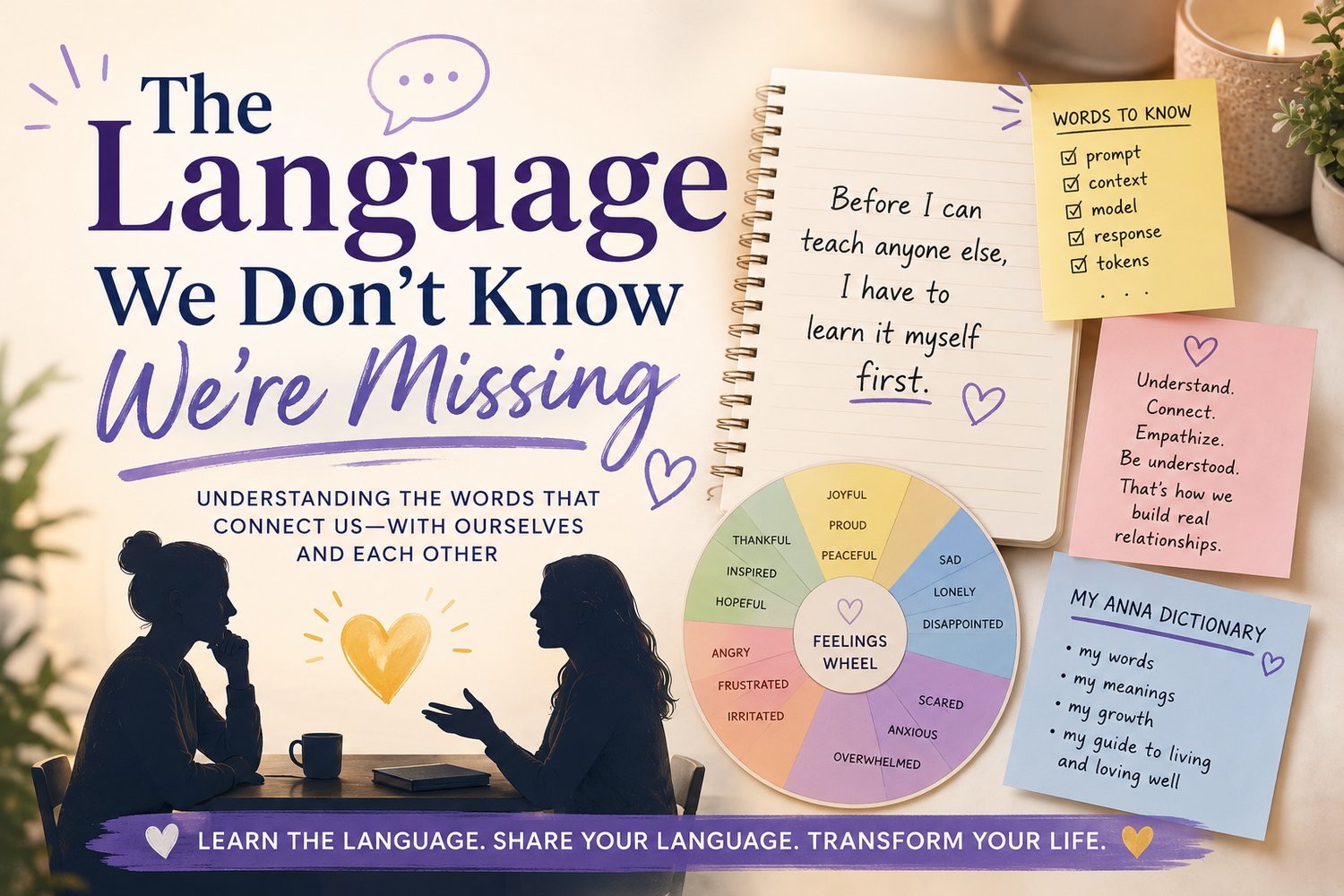
So I restructured on the spot. I went back to the beginning and added a "Words to Know" section, walking through the 10 most commonly used terms in AI. After that? Everyone was engaged, curious, and eager to learn more.
On the drive home, that moment stayed with me. And it got me thinking — how often does this happen in our everyday lives?
That disconnect we feel with the people around us — our friends, our partners, our coworkers — could it simply be because we don't know the language being used? Or worse, that they don't know ours?
Because here's the thing: if you don't know the language, how can you truly understand someone? How can you relate to them? How can you even begin to empathize?
And let me take it a step further. How can we expect others to understand, relate to, or empathize with us if we're not speaking in a language they can receive?
Take me for example. If I don't have the words to name what I'm feeling, how can I expect my husband, my kids, or my friends to understand me? They're not mind readers — they need my language just as much as I need theirs.
And just like my students in that classroom, something connected for me in that moment.
Understanding the language of the people I love is the key to understanding them — their choices, their reactions, their needs. And in return, teaching the people I love my language is how they get to understand me.
But here's the catch — before I can teach anyone else, I have to learn it myself first.
So how do I do that? I started by paying attention. To the words I use. To how I use them. I began building what I'm calling my own personal glossary — an Anna Dictionary, if you will.
And let me tell you, naming my emotions was not as easy as I thought it would be.
So I looked up a feelings wheel. Have you ever seen one? It's a simple tool that helps you identify and name what you're actually experiencing beyond just "fine," "mad," or "sad." It helped me more than I expected — and it also made me wonder: what other basic life skills are we missing the language for? And why aren't we taught this in school?
Emotional literacy should be a requirement to graduate. I truly believe that.
In fact, I've been thinking about creating a class called The Language of Life — one that covers emotions, values, and personality, because even though every single one of us is one of a kind, we're all made from the same ingredients. Our recipes are just a little different.
If you're ready to start learning your own language, I'm here to help. I've shared the link to my store below where you can find worksheets designed to help you help yourself.
Let's start the conversation. 💛
https://payhip.com/HelpYourselfHub
Comments ()