

Many people do not hate money management.
They hate the feeling that comes with it.
Budgeting often feels like punishment. You open a spreadsheet or notebook, look at what you spent, and suddenly it feels like the numbers are judging you.
Too much dining out.
Too many small purchases.
Not enough savings.
Unexpected costs again.
Another month where the money disappeared too quickly.
That feeling can make people avoid their numbers completely.
But avoiding the numbers does not create peace. It only creates fog.
The problem is not always that you are careless with money. Sometimes the real problem is that your spending has no clear system. Money goes out in many small directions, and by the end of the month, it becomes difficult to understand what actually happened.
That is why I prefer the idea of intentional spending instead of strict budgeting.
A strict budget often asks:
“Did you spend too much?”
Intentional spending asks better questions:
Was this necessary?
Was this planned?
Did this support my life, work, or future?
Was this a need, a want, or something that builds the future?
Do I still feel clear about this decision after seeing the numbers?
This changes the emotional tone.
The goal is not to shame yourself. The goal is to see your spending clearly enough to make better decisions next month.
A useful spending system should help you separate your money into simple areas.
For example:
Needs are the things you must pay for basic life: rent, utilities, food, transport, insurance, and required payments.
Wants are lifestyle and optional spending: dining out, hobbies, entertainment, gifts, subscriptions, and comfort purchases.
Future is money that protects or builds your future: savings, investments, emergency funds, or extra debt payments.
When spending is separated like this, your money becomes easier to understand.
You can see whether your income is mostly going to survival, lifestyle, or future-building. You can also see whether your spending was planned or impulsive.
This is where a simple spreadsheet can help.
Not because spreadsheets are magical. They are not.
But a spreadsheet gives your spending one clear place to live. Instead of trying to remember everything in your head, you can record each transaction, choose a category, and let the system summarize the month.
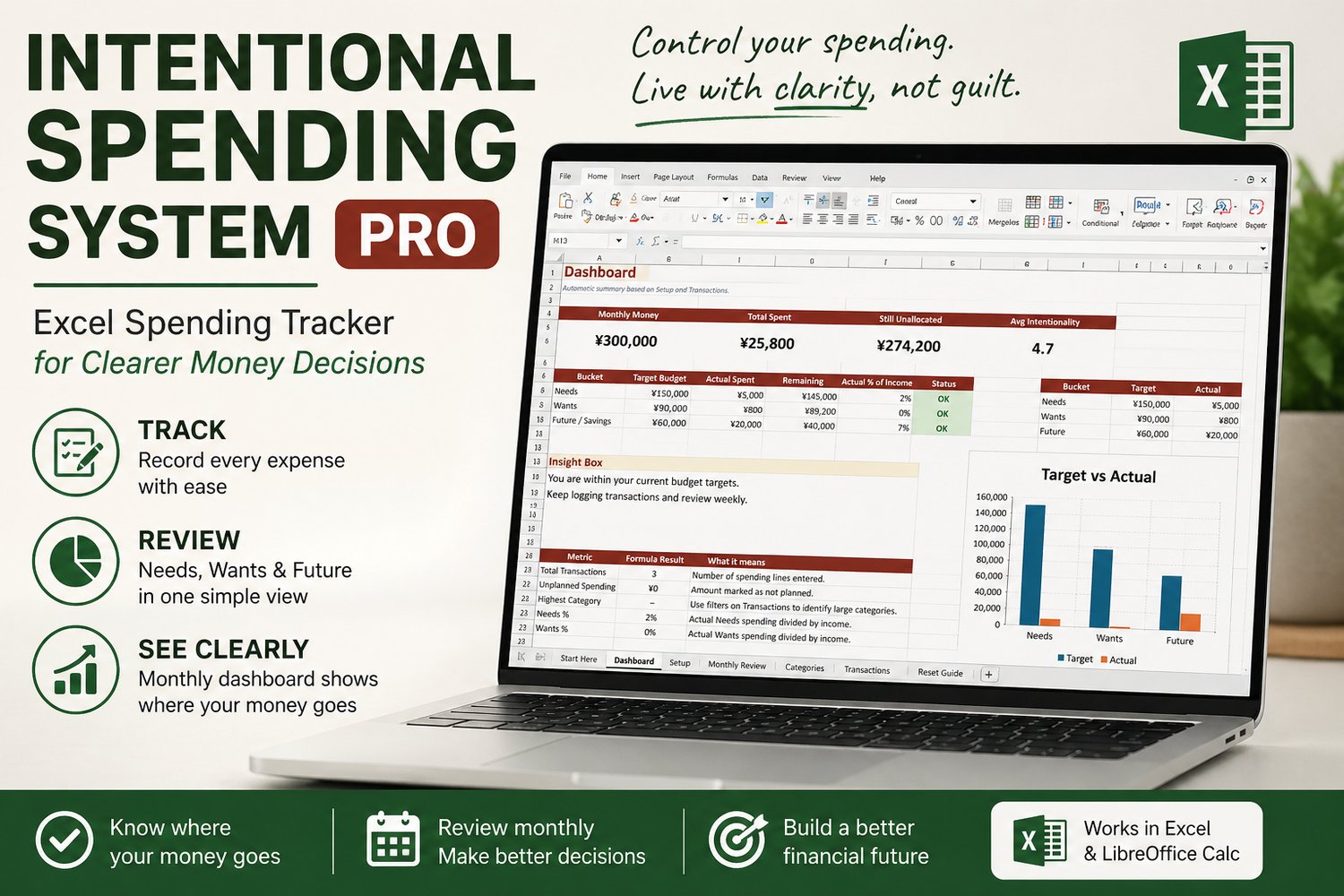
A simple monthly dashboard can show:
- how much money came in
- how much was spent
- how much is still unallocated
- how much went to needs, wants, and future
- whether each area is still okay or over the target
- how intentional your spending felt overall
That last part matters.
Money is not only mathematics. It is also behavior.
Two people can spend the same amount of money and feel completely different about it. One person may feel guilty because the purchase was impulsive. Another may feel peaceful because the purchase was planned, useful, and aligned with their priorities.
That is why spending should not only be tracked by amount. It should also be reviewed by intention.
You do not need to become perfect with money.
You do not need to stop all enjoyable spending.
You do not need to punish yourself every time you buy something optional.
But you do need visibility.
Because when spending is invisible, it controls you quietly.
When spending becomes visible, you can start making calmer decisions.
That is why I built the Intentional Spending System Pro.
It is a simple Excel workbook designed for people who want control, clarity, and better money decisions — not guilt.
It helps you set your monthly income, organize spending into Needs, Wants, and Future, record transactions, review planned and unplanned spending, and see a simple dashboard summary of your month.
The goal is not to make money management feel heavy.
The goal is to make it clear enough that you can breathe, review, and improve.
Because better money decisions do not start with shame.
They start with visibility.
If you want a simple way to review your spending without building a spreadsheet from zero, the Intentional Spending System Pro is available in my store.